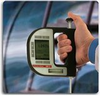
Micromeritics GeoPyc 1360 Envelope Density Analyzer

Description
The GeoPyc 1360 Envelope Density Analyzer is a revolutionary instrument for rapidly measuring the envelope density of porous objects of irregular size and shape. Particle Size should exceed 2 mm for best results. Envelope density, or bulk density as it is sometimes called, is the mass of an object divided by its volume where the volume includes that of its pore and small cavities. Envelope density information is useful in characterizing catalysts, structural foams, insulators, ceramics, powder metallurgy objects, and other manufactured goods. The GeoPyc follows a unique displacement measurement technique that uses a quasi-fluid composed of small, rigid spheres having a high degree of flow-ability; we call this medium DryFlo . The sample is placed in a bed of Dry Flo , and the Dry Flo is agitated and gently consolidated about the sample. The GeoPyc collects the displacement data, performs the calculations, and displays or prints the results. The unit also reports percentage porosity and specific pore volume when absolute density information (density excluding pore and small cavity volume obtained from a Micromeritics Accu-Pyc helium pycnometer) is entered. The analyzer is operated from a full character-set keypad. Data acquisition and reporting are fully automated for convenient incorporation in LIMS or other data concentrating systems. A variety of sample chambers is available to accommodate a wide range of sample sizes. After the analysis, a light shaking or dusting completely removes the Dry Flo so the samples can be reused or retested. The GeoPyc has multiple operating modes including full blank, computed blank, and reference solid calibration with variance, which allows you to optimize speed and accuracy for your individual needs. During analysis, indications of progress and preliminary results make it possible to track what is occurring. Sample-specific information can be entered and the report generated in English, German, Italian, or Spanish. T.A.P. Density Option When equipped with the T.A.P. Density option, the GeoPyc measures the packing volume and calculates the bulk density of granular and powdered samples under a wide range of compaction conditions. To determine T.A.P. density, the sample chamber is rotated and agitated while a precise specified force is applied to the sample. A force transducer measures the consolidation force in Newtons and the distance over which the consolidation piston and plunger travel is measured in steps. The user specifies the force applied and the number of consolidations per analysis. The GeoPyc averages the measurements from each consolidation and automatically calculates volume and density, and reports the results in cm3 and g/cm3. The GeoPyc T.A.P. density option obtains precise results comparable to conventional tap density analyzers, only it does it faster, quieter, and with greater reproducibility. Features Highly accurate and reproducible results Fast operation Small table-top unit Fully automated data acquisition and reporting Uses non-hazardous micro-spheres Non-destructive to samples Multiple operation modes Multiple sample chambers available multiple language capability
Datasheet
Description
The GeoPyc 1360 Envelope Density Analyzer is a revolutionary instrument for rapidly measuring the envelope density of porous objects of irregular size and shape. Particle Size should exceed 2 mm for best results. Envelope density, or bulk density as it is sometimes called, is the mass of an object divided by its volume where the volume includes that of its pore and small cavities. Envelope density information is useful in characterizing catalysts, structural foams, insulators, ceramics, powder metallurgy objects, and other manufactured goods. The GeoPyc follows a unique displacement measurement technique that uses a quasi-fluid composed of small, rigid spheres having a high degree of flow-ability; we call this medium DryFlo . The sample is placed in a bed of Dry Flo , and the Dry Flo is agitated and gently consolidated about the sample. The GeoPyc collects the displacement data, performs the calculations, and displays or prints the results. The unit also reports percentage porosity and specific pore volume when absolute density information (density excluding pore and small cavity volume obtained from a Micromeritics Accu-Pyc helium pycnometer) is entered. The analyzer is operated from a full character-set keypad. Data acquisition and reporting are fully automated for convenient incorporation in LIMS or other data concentrating systems. A variety of sample chambers is available to accommodate a wide range of sample sizes. After the analysis, a light shaking or dusting completely removes the Dry Flo so the samples can be reused or retested. The GeoPyc has multiple operating modes including full blank, computed blank, and reference solid calibration with variance, which allows you to optimize speed and accuracy for your individual needs. During analysis, indications of progress and preliminary results make it possible to track what is occurring. Sample-specific information can be entered and the report generated in English, German, Italian, or Spanish. T.A.P. Density Option When equipped with the T.A.P. Density option, the GeoPyc measures the packing volume and calculates the bulk density of granular and powdered samples under a wide range of compaction conditions. To determine T.A.P. density, the sample chamber is rotated and agitated while a precise specified force is applied to the sample. A force transducer measures the consolidation force in Newtons and the distance over which the consolidation piston and plunger travel is measured in steps. The user specifies the force applied and the number of consolidations per analysis. The GeoPyc averages the measurements from each consolidation and automatically calculates volume and density, and reports the results in cm3 and g/cm3. The GeoPyc T.A.P. density option obtains precise results comparable to conventional tap density analyzers, only it does it faster, quieter, and with greater reproducibility. Features Highly accurate and reproducible results Fast operation Small table-top unit Fully automated data acquisition and reporting Uses non-hazardous micro-spheres Non-destructive to samples Multiple operation modes Multiple sample chambers available multiple language capability
Datasheet

Suppliers

Company
Product
Description
Supplier Links
GeoPyc 1360 Envelope Density Analyzer -  - Micromeritics
Norcross, GA, USA
GeoPyc 1360 Envelope Density Analyzer
The GeoPyc 1360 Envelope Density Analyzer is a revolutionary instrument for rapidly measuring the envelope density of porous objects of irregular size and shape. Particle Size should exceed 2 mm for best results. Envelope density, or bulk density as it is sometimes called, is the mass of an object divided by its volume where the volume includes that of its pore and small cavities. Envelope density information is useful in characterizing catalysts, structural foams, insulators, ceramics, powder metallurgy objects, and other manufactured goods. The GeoPyc follows a unique displacement measurement technique that uses a quasi-fluid composed of small, rigid spheres having a high degree of flow-ability; we call this medium DryFlo . The sample is placed in a bed of Dry Flo , and the Dry Flo is agitated and gently consolidated about the sample. The GeoPyc collects the displacement data, performs the calculations, and displays or prints the results. The unit also reports percentage porosity and specific pore volume when absolute density information (density excluding pore and small cavity volume obtained from a Micromeritics Accu-Pyc helium pycnometer) is entered. The analyzer is operated from a full character-set keypad. Data acquisition and reporting are fully automated for convenient incorporation in LIMS or other data concentrating systems. A variety of sample chambers is available to accommodate a wide range of sample sizes. After the analysis, a light shaking or dusting completely removes the Dry Flo so the samples can be reused or retested. The GeoPyc has multiple operating modes including full blank, computed blank, and reference solid calibration with variance, which allows you to optimize speed and accuracy for your individual needs. During analysis, indications of progress and preliminary results make it possible to track what is occurring. Sample-specific information can be entered and the report generated in English, German, Italian, or Spanish. T.A.P. Density Option When equipped with the T.A.P. Density option, the GeoPyc measures the packing volume and calculates the bulk density of granular and powdered samples under a wide range of compaction conditions. To determine T.A.P. density, the sample chamber is rotated and agitated while a precise specified force is applied to the sample. A force transducer measures the consolidation force in Newtons and the distance over which the consolidation piston and plunger travel is measured in steps. The user specifies the force applied and the number of consolidations per analysis. The GeoPyc averages the measurements from each consolidation and automatically calculates volume and density, and reports the results in cm3 and g/cm3. The GeoPyc T.A.P. density option obtains precise results comparable to conventional tap density analyzers, only it does it faster, quieter, and with greater reproducibility. Features Highly accurate and reproducible results Fast operation Small table-top unit Fully automated data acquisition and reporting Uses non-hazardous micro-spheres Non-destructive to samples Multiple operation modes Multiple sample chambers available multiple language capability

The GeoPyc 1360 Envelope Density Analyzer is a revolutionary instrument for rapidly measuring the envelope density of porous objects of irregular size and shape. Particle Size should exceed 2 mm for best results. Envelope density, or bulk density as it is sometimes called, is the mass of an object divided by its volume where the volume includes that of its pore and small cavities. Envelope density information is useful in characterizing catalysts, structural foams, insulators, ceramics, powder metallurgy objects, and other manufactured goods.

The GeoPyc follows a unique displacement measurement technique that uses a quasi-fluid composed of small, rigid spheres having a high degree of flow-ability; we call this medium DryFlo . The sample is placed in a bed of Dry Flo , and the Dry Flo is agitated and gently consolidated about the sample. The GeoPyc collects the displacement data, performs the calculations, and displays or prints the results. The unit also reports percentage porosity and specific pore volume when absolute density information (density excluding pore and small cavity volume obtained from a Micromeritics Accu-Pyc helium pycnometer) is entered.

The analyzer is operated from a full character-set keypad. Data acquisition and reporting are fully automated for convenient incorporation in LIMS or other data concentrating systems.

A variety of sample chambers is available to accommodate a wide range of sample sizes. After the analysis, a light shaking or dusting completely removes the Dry Flo so the samples can be reused or retested. The GeoPyc has multiple operating modes including full blank, computed blank, and reference solid calibration with variance, which allows you to optimize speed and accuracy for your individual needs. During analysis, indications of progress and preliminary results make it possible to track what is occurring. Sample-specific information can be entered and the report generated in English, German, Italian, or Spanish.

T.A.P. Density Option

When equipped with the T.A.P. Density option, the GeoPyc measures the packing volume and calculates the bulk density of granular and powdered samples under a wide range of compaction conditions.

To determine T.A.P. density, the sample chamber is rotated and agitated while a precise specified force is applied to the sample. A force transducer measures the consolidation force in Newtons and the distance over which the consolidation piston and plunger travel is measured in steps. The user specifies the force applied and the number of consolidations per analysis. The GeoPyc averages the measurements from each consolidation and automatically calculates volume and density, and reports the results in cm3 and g/cm3. The GeoPyc T.A.P. density option obtains precise results comparable to conventional tap density analyzers, only it does it faster, quieter, and with greater reproducibility.

Features

  • Highly accurate and reproducible results
  • Fast operation
  • Small table-top unit
  • Fully automated data acquisition and reporting
  • Uses non-hazardous micro-spheres
  • Non-destructive to samples
  • Multiple operation modes
  • Multiple sample chambers available
  • multiple language capability
Supplier's Site Datasheet

Technical Specifications

  Micromeritics
Product Category Density and Specific Gravity Instruments
Product Name GeoPyc 1360 Envelope Density Analyzer
Instrument Type Density Instruments
Unlock Full Specs
to access all available technical data

Similar Products

Hydrometers - 3805072 - RS Components, Ltd.
RS Components, Ltd.
Specs
Instrument Type Density Instruments; Hydrometer
Temperature Range 68 F (20 C)
Density Range 1 to 1.1 g/cm³ (62.43 to 68.67 lbs/ft³)
View Details
Integrated Sensing Systems, Inc.
Specs
Instrument Type Density Instruments
Media Type Liquid
Technology Type Digital Pycnometer Instrument; Oscillating Tube
View Details
Specific Gravity Analyzer - Single Tube CPVC Model SGA-CPVC-FS - JOGLER, Inc.
Specs
Instrument Type Density Instruments; Hydrometer
Media Type Liquid
Technology Type Simple Glass Assembly
View Details
Density Sensor - L-Dens 2300 - Anton Paar
Specs
Instrument Type Density Instruments
Media Type Liquid
Technology Type Oscillating Tube
View Details