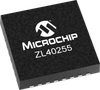
The ZL40255 SmartBuffer™ is a flexible, programmable fanout buffer IC. The ZL40255 can select from 1 of 4 input clocks and provide as many as 3 differential or 6 CMOS outputs. Each output can provide format conversion, integer frequency division, and skew adjustment. Flexible any-format outputs simplify design. Automatic self-configuration after power-up or reset.
Additional Features
Four Input Clocks: one crystal/CMOS input, two differential/CMOS inputs, one single-ended/CMOS input
Any input frequency up to 1035MHz (up to 300MHz for CMOS)
Clock selection by pin or register control
Up to 3 Differential Outputs (Up to 6 CMOS)
Output frequencies are any integer divisor up to 232 of the input frequency (CMOS 250MHz max)
Each output has independent dividers
Low additive jitter <200fs RMS (12kHz-20MHz, for input frequencies above 100MHz)
Outputs are CML or 2xCMOS, can interface to LVDS, LVPECL, HSTL, SSTL and HCSL
In 2xCMOS mode, the P and N pins can be different frequencies (e.g. 125MHz and 25MHz)
Per-output supply pin with CMOS output voltages from 1.5V to 3.3V
Precise output alignment circuitry and per-output phase adjustment
Per-output enable/disable and glitch-less start/stop (stop high or low)
Automatic self-configuration at power-up from internal EEPROM; up to four configurations, pin-selectable
Crystal interface for frequency synthesis up to 60MHz
Four general-purpose I/O pins, each with many status and control options
SPI or I2C processor Interface
Tiny 5x5mm QFN package
The ZL40255 SmartBuffer™ is a flexible, programmable fanout buffer IC. The ZL40255 can select from 1 of 4 input clocks and provide as many as 3 differential or 6 CMOS outputs. Each output can provide format conversion, integer frequency division, and skew adjustment. Flexible any-format outputs simplify design. Automatic self-configuration after power-up or reset.
Additional Features
- Four Input Clocks: one crystal/CMOS input, two differential/CMOS inputs, one single-ended/CMOS input
- Any input frequency up to 1035MHz (up to 300MHz for CMOS)
- Clock selection by pin or register control
- Up to 3 Differential Outputs (Up to 6 CMOS)
- Output frequencies are any integer divisor up to 232 of the input frequency (CMOS 250MHz max)
- Each output has independent dividers
- Low additive jitter <200fs RMS (12kHz-20MHz, for input frequencies above 100MHz)
- Outputs are CML or 2xCMOS, can interface to LVDS, LVPECL, HSTL, SSTL and HCSL
- In 2xCMOS mode, the P and N pins can be different frequencies (e.g. 125MHz and 25MHz)
- Per-output supply pin with CMOS output voltages from 1.5V to 3.3V
- Precise output alignment circuitry and per-output phase adjustment
- Per-output enable/disable and glitch-less start/stop (stop high or low)
- Automatic self-configuration at power-up from internal EEPROM; up to four configurations, pin-selectable
- Crystal interface for frequency synthesis up to 60MHz
- Four general-purpose I/O pins, each with many status and control options
- SPI or I2C processor Interface
- Tiny 5x5mm QFN package