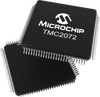
The TMC2072 network controller is CircLink technology's flagship product. The TMC2072's flexibility and rich feature set enable a high-reliability and high-performance, real-time and control-oriented network without the cumbersome middle layer protocol stacks and complex packet prioritization schemes typically required.
TMC2072 operates at network data transfer rates up to 5 Mbps. Its embedded 1 kByte RAM can be configured into a maximum of 32 pages to implement a 31-node network where each node in the network has the same local memory.
TMC2072 supports "Peripheral Mode" operation, which includes two selectable communication modes:"Free Format Mode" and "Remote Buffer Mode". Free Format mode, retained from ARCNET, is "packet oriented" communication. Remote Buffer mode communication is a CircLink-specific feature, and is a token oriented communication, which includes automatic data transmission when the token arrives.
The TMC2072 has a flexible 8-bit or 16-bit databus to interface various CPU types including X86, 68XX, and SHx with multiplexed or non-multiplexed address/data. When operating in Peripheral mode, the TMC2072 has 8-bit programmable I/O available. When operating in Standalone mode, the TMC2072's I/O configuration is16-bit. The TMC2072 also integrates a 3-port hub (two ports for external connection) to accommodate various network topologies (Bus, Star, etc.) and combinations.
Additional Features Features
Low Power CMOS, 3.3 Volt Power Supply with 5 Volt Tolerant I/O
Supports 8/16-Bit Data Bus
Both 86xx and 68hxx Platforms
1K On-chip Dual Port Buffer Memory
Sequential I/O Mapped Access
Enhanced Token Passing Protocol from ARCNET
Maximum 31 Nodes per Network
Token Retry Mechanism
Maximum 256 Bytes per Packet
Consecutive Node ID Assignment
Memory Mirror
Shared Memory within Network
Network Standard Time
Network Time Synchronization
Automatic Time Stamping
Coded Mark Inversion
Intelligent 1-Bit Error Correction
Magnetic Saturation Prevention
Single Operation Mode
Supports Only Peripheral (Host) Mode Operates with MCU
Supports 8 Bit Programmable General Purpose I/O
Dual Communication Modes (with Peripheral Mode)
Free Format Mode
Remote Buffer Mode
3 Port Hub Integrated
1 Internal and 2 External
Flexible Topologies
Bus, Star, and Tree
Low-Cost Media can be Used
RS485 Differential Driver
Fiber Optics and Twisted Pair Cable Supported
100-Pin, TQFP RoHS Compliant Package
Temperature Range from 0 to 70 Degrees C
The TMC2072 network controller is CircLink technology's flagship product. The TMC2072's flexibility and rich feature set enable a high-reliability and high-performance, real-time and control-oriented network without the cumbersome middle layer protocol stacks and complex packet prioritization schemes typically required.
TMC2072 operates at network data transfer rates up to 5 Mbps. Its embedded 1 kByte RAM can be configured into a maximum of 32 pages to implement a 31-node network where each node in the network has the same local memory.
TMC2072 supports "Peripheral Mode" operation, which includes two selectable communication modes:"Free Format Mode" and "Remote Buffer Mode". Free Format mode, retained from ARCNET, is "packet oriented" communication. Remote Buffer mode communication is a CircLink-specific feature, and is a token oriented communication, which includes automatic data transmission when the token arrives.
The TMC2072 has a flexible 8-bit or 16-bit databus to interface various CPU types including X86, 68XX, and SHx with multiplexed or non-multiplexed address/data. When operating in Peripheral mode, the TMC2072 has 8-bit programmable I/O available. When operating in Standalone mode, the TMC2072's I/O configuration is16-bit. The TMC2072 also integrates a 3-port hub (two ports for external connection) to accommodate various network topologies (Bus, Star, etc.) and combinations.
Additional Features
Features
- Low Power CMOS, 3.3 Volt Power Supply with 5 Volt Tolerant I/O
- Supports 8/16-Bit Data Bus
- Both 86xx and 68hxx Platforms
- 1K On-chip Dual Port Buffer Memory
- Sequential I/O Mapped Access
- Enhanced Token Passing Protocol from ARCNET
- Maximum 31 Nodes per Network
- Token Retry Mechanism
- Maximum 256 Bytes per Packet
- Consecutive Node ID Assignment
- Memory Mirror
- Shared Memory within Network
- Network Standard Time
- Network Time Synchronization
- Automatic Time Stamping
- Coded Mark Inversion
- Intelligent 1-Bit Error Correction
- Magnetic Saturation Prevention
- Single Operation Mode
- Supports Only Peripheral (Host) Mode Operates with MCU
- Supports 8 Bit Programmable General Purpose I/O
- Dual Communication Modes (with Peripheral Mode)
- Free Format Mode
- Remote Buffer Mode
- 3 Port Hub Integrated
- 1 Internal and 2 External
- Flexible Topologies
- Low-Cost Media can be Used
- RS485 Differential Driver
- Fiber Optics and Twisted Pair Cable Supported
- 100-Pin, TQFP RoHS Compliant Package
- Temperature Range from 0 to 70 Degrees C