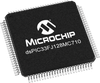
Microchip Technology, Inc. dsPIC33FJ128MC710

Description
dsPIC33F Motor Control Digital Signal Controller with seamless migration options to/from PIC24F, PIC24H MCUs & dsPIC30F DSC Please consider this device dsPIC33FJ128MC710A Additional Features Operating Range: DC – 40 MIPS (40 MIPS @ 3.0-3.6V, -40°C to +85°C) Industrial temperature range (-40°C to +85°C)High-Performan ce DSC CPU: Modified Harvard architecture C compiler optimized instruction set 16-bit wide data path 24-bit wide instructions Linear program memory addressing up to 4M instruction words Linear data memory addressing up to 64 Kbytes 83 base instructions: mostly 1 word/1 cycle Sixteen 16-bit General Purpose Registers Two 40-bit accumulators:- With rounding and saturation options Flexible and powerful addressing modes:- Indirect, Modulo and Bit-Reversed Software stack 16 x 16 fractional/integer multiply operations 32/16 and 16/16 divide operations Single-cycle multiply and accumulate:- Accumulator write back for DSP operations- Dual data fetch Up to ±16-bit shifts for up to 40-bit dataDirect Memory Access (DMA): 8-channel hardware DMA: 2 Kbytes dual ported DMA buffer area (DMA RAM) to store data transferred via DMA:- Allows data transfer between RAM and a peripheral while CPU is executing code (no cycle stealing) Most peripherals support DMAInterrupt Controller: 5-cycle latency 118 interrupt vectors Up to 67 available interrupt sources Up to 5 external interrupts 7 programmable priority levels 5 processor exceptionsDigital I/O: Wake-up/Interrupt-on -Change on up to 24 pins Output pins can drive from 3.0V to 3.6V All digital input pins are 5V tolerant 4 mA sink on all I/O pinsSystem Management: Flexible clock options:- External, crystal, resonator, internal RC- Fully integrated PLL- Extremely low jitter PLL Power-up Timer Oscillator Start-up Timer/Stabilizer Watchdog Timer with its own RC oscillator Fail-Safe Clock Monitor Reset by multiple sourcesPower Management: On-chip 2.5V voltage regulator Switch between clock sources in real time Idle, Sleep and Doze modes with fast wake-upTimers/Captur e/Compare/PWM: Timer/Counters, up to nine 16-bit timers:- Can pair up to make four 32-bit timers- 1 timer runs as Real-Time Clock with external 32.768 kHz oscillator- Programmable prescaler Input Capture (up to 8 channels):- Capture on up, down or both edges- 16-bit capture input functions- 4-deep FIFO on each capture Output Compare (up to 8 channels):- Single or Dual 16-Bit Compare mode- 16-bit Glitchless PWM modeCommunication Modules: 3-wire SPI (up to 2 modules):- Framing supports I/O interface to simple codecs- Supports 8-bit and 16-bit data- Supports all serial clock formats and sampling modes I2C™ (up to 2 modules):- Full Multi-Master Slave mode support- 7-bit and 10-bit addressing- Bus collision detection and arbitration- Integrated signal conditioning- Slave address masking UART (up to 2 modules):- Interrupt on address bit detect- Interrupt on UART error- Wake-up on Start bit from Sleep mode- 4-character TX and RX FIFO buffers- LIN bus support- IrDA® encoding and decoding in hardware- High-Speed Baud mode- Hardware Flow Control with CTS and RTS Enhanced CAN (ECAN™ module) 2.0B active (up to 2 modules):- Up to 8 transmit and up to 32 receive buffers- 16 receive filters and 3 masks- Loopback, Listen Only and Listen All Messages modes for diagnostics and bus monitoring- Wake-up on CAN message- Automatic processing of Remote Transmission Requests- FIFO mode using DMA- DeviceNet™ addressing supportMotor Control Peripherals: Motor Control PWM (up to 8 channels):- 4 duty cycle generators- Independent or Complementary mode- Programmable dead time and output polarity- Edge or center-aligned- Manual output override control- Up to 2 Fault inputs- Trigger for ADC conversions- PWM frequency for 16-bit resolution (@ 40 MIPS) = 1220 Hz for Edge-Aligned mode, 610 Hz for Center-Aligned mode- PWM frequency for 11-bit resolution (@ 40 MIPS) = 39.1 kHz for Edge-Aligned mode, 19.55 kHz for Center-Aligned mode Quadrature Encoder Interface module:- Phase A, Phase B and index pulse input- 16-bit up/down position counter- Count direction status- Position Measurement (x2 and x4) mode- Programmable digital noise filters on inputs- Alternate 16-bit Timer/Counter mode- Interrupt on position counter rollover/underflowAn alog-to-Digital Converters (ADCs): Up to two ADC modules in a device 10-bit, 1.1 Msps or 12-bit, 500 Ksps conversion:- 2, 4 or 8 simultaneous samples- Up to 32 input channels with auto-scanning- Conversion start can be manual or synchronized with 1 of 4 trigger sources- Conversion possible in Sleep mode- ±2 LSb max integral nonlinearity- ±1 LSb max differential nonlinearityCMOS Flash Technology: Low-power, high-speed Flash technology Fully static design 3.3V (±10%) operating voltage Industrial temperature Low-power consumption
Datasheet
Description
dsPIC33F Motor Control Digital Signal Controller with seamless migration options to/from PIC24F, PIC24H MCUs & dsPIC30F DSC Please consider this device dsPIC33FJ128MC710A Additional Features Operating Range: DC – 40 MIPS (40 MIPS @ 3.0-3.6V, -40°C to +85°C) Industrial temperature range (-40°C to +85°C)High-Performan ce DSC CPU: Modified Harvard architecture C compiler optimized instruction set 16-bit wide data path 24-bit wide instructions Linear program memory addressing up to 4M instruction words Linear data memory addressing up to 64 Kbytes 83 base instructions: mostly 1 word/1 cycle Sixteen 16-bit General Purpose Registers Two 40-bit accumulators:- With rounding and saturation options Flexible and powerful addressing modes:- Indirect, Modulo and Bit-Reversed Software stack 16 x 16 fractional/integer multiply operations 32/16 and 16/16 divide operations Single-cycle multiply and accumulate:- Accumulator write back for DSP operations- Dual data fetch Up to ±16-bit shifts for up to 40-bit dataDirect Memory Access (DMA): 8-channel hardware DMA: 2 Kbytes dual ported DMA buffer area (DMA RAM) to store data transferred via DMA:- Allows data transfer between RAM and a peripheral while CPU is executing code (no cycle stealing) Most peripherals support DMAInterrupt Controller: 5-cycle latency 118 interrupt vectors Up to 67 available interrupt sources Up to 5 external interrupts 7 programmable priority levels 5 processor exceptionsDigital I/O: Wake-up/Interrupt-on -Change on up to 24 pins Output pins can drive from 3.0V to 3.6V All digital input pins are 5V tolerant 4 mA sink on all I/O pinsSystem Management: Flexible clock options:- External, crystal, resonator, internal RC- Fully integrated PLL- Extremely low jitter PLL Power-up Timer Oscillator Start-up Timer/Stabilizer Watchdog Timer with its own RC oscillator Fail-Safe Clock Monitor Reset by multiple sourcesPower Management: On-chip 2.5V voltage regulator Switch between clock sources in real time Idle, Sleep and Doze modes with fast wake-upTimers/Captur e/Compare/PWM: Timer/Counters, up to nine 16-bit timers:- Can pair up to make four 32-bit timers- 1 timer runs as Real-Time Clock with external 32.768 kHz oscillator- Programmable prescaler Input Capture (up to 8 channels):- Capture on up, down or both edges- 16-bit capture input functions- 4-deep FIFO on each capture Output Compare (up to 8 channels):- Single or Dual 16-Bit Compare mode- 16-bit Glitchless PWM modeCommunication Modules: 3-wire SPI (up to 2 modules):- Framing supports I/O interface to simple codecs- Supports 8-bit and 16-bit data- Supports all serial clock formats and sampling modes I2C™ (up to 2 modules):- Full Multi-Master Slave mode support- 7-bit and 10-bit addressing- Bus collision detection and arbitration- Integrated signal conditioning- Slave address masking UART (up to 2 modules):- Interrupt on address bit detect- Interrupt on UART error- Wake-up on Start bit from Sleep mode- 4-character TX and RX FIFO buffers- LIN bus support- IrDA® encoding and decoding in hardware- High-Speed Baud mode- Hardware Flow Control with CTS and RTS Enhanced CAN (ECAN™ module) 2.0B active (up to 2 modules):- Up to 8 transmit and up to 32 receive buffers- 16 receive filters and 3 masks- Loopback, Listen Only and Listen All Messages modes for diagnostics and bus monitoring- Wake-up on CAN message- Automatic processing of Remote Transmission Requests- FIFO mode using DMA- DeviceNet™ addressing supportMotor Control Peripherals: Motor Control PWM (up to 8 channels):- 4 duty cycle generators- Independent or Complementary mode- Programmable dead time and output polarity- Edge or center-aligned- Manual output override control- Up to 2 Fault inputs- Trigger for ADC conversions- PWM frequency for 16-bit resolution (@ 40 MIPS) = 1220 Hz for Edge-Aligned mode, 610 Hz for Center-Aligned mode- PWM frequency for 11-bit resolution (@ 40 MIPS) = 39.1 kHz for Edge-Aligned mode, 19.55 kHz for Center-Aligned mode Quadrature Encoder Interface module:- Phase A, Phase B and index pulse input- 16-bit up/down position counter- Count direction status- Position Measurement (x2 and x4) mode- Programmable digital noise filters on inputs- Alternate 16-bit Timer/Counter mode- Interrupt on position counter rollover/underflowAn alog-to-Digital Converters (ADCs): Up to two ADC modules in a device 10-bit, 1.1 Msps or 12-bit, 500 Ksps conversion:- 2, 4 or 8 simultaneous samples- Up to 32 input channels with auto-scanning- Conversion start can be manual or synchronized with 1 of 4 trigger sources- Conversion possible in Sleep mode- ±2 LSb max integral nonlinearity- ±1 LSb max differential nonlinearityCMOS Flash Technology: Low-power, high-speed Flash technology Fully static design 3.3V (±10%) operating voltage Industrial temperature Low-power consumption
Datasheet

Suppliers

Company
Product
Description
Supplier Links
dsPIC33F Motor Control Digital Signal Controller with seamless migration options to/from PIC24F, PIC24H MCUs & dsPIC30F DSC Please consider this device dsPIC33FJ128MC710A Additional Features Operating Range: DC – 40 MIPS (40 MIPS @ 3.0-3.6V, -40°C to +85°C) Industrial temperature range (-40°C to +85°C)High-Performan ce DSC CPU: Modified Harvard architecture C compiler optimized instruction set 16-bit wide data path 24-bit wide instructions Linear program memory addressing up to 4M instruction words Linear data memory addressing up to 64 Kbytes 83 base instructions: mostly 1 word/1 cycle Sixteen 16-bit General Purpose Registers Two 40-bit accumulators:- With rounding and saturation options Flexible and powerful addressing modes:- Indirect, Modulo and Bit-Reversed Software stack 16 x 16 fractional/integer multiply operations 32/16 and 16/16 divide operations Single-cycle multiply and accumulate:- Accumulator write back for DSP operations- Dual data fetch Up to ±16-bit shifts for up to 40-bit dataDirect Memory Access (DMA): 8-channel hardware DMA: 2 Kbytes dual ported DMA buffer area (DMA RAM) to store data transferred via DMA:- Allows data transfer between RAM and a peripheral while CPU is executing code (no cycle stealing) Most peripherals support DMAInterrupt Controller: 5-cycle latency 118 interrupt vectors Up to 67 available interrupt sources Up to 5 external interrupts 7 programmable priority levels 5 processor exceptionsDigital I/O: Wake-up/Interrupt-on -Change on up to 24 pins Output pins can drive from 3.0V to 3.6V All digital input pins are 5V tolerant 4 mA sink on all I/O pinsSystem Management: Flexible clock options:- External, crystal, resonator, internal RC- Fully integrated PLL- Extremely low jitter PLL Power-up Timer Oscillator Start-up Timer/Stabilizer Watchdog Timer with its own RC oscillator Fail-Safe Clock Monitor Reset by multiple sourcesPower Management: On-chip 2.5V voltage regulator Switch between clock sources in real time Idle, Sleep and Doze modes with fast wake-upTimers/Captur e/Compare/PWM: Timer/Counters, up to nine 16-bit timers:- Can pair up to make four 32-bit timers- 1 timer runs as Real-Time Clock with external 32.768 kHz oscillator- Programmable prescaler Input Capture (up to 8 channels):- Capture on up, down or both edges- 16-bit capture input functions- 4-deep FIFO on each capture Output Compare (up to 8 channels):- Single or Dual 16-Bit Compare mode- 16-bit Glitchless PWM modeCommunication Modules: 3-wire SPI (up to 2 modules):- Framing supports I/O interface to simple codecs- Supports 8-bit and 16-bit data- Supports all serial clock formats and sampling modes I2C™ (up to 2 modules):- Full Multi-Master Slave mode support- 7-bit and 10-bit addressing- Bus collision detection and arbitration- Integrated signal conditioning- Slave address masking UART (up to 2 modules):- Interrupt on address bit detect- Interrupt on UART error- Wake-up on Start bit from Sleep mode- 4-character TX and RX FIFO buffers- LIN bus support- IrDA® encoding and decoding in hardware- High-Speed Baud mode- Hardware Flow Control with CTS and RTS Enhanced CAN (ECAN™ module) 2.0B active (up to 2 modules):- Up to 8 transmit and up to 32 receive buffers- 16 receive filters and 3 masks- Loopback, Listen Only and Listen All Messages modes for diagnostics and bus monitoring- Wake-up on CAN message- Automatic processing of Remote Transmission Requests- FIFO mode using DMA- DeviceNet™ addressing supportMotor Control Peripherals: Motor Control PWM (up to 8 channels):- 4 duty cycle generators- Independent or Complementary mode- Programmable dead time and output polarity- Edge or center-aligned- Manual output override control- Up to 2 Fault inputs- Trigger for ADC conversions- PWM frequency for 16-bit resolution (@ 40 MIPS) = 1220 Hz for Edge-Aligned mode, 610 Hz for Center-Aligned mode- PWM frequency for 11-bit resolution (@ 40 MIPS) = 39.1 kHz for Edge-Aligned mode, 19.55 kHz for Center-Aligned mode Quadrature Encoder Interface module:- Phase A, Phase B and index pulse input- 16-bit up/down position counter- Count direction status- Position Measurement (x2 and x4) mode- Programmable digital noise filters on inputs- Alternate 16-bit Timer/Counter mode- Interrupt on position counter rollover/underflowAn alog-to-Digital Converters (ADCs): Up to two ADC modules in a device 10-bit, 1.1 Msps or 12-bit, 500 Ksps conversion:- 2, 4 or 8 simultaneous samples- Up to 32 input channels with auto-scanning- Conversion start can be manual or synchronized with 1 of 4 trigger sources- Conversion possible in Sleep mode- ±2 LSb max integral nonlinearity- ±1 LSb max differential nonlinearityCMOS Flash Technology: Low-power, high-speed Flash technology Fully static design 3.3V (±10%) operating voltage Industrial temperature Low-power consumption

dsPIC33F Motor Control Digital Signal Controller with seamless migration options to/from PIC24F, PIC24H MCUs & dsPIC30F DSC

Please consider this device dsPIC33FJ128MC710A

Additional Features

    Operating Range:
  • DC – 40 MIPS (40 MIPS @ 3.0-3.6V, -40°C to +85°C)
  • Industrial temperature range (-40°C to +85°C)High-Performance DSC CPU:
  • Modified Harvard architecture
  • C compiler optimized instruction set
  • 16-bit wide data path
  • 24-bit wide instructions
  • Linear program memory addressing up to 4M instruction words
  • Linear data memory addressing up to 64 Kbytes
  • 83 base instructions: mostly 1 word/1 cycle
  • Sixteen 16-bit General Purpose Registers
  • Two 40-bit accumulators:- With rounding and saturation options
  • Flexible and powerful addressing modes:- Indirect, Modulo and Bit-Reversed
  • Software stack
  • 16 x 16 fractional/integer multiply operations
  • 32/16 and 16/16 divide operations
  • Single-cycle multiply and accumulate:- Accumulator write back for DSP operations- Dual data fetch
  • Up to ±16-bit shifts for up to 40-bit dataDirect Memory Access (DMA):
  • 8-channel hardware DMA:
  • 2 Kbytes dual ported DMA buffer area (DMA RAM) to store data transferred via DMA:- Allows data transfer between RAM and a peripheral while CPU is executing code (no cycle stealing)
  • Most peripherals support DMAInterrupt Controller:
  • 5-cycle latency
  • 118 interrupt vectors
  • Up to 67 available interrupt sources
  • Up to 5 external interrupts
  • 7 programmable priority levels
  • 5 processor exceptionsDigital I/O:
  • Wake-up/Interrupt-on-Change on up to 24 pins
  • Output pins can drive from 3.0V to 3.6V
  • All digital input pins are 5V tolerant
  • 4 mA sink on all I/O pinsSystem Management:
  • Flexible clock options:- External, crystal, resonator, internal RC- Fully integrated PLL- Extremely low jitter PLL
  • Power-up Timer
  • Oscillator Start-up Timer/Stabilizer
  • Watchdog Timer with its own RC oscillator
  • Fail-Safe Clock Monitor
  • Reset by multiple sourcesPower Management:
  • On-chip 2.5V voltage regulator
  • Switch between clock sources in real time
  • Idle, Sleep and Doze modes with fast wake-upTimers/Capture/Compare/PWM:
  • Timer/Counters, up to nine 16-bit timers:- Can pair up to make four 32-bit timers- 1 timer runs as Real-Time Clock with external 32.768 kHz oscillator- Programmable prescaler
  • Input Capture (up to 8 channels):- Capture on up, down or both edges- 16-bit capture input functions- 4-deep FIFO on each capture
  • Output Compare (up to 8 channels):- Single or Dual 16-Bit Compare mode- 16-bit Glitchless PWM modeCommunication Modules:
  • 3-wire SPI (up to 2 modules):- Framing supports I/O interface to simple codecs- Supports 8-bit and 16-bit data- Supports all serial clock formats and sampling modes
  • I2C™ (up to 2 modules):- Full Multi-Master Slave mode support- 7-bit and 10-bit addressing- Bus collision detection and arbitration- Integrated signal conditioning- Slave address masking
  • UART (up to 2 modules):- Interrupt on address bit detect- Interrupt on UART error- Wake-up on Start bit from Sleep mode- 4-character TX and RX FIFO buffers- LIN bus support- IrDA® encoding and decoding in hardware- High-Speed Baud mode- Hardware Flow Control with CTS and RTS
  • Enhanced CAN (ECAN™ module) 2.0B active (up to 2 modules):- Up to 8 transmit and up to 32 receive buffers- 16 receive filters and 3 masks- Loopback, Listen Only and Listen All Messages modes for diagnostics and bus monitoring- Wake-up on CAN message- Automatic processing of Remote Transmission Requests- FIFO mode using DMA- DeviceNet™ addressing supportMotor Control Peripherals:
  • Motor Control PWM (up to 8 channels):- 4 duty cycle generators- Independent or Complementary mode- Programmable dead time and output polarity- Edge or center-aligned- Manual output override control- Up to 2 Fault inputs- Trigger for ADC conversions- PWM frequency for 16-bit resolution (@ 40 MIPS) = 1220 Hz for Edge-Aligned mode, 610 Hz for Center-Aligned mode- PWM frequency for 11-bit resolution (@ 40 MIPS) = 39.1 kHz for Edge-Aligned mode, 19.55 kHz for Center-Aligned mode
  • Quadrature Encoder Interface module:- Phase A, Phase B and index pulse input- 16-bit up/down position counter- Count direction status- Position Measurement (x2 and x4) mode- Programmable digital noise filters on inputs- Alternate 16-bit Timer/Counter mode- Interrupt on position counter rollover/underflowAnalog-to-Digital Converters (ADCs):
  • Up to two ADC modules in a device
  • 10-bit, 1.1 Msps or 12-bit, 500 Ksps conversion:- 2, 4 or 8 simultaneous samples- Up to 32 input channels with auto-scanning- Conversion start can be manual or synchronized with 1 of 4 trigger sources- Conversion possible in Sleep mode- ±2 LSb max integral nonlinearity- ±1 LSb max differential nonlinearityCMOS Flash Technology:
  • Low-power, high-speed Flash technology
  • Fully static design
  • 3.3V (±10%) operating voltage
  • Industrial temperature
  • Low-power consumption
Supplier's Site Datasheet

Technical Specifications

  Microchip Technology, Inc.
Product Category Microcontrollers (MCU)
Product Number dsPIC33FJ128MC710
Data Bus 16 Bit
Clock Speed 80 MHz
Features PWM
Bits 16 Bit; 32 Bit
Number 9
Unlock Full Specs
to access all available technical data

Similar Products

Integrated Circuits (ICs) - Embedded - Microcontrollers - C509LMDBFXUMA1 - Acme Chip Technology Co., Limited
Specs
Life Cycle Stage Active
View Details
2 suppliers
Microcontrollers - 1899518 - RS Components, Ltd.
RS Components, Ltd.
Specs
Data Bus 8 Bit; 8bit
RAM 64 KB
ROM 64 KB
View Details
Embedded - Microcontrollers - ADUC848BCPZ62-3 - Lingto Electronic Limited
Specs
Data Bus 8 Bit; 8-Bit
View Details