Microchip Technology, Inc. ATSAME70N21

Description
The Microchip SAME70N21 devices are members of a flash microcontrollers family based on the high-performance 32-bit ARM Cortex-M7 processor with Floating Point Unit (FPU). These devices operate at up to 300MHz and feature up to 2048 Kbytes of Flash, up to 384 Kbytes of multi-port SRAM and configurable Instruction and Data Tightly Couple Memories to leverage the advanced DSP capabilities of the core. SAME70N21 features multiple networking/connectiv ity peripherals, including CAN-FD interface and one 1O/100Mbps Ethernet MAC with specific hardware support for Audio Video Bridging (AVB). Additional communication interfaces include a HS USB Host and Device, a HS SDCard/SDIO/MMC interface, USARTs, SPIs and multiple TWIs. Analog features include dual 2Msps 12-bit ADCs with analog front end offering offset and gain error correction, and 2Msps 12-bit DAC. The SAME70N21 is available in 100-pin QFP and BGA package options. Note: While there are no plans to change the availability status of Revision A for this device, new designs should use Revision B for prototypes and production. Additional Features Core ARM® Cortex®-M7 running up to 300MHz 16 Kbytes of ICache and 16 Kbytes of DCache with Error Code Correction (ECC) Single- and double-precision HW Floating Point Unit (FPU) Memory Protection Unit (MPU) with 16 zones DSP Instructions, Thumb®-2 Instruction Set Embedded Trace Module (ETM) with instruction trace stream, including Trace Port Interface Unit (TPIU) Memories 2048 Kbytes embedded Flash with unique identifier and user signature for user-defined data 384 Kbytes embedded Multi-port SRAM Tightly Coupled Memory (TCM) interface with four configurations (disabled, 2 x 32 Kbytes, 2 x 64 Kbytes, 2 x 128 Kbytes) 16 Kbytes ROM with embedded Bootloader routines (UART0, USB) and IAP routines 16-bit Static Memory Controller (SMC) with support for SRAM, PSRAM, LCD module, NOR and NAND Flash with on-the-fly scrambling 16-bit SDRAM Controller (SDRAMC) interfacing up to 256 MB and with on-the-fly scrambling System Embedded voltage regulator for single-supply operation Power-on-Reset (POR), Brown-out Detector (BOD) and Dual Watchdog for safe operation Quartz or ceramic resonator oscillators: 3 to 20 MHz main oscillator with failure detection, 12 MHz or 16 MHz needed for USB operations. Optional low-power 32.768 kHz for RTC or device clock RTC with Gregorian calendar mode, waveform generation in low-power modes RTC counter calibration circuitry compensates for 32.768 kHz crystal frequency variations 32-bit low-power Real-time Timer (RTT) High-precision Main RC oscillator with 12 MHz default frequency for device startup. In-application trimming access for frequency adjustment. 8/12 MHz are factory-trimmed. 32.768 kHz crystal oscillator or Slow RC oscillator as source of low-power mode device clock (SLCK) One 500 MHz PLL for system clock, one 480 MHz PLL for USB high-speed operations Temperature Sensor One dual-port 24-channel central DMA Controller (XDMAC) Low-Power Features Low-power Sleep, Wait and Backup modes, with typical power consumption down to 1.1 μA in Backup mode with RTC, RTT and wakeup logic enabled Ultra-low-power RTC and RTT 1 Kbyte of backup RAM (BRAM) with dedicated regulator Peripherals One Ethernet MAC (GMAC) 10/100 Mbps in MII mode and RMII with dedicated DMA. IEEE1588 PTP frames and 802.3az Energy-efficiency support. Ethernet AVB support with IEEE802.1AS Timestamping and IEEE802.1Qav credit-based traffic-shaping hardware support USB 2.0 Device/Mini Host High-speed (USBHS) at 480 Mbps, 4-Kbyte FIFO, up to 10 bidirectional endpoints, dedicated DMA 12-bit ITU-R BT. 601/656 Image Sensor Interface (ISI) Two master Controller Area Networks (MCAN) with Flexible Data Rate (CAN-FD) with SRAM-based mailboxes, time- and event-triggered transmission ISO CAN FD; ISO 1189801:2015 (Revision B only) Three USARTs. USART0/1/2 support LIN mode, ISO7816, IrDA®, RS-485, SPI, Manchester and Modem modes; USART1 supports LON mode. Five 2-wire UARTs with SleepWalking™ support Three Two-Wire Interfaces (TWIHS) (I2C-compatible) with SleepWalking™ support Quad I/O Serial Peripheral Interface (QSPI) interfacing up to 256 MB Flash and with eXecute-In-Place and on-the-fly scrambling Two Serial Peripheral Interfaces (SPI) One Serial Synchronous Controller (SSC) with I2S and TDM support Two Inter-IC Sound Controllers (I2SC) One High-speed Multimedia Card Interface (HSMCI) (SDIO/SD Card/e.MMC) Four Three-Channel 16-bit Timer/Counters (TC) with Capture, Waveform, Compare and PWM modes, constant on time. Quadrature decoder logic and 2-bit Gray Up/Down Counter for stepper motor Two 4-channel 16-bit PWMs with complementary outputs, Dead Time Generator and eight fault inputs per PWM for motor control, two external triggers to manage power factor correction (PFC), DC-DC and lighting control. Two Analog Front-End Controllers (AFEC), each supporting up to 12 channels with differential input mode and programmable gain stage, allowing dual sample-and-hold at up to 1.7 Msps. Offset and gain error correction feature. One 2-channel 12-bit 1 Msps-per-channel Digital-to-Analog Controller (DAC) with Differential and Over Sampling modes One Analog Comparator Controller (ACC) with flexible input selection, selectable input hysteresis Cryptography True Random Number Generator (TRNG) AES: 256-, 192-, 128-bit Key Algorithm, Compliant with FIPS PUB-197 Specifications Integrity Check Monitor (ICM). Supports Secure Hash Algorithm SHA1, SHA224 and SHA256. I/O Up to 114 I/O lines with external interrupt capability (edge- or level-sensitivity), debouncing, glitch filtering and On-die Series Resistor Termination Five Parallel Input/output Controllers (PIO) Voltage Single Supply voltage from 1.7V to 3.6V for Industrial Temperature Devices
Datasheet
Description
The Microchip SAME70N21 devices are members of a flash microcontrollers family based on the high-performance 32-bit ARM Cortex-M7 processor with Floating Point Unit (FPU). These devices operate at up to 300MHz and feature up to 2048 Kbytes of Flash, up to 384 Kbytes of multi-port SRAM and configurable Instruction and Data Tightly Couple Memories to leverage the advanced DSP capabilities of the core. SAME70N21 features multiple networking/connectiv ity peripherals, including CAN-FD interface and one 1O/100Mbps Ethernet MAC with specific hardware support for Audio Video Bridging (AVB). Additional communication interfaces include a HS USB Host and Device, a HS SDCard/SDIO/MMC interface, USARTs, SPIs and multiple TWIs. Analog features include dual 2Msps 12-bit ADCs with analog front end offering offset and gain error correction, and 2Msps 12-bit DAC. The SAME70N21 is available in 100-pin QFP and BGA package options. Note: While there are no plans to change the availability status of Revision A for this device, new designs should use Revision B for prototypes and production. Additional Features Core ARM® Cortex®-M7 running up to 300MHz 16 Kbytes of ICache and 16 Kbytes of DCache with Error Code Correction (ECC) Single- and double-precision HW Floating Point Unit (FPU) Memory Protection Unit (MPU) with 16 zones DSP Instructions, Thumb®-2 Instruction Set Embedded Trace Module (ETM) with instruction trace stream, including Trace Port Interface Unit (TPIU) Memories 2048 Kbytes embedded Flash with unique identifier and user signature for user-defined data 384 Kbytes embedded Multi-port SRAM Tightly Coupled Memory (TCM) interface with four configurations (disabled, 2 x 32 Kbytes, 2 x 64 Kbytes, 2 x 128 Kbytes) 16 Kbytes ROM with embedded Bootloader routines (UART0, USB) and IAP routines 16-bit Static Memory Controller (SMC) with support for SRAM, PSRAM, LCD module, NOR and NAND Flash with on-the-fly scrambling 16-bit SDRAM Controller (SDRAMC) interfacing up to 256 MB and with on-the-fly scrambling System Embedded voltage regulator for single-supply operation Power-on-Reset (POR), Brown-out Detector (BOD) and Dual Watchdog for safe operation Quartz or ceramic resonator oscillators: 3 to 20 MHz main oscillator with failure detection, 12 MHz or 16 MHz needed for USB operations. Optional low-power 32.768 kHz for RTC or device clock RTC with Gregorian calendar mode, waveform generation in low-power modes RTC counter calibration circuitry compensates for 32.768 kHz crystal frequency variations 32-bit low-power Real-time Timer (RTT) High-precision Main RC oscillator with 12 MHz default frequency for device startup. In-application trimming access for frequency adjustment. 8/12 MHz are factory-trimmed. 32.768 kHz crystal oscillator or Slow RC oscillator as source of low-power mode device clock (SLCK) One 500 MHz PLL for system clock, one 480 MHz PLL for USB high-speed operations Temperature Sensor One dual-port 24-channel central DMA Controller (XDMAC) Low-Power Features Low-power Sleep, Wait and Backup modes, with typical power consumption down to 1.1 μA in Backup mode with RTC, RTT and wakeup logic enabled Ultra-low-power RTC and RTT 1 Kbyte of backup RAM (BRAM) with dedicated regulator Peripherals One Ethernet MAC (GMAC) 10/100 Mbps in MII mode and RMII with dedicated DMA. IEEE1588 PTP frames and 802.3az Energy-efficiency support. Ethernet AVB support with IEEE802.1AS Timestamping and IEEE802.1Qav credit-based traffic-shaping hardware support USB 2.0 Device/Mini Host High-speed (USBHS) at 480 Mbps, 4-Kbyte FIFO, up to 10 bidirectional endpoints, dedicated DMA 12-bit ITU-R BT. 601/656 Image Sensor Interface (ISI) Two master Controller Area Networks (MCAN) with Flexible Data Rate (CAN-FD) with SRAM-based mailboxes, time- and event-triggered transmission ISO CAN FD; ISO 1189801:2015 (Revision B only) Three USARTs. USART0/1/2 support LIN mode, ISO7816, IrDA®, RS-485, SPI, Manchester and Modem modes; USART1 supports LON mode. Five 2-wire UARTs with SleepWalking™ support Three Two-Wire Interfaces (TWIHS) (I2C-compatible) with SleepWalking™ support Quad I/O Serial Peripheral Interface (QSPI) interfacing up to 256 MB Flash and with eXecute-In-Place and on-the-fly scrambling Two Serial Peripheral Interfaces (SPI) One Serial Synchronous Controller (SSC) with I2S and TDM support Two Inter-IC Sound Controllers (I2SC) One High-speed Multimedia Card Interface (HSMCI) (SDIO/SD Card/e.MMC) Four Three-Channel 16-bit Timer/Counters (TC) with Capture, Waveform, Compare and PWM modes, constant on time. Quadrature decoder logic and 2-bit Gray Up/Down Counter for stepper motor Two 4-channel 16-bit PWMs with complementary outputs, Dead Time Generator and eight fault inputs per PWM for motor control, two external triggers to manage power factor correction (PFC), DC-DC and lighting control. Two Analog Front-End Controllers (AFEC), each supporting up to 12 channels with differential input mode and programmable gain stage, allowing dual sample-and-hold at up to 1.7 Msps. Offset and gain error correction feature. One 2-channel 12-bit 1 Msps-per-channel Digital-to-Analog Controller (DAC) with Differential and Over Sampling modes One Analog Comparator Controller (ACC) with flexible input selection, selectable input hysteresis Cryptography True Random Number Generator (TRNG) AES: 256-, 192-, 128-bit Key Algorithm, Compliant with FIPS PUB-197 Specifications Integrity Check Monitor (ICM). Supports Secure Hash Algorithm SHA1, SHA224 and SHA256. I/O Up to 114 I/O lines with external interrupt capability (edge- or level-sensitivity), debouncing, glitch filtering and On-die Series Resistor Termination Five Parallel Input/output Controllers (PIO) Voltage Single Supply voltage from 1.7V to 3.6V for Industrial Temperature Devices
Datasheet

Suppliers

Company
Product
Description
Supplier Links
The Microchip SAME70N21 devices are members of a flash microcontrollers family based on the high-performance 32-bit ARM Cortex-M7 processor with Floating Point Unit (FPU). These devices operate at up to 300MHz and feature up to 2048 Kbytes of Flash, up to 384 Kbytes of multi-port SRAM and configurable Instruction and Data Tightly Couple Memories to leverage the advanced DSP capabilities of the core. SAME70N21 features multiple networking/connectiv ity peripherals, including CAN-FD interface and one 1O/100Mbps Ethernet MAC with specific hardware support for Audio Video Bridging (AVB). Additional communication interfaces include a HS USB Host and Device, a HS SDCard/SDIO/MMC interface, USARTs, SPIs and multiple TWIs. Analog features include dual 2Msps 12-bit ADCs with analog front end offering offset and gain error correction, and 2Msps 12-bit DAC. The SAME70N21 is available in 100-pin QFP and BGA package options. Note: While there are no plans to change the availability status of Revision A for this device, new designs should use Revision B for prototypes and production. Additional Features Core ARM® Cortex®-M7 running up to 300MHz 16 Kbytes of ICache and 16 Kbytes of DCache with Error Code Correction (ECC) Single- and double-precision HW Floating Point Unit (FPU) Memory Protection Unit (MPU) with 16 zones DSP Instructions, Thumb®-2 Instruction Set Embedded Trace Module (ETM) with instruction trace stream, including Trace Port Interface Unit (TPIU) Memories 2048 Kbytes embedded Flash with unique identifier and user signature for user-defined data 384 Kbytes embedded Multi-port SRAM Tightly Coupled Memory (TCM) interface with four configurations (disabled, 2 x 32 Kbytes, 2 x 64 Kbytes, 2 x 128 Kbytes) 16 Kbytes ROM with embedded Bootloader routines (UART0, USB) and IAP routines 16-bit Static Memory Controller (SMC) with support for SRAM, PSRAM, LCD module, NOR and NAND Flash with on-the-fly scrambling 16-bit SDRAM Controller (SDRAMC) interfacing up to 256 MB and with on-the-fly scrambling System Embedded voltage regulator for single-supply operation Power-on-Reset (POR), Brown-out Detector (BOD) and Dual Watchdog for safe operation Quartz or ceramic resonator oscillators: 3 to 20 MHz main oscillator with failure detection, 12 MHz or 16 MHz needed for USB operations. Optional low-power 32.768 kHz for RTC or device clock RTC with Gregorian calendar mode, waveform generation in low-power modes RTC counter calibration circuitry compensates for 32.768 kHz crystal frequency variations 32-bit low-power Real-time Timer (RTT) High-precision Main RC oscillator with 12 MHz default frequency for device startup. In-application trimming access for frequency adjustment. 8/12 MHz are factory-trimmed. 32.768 kHz crystal oscillator or Slow RC oscillator as source of low-power mode device clock (SLCK) One 500 MHz PLL for system clock, one 480 MHz PLL for USB high-speed operations Temperature Sensor One dual-port 24-channel central DMA Controller (XDMAC) Low-Power Features Low-power Sleep, Wait and Backup modes, with typical power consumption down to 1.1 μA in Backup mode with RTC, RTT and wakeup logic enabled Ultra-low-power RTC and RTT 1 Kbyte of backup RAM (BRAM) with dedicated regulator Peripherals One Ethernet MAC (GMAC) 10/100 Mbps in MII mode and RMII with dedicated DMA. IEEE1588 PTP frames and 802.3az Energy-efficiency support. Ethernet AVB support with IEEE802.1AS Timestamping and IEEE802.1Qav credit-based traffic-shaping hardware support USB 2.0 Device/Mini Host High-speed (USBHS) at 480 Mbps, 4-Kbyte FIFO, up to 10 bidirectional endpoints, dedicated DMA 12-bit ITU-R BT. 601/656 Image Sensor Interface (ISI) Two master Controller Area Networks (MCAN) with Flexible Data Rate (CAN-FD) with SRAM-based mailboxes, time- and event-triggered transmission ISO CAN FD; ISO 1189801:2015 (Revision B only) Three USARTs. USART0/1/2 support LIN mode, ISO7816, IrDA®, RS-485, SPI, Manchester and Modem modes; USART1 supports LON mode. Five 2-wire UARTs with SleepWalking™ support Three Two-Wire Interfaces (TWIHS) (I2C-compatible) with SleepWalking™ support Quad I/O Serial Peripheral Interface (QSPI) interfacing up to 256 MB Flash and with eXecute-In-Place and on-the-fly scrambling Two Serial Peripheral Interfaces (SPI) One Serial Synchronous Controller (SSC) with I2S and TDM support Two Inter-IC Sound Controllers (I2SC) One High-speed Multimedia Card Interface (HSMCI) (SDIO/SD Card/e.MMC) Four Three-Channel 16-bit Timer/Counters (TC) with Capture, Waveform, Compare and PWM modes, constant on time. Quadrature decoder logic and 2-bit Gray Up/Down Counter for stepper motor Two 4-channel 16-bit PWMs with complementary outputs, Dead Time Generator and eight fault inputs per PWM for motor control, two external triggers to manage power factor correction (PFC), DC-DC and lighting control. Two Analog Front-End Controllers (AFEC), each supporting up to 12 channels with differential input mode and programmable gain stage, allowing dual sample-and-hold at up to 1.7 Msps. Offset and gain error correction feature. One 2-channel 12-bit 1 Msps-per-channel Digital-to-Analog Controller (DAC) with Differential and Over Sampling modes One Analog Comparator Controller (ACC) with flexible input selection, selectable input hysteresis Cryptography True Random Number Generator (TRNG) AES: 256-, 192-, 128-bit Key Algorithm, Compliant with FIPS PUB-197 Specifications Integrity Check Monitor (ICM). Supports Secure Hash Algorithm SHA1, SHA224 and SHA256. I/O Up to 114 I/O lines with external interrupt capability (edge- or level-sensitivity), debouncing, glitch filtering and On-die Series Resistor Termination Five Parallel Input/output Controllers (PIO) Voltage Single Supply voltage from 1.7V to 3.6V for Industrial Temperature Devices

The Microchip SAME70N21 devices are members of a flash microcontrollers family based on the high-performance 32-bit ARM Cortex-M7 processor with Floating Point Unit (FPU). These devices operate at up to 300MHz and feature up to 2048 Kbytes of Flash, up to 384 Kbytes of multi-port SRAM and configurable Instruction and Data Tightly Couple Memories to leverage the advanced DSP capabilities of the core. SAME70N21 features multiple networking/connectivity peripherals, including CAN-FD interface and one 1O/100Mbps Ethernet MAC with specific hardware support for Audio Video Bridging (AVB). Additional communication interfaces include a HS USB Host and Device, a HS SDCard/SDIO/MMC interface, USARTs, SPIs and multiple TWIs. Analog features include dual 2Msps 12-bit ADCs with analog front end offering offset and gain error correction, and 2Msps 12-bit DAC.

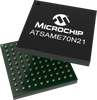
The SAME70N21 is available in 100-pin QFP and BGA package options.

Note: While there are no plans to change the availability status of Revision A for this device, new designs should use Revision B for prototypes and production.
Additional Features

      • Core
        • ARM® Cortex®-M7 running up to 300MHz
        • 16 Kbytes of ICache and 16 Kbytes of DCache with Error Code Correction (ECC)
        • Single- and double-precision HW Floating Point Unit (FPU)
        • Memory Protection Unit (MPU) with 16 zones
        • DSP Instructions, Thumb®-2 Instruction Set
        • Embedded Trace Module (ETM) with instruction trace stream, including Trace Port Interface Unit (TPIU)
      • Memories
        • 2048 Kbytes embedded Flash with unique identifier and user signature for user-defined data
        • 384 Kbytes embedded Multi-port SRAM
        • Tightly Coupled Memory (TCM) interface with four configurations (disabled, 2 x 32 Kbytes, 2 x 64 Kbytes, 2 x 128 Kbytes)
        • 16 Kbytes ROM with embedded Bootloader routines (UART0, USB) and IAP routines
        • 16-bit Static Memory Controller (SMC) with support for SRAM, PSRAM, LCD module, NOR and NAND Flash with on-the-fly scrambling
        • 16-bit SDRAM Controller (SDRAMC) interfacing up to 256 MB and with on-the-fly scrambling
      • System
        • Embedded voltage regulator for single-supply operation
        • Power-on-Reset (POR), Brown-out Detector (BOD) and Dual Watchdog for safe operation
        • Quartz or ceramic resonator oscillators: 3 to 20 MHz main oscillator with failure detection, 12 MHz or 16 MHz needed for USB operations. Optional low-power 32.768 kHz for RTC or device clock
        • RTC with Gregorian calendar mode, waveform generation in low-power modes
        • RTC counter calibration circuitry compensates for 32.768 kHz crystal frequency variations
        • 32-bit low-power Real-time Timer (RTT)
        • High-precision Main RC oscillator with 12 MHz default frequency for device startup. In-application trimming access for frequency adjustment. 8/12 MHz are factory-trimmed.
        • 32.768 kHz crystal oscillator or Slow RC oscillator as source of low-power mode device clock (SLCK)
        • One 500 MHz PLL for system clock, one 480 MHz PLL for USB high-speed operations
        • Temperature Sensor
        • One dual-port 24-channel central DMA Controller (XDMAC)
      • Low-Power Features
        • Low-power Sleep, Wait and Backup modes, with typical power consumption down to 1.1 μA in Backup mode with RTC, RTT and wakeup logic enabled
        • Ultra-low-power RTC and RTT
        • 1 Kbyte of backup RAM (BRAM) with dedicated regulator
      • Peripherals
        • One Ethernet MAC (GMAC) 10/100 Mbps in MII mode and RMII with dedicated DMA. IEEE1588 PTP frames and 802.3az Energy-efficiency support. Ethernet AVB support with IEEE802.1AS Timestamping and IEEE802.1Qav credit-based traffic-shaping hardware support
        • USB 2.0 Device/Mini Host High-speed (USBHS) at 480 Mbps, 4-Kbyte FIFO, up to 10 bidirectional endpoints, dedicated DMA
        • 12-bit ITU-R BT. 601/656 Image Sensor Interface (ISI)
        • Two master Controller Area Networks (MCAN) with Flexible Data Rate (CAN-FD) with SRAM-based mailboxes, time- and event-triggered transmission
          • ISO CAN FD; ISO 1189801:2015 (Revision B only)
        • Three USARTs. USART0/1/2 support LIN mode, ISO7816, IrDA®, RS-485, SPI, Manchester and Modem modes; USART1 supports LON mode.
        • Five 2-wire UARTs with SleepWalking™ support
        • Three Two-Wire Interfaces (TWIHS) (I2C-compatible) with SleepWalking™ support
        • Quad I/O Serial Peripheral Interface (QSPI) interfacing up to 256 MB Flash and with eXecute-In-Place and on-the-fly scrambling
        • Two Serial Peripheral Interfaces (SPI)
        • One Serial Synchronous Controller (SSC) with I2S and TDM support
        • Two Inter-IC Sound Controllers (I2SC)
        • One High-speed Multimedia Card Interface (HSMCI) (SDIO/SD Card/e.MMC)
        • Four Three-Channel 16-bit Timer/Counters (TC) with Capture, Waveform, Compare and PWM modes, constant on time. Quadrature decoder logic and 2-bit Gray Up/Down Counter for stepper motor
        • Two 4-channel 16-bit PWMs with complementary outputs, Dead Time Generator and eight fault inputs per PWM for motor control, two external triggers to manage power factor correction (PFC), DC-DC and lighting control.
        • Two Analog Front-End Controllers (AFEC), each supporting up to 12 channels with differential input mode and programmable gain stage, allowing dual sample-and-hold at up to 1.7 Msps. Offset and gain error correction feature.
        • One 2-channel 12-bit 1 Msps-per-channel Digital-to-Analog Controller (DAC) with Differential and Over Sampling modes
        • One Analog Comparator Controller (ACC) with flexible input selection, selectable input hysteresis
      • Cryptography
        • True Random Number Generator (TRNG)
        • AES: 256-, 192-, 128-bit Key Algorithm, Compliant with FIPS PUB-197 Specifications
        • Integrity Check Monitor (ICM). Supports Secure Hash Algorithm SHA1, SHA224 and SHA256.
      • I/O
        • Up to 114 I/O lines with external interrupt capability (edge- or level-sensitivity), debouncing, glitch filtering and On-die Series Resistor Termination
        • Five Parallel Input/output Controllers (PIO)
      • Voltage
        • Single Supply voltage from 1.7V to 3.6V for Industrial Temperature Devices
Supplier's Site Datasheet

Technical Specifications

  Microchip Technology, Inc.
Product Category Microcontrollers (MCU)
Product Number ATSAME70N21
Clock Speed 300 MHz
Bits Other; 12-bit
Number 10
RAM 384 KB
ROM 2048 KB
Unlock Full Specs
to access all available technical data

Similar Products

RF and Wireless - RF Transceiver ICs - CC1110F8RHHT - Shenzhen Shengyu Electronics Technology Limited
Specs
Life Cycle Stage Active
Supply Voltage 3.6 to 2 volts
Operating Temperature -40 to 85 C (-40 to 185 F)
View Details
Microcontrollers - C167CSL40MCAKXUMA2-ND - DigiKey
Specs
Data Bus 16 Bit
Clock Speed 40 MHz
Bits Other; A/D 24x10b
View Details
4 suppliers
Microcontrollers - 428484 - RS Components, Ltd.
RS Components, Ltd.
Specs
Data Bus 32 Bit; 32bit
ROM 256 KB
Package Type Other; QFN
View Details
Embedded - Microcontrollers - ADUC845BS8-3 - Lingto Electronic Limited
Specs
Data Bus 8 Bit; 8-Bit
View Details