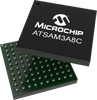
Microchip Technology, Inc. ATSAM3A8C

Description
Based on the ARM® Cortex®-M3 processor, the Microchip's SAM3A8C runs at 84MHz and features 512KB of flash memory in 2 x 256KB banks and 96KB of SRAM in 64KB +32KB banks. Its highly-integrated peripheral set includes dual CAN, High Speed USB MiniHost and device with on-chip PHY, high-speed SD/SDIO/MMC, and multiple USARTs, SPIs, TWIs (I2C), and one I2S. The SAM3A8C also features a 12-bit ADC/DAC, temperature sensor, 32-bit timers, PWM timer and RTC. It supports the Microchip QTouch Library for easy implementation of buttons, sliders and wheels. The device operates from 1.62V to 3.6V and is available in 100-pin QFP and BGA packages. Additional Features Microcontroller Features Core ARM Cortex-M3 revision 2.0 running at up to 84 MHz Memory Protection Unit (MPU) 24-bit SysTick Counter Thumb®-2 instruction set Nested Vector Interrupt Controller Memories 2 x 256 Kbytes embedded Flash, 128-bit wide access, memory accelerator, dual bank 64 + 32 Kbytes embedded SRAM with dual banks 16 Kbytes ROM with embedded bootloader routines (UART, USB) and IAP routines System Embedded voltage regulator for single-supply operation POR, BOD and Watchdog for safe reset Quartz or resonator oscillators: 3 to 20 MHz main and optional low power 32.768 kHz for RTC or device clock High precision 8/12 MHz factory trimmed internal RC oscillator with 4 MHz Default Frequency for fast device startup Slow Clock Internal RC oscillator as permanent clock for device clock in low power mode One PLL for device clock and one dedicated PLL for USB 2.0 High Speed Mini Host/Device Temperature Sensor 15 peripheral DMA (PDC) channels and 6-channel central DMA plus dedicated DMA for High-Speed USB Mini Host/Device Low Power modes Sleep, Wait and Backup modes, down to 2.5 μA in Backup mode with RTC, RTT, and GPBR Package 100-lead LQFP – 14 x 14 mm, pitch 0.5 mm 100-ball TFBGA – 9 x 9 mm, pitch 0.8 mm Temperature operating range Industrial (-40° C to +85° C) Peripheral Features USB 2.0 Device/Mini Host: 480 Mbps, 4 Kbyte FIFO, up to 10 bidirectional Endpoints, dedicated DMA 3 USARTs (ISO7816, IrDA®, Flow Control, SPI, Manchester and LIN support) and one UART 2 TWI (I2C compatible), up to 6 SPIs, 1 SSC (I2S), 1 HSMCI (SDIO/SD/MMC) with up to 2 slots 9-channel 32-bit Timer Counter (TC) for capture, compare and PWM mode, Quadrature Decoder Logic and 2-bit Gray Up/Down Counter for Stepper Motor 32-bit low-power Real-time Timer (RTT) and low-power Real-time Clock (RTC) with calendar and alarm features 256-bit General Purpose Backup Registers (GPBR) 2 CAN Controllers with 8 Mailboxes True Random Number Generator (TRNG) I/O 63 I/O lines with external interrupt capability (edge or level sensitivity), debouncing, glitch filtering and on-die Series Resistor Termination Six 32-bit Parallel Input/Output Controllers Analog Features 16-channel 12-bit 1 msps ADC with differential input mode and programmable gain stage 2-channel 12-bit 1 msps DAC Debugger Development Support Serial Wire/JTAG Debug Port(SWJ-DP) Debug access to all memories and registers in the system, including Cortex-M4 register bank when the core is running, halted, or held in reset. Serial Wire Debug Port (SW-DP) and Serial Wire JTAG Debug Port (SWJ-DP) debug access. Flash Patch and Breakpoint (FPB) unit for implementing breakpoints and code patches. Data Watchpoint and Trace (DWT) unit for implementing watchpoints, data tracing, and system profiling. Instrumentation Trace Macrocell (ITM) for support of printf style debugging. IEEE1149.1 JTAG Boundary-scan on all digital pins. Integrated Software Libraries and Tools ASF-Atmel software Framework – SAM software development framework Integrated in the Atmel Studio IDE with a graphical user interface or available as standalone for GCC, IAR compilers. DMA support, Interrupt handlers Driver support USB, TCP/IP, Wi-Fi and Bluetooth, Numerous USB classes, DHCP and Wi-Fi encryption Stacks RTOS integration, FreeRTOS is a core component
Datasheet
Description
Based on the ARM® Cortex®-M3 processor, the Microchip's SAM3A8C runs at 84MHz and features 512KB of flash memory in 2 x 256KB banks and 96KB of SRAM in 64KB +32KB banks. Its highly-integrated peripheral set includes dual CAN, High Speed USB MiniHost and device with on-chip PHY, high-speed SD/SDIO/MMC, and multiple USARTs, SPIs, TWIs (I2C), and one I2S. The SAM3A8C also features a 12-bit ADC/DAC, temperature sensor, 32-bit timers, PWM timer and RTC. It supports the Microchip QTouch Library for easy implementation of buttons, sliders and wheels. The device operates from 1.62V to 3.6V and is available in 100-pin QFP and BGA packages. Additional Features Microcontroller Features Core ARM Cortex-M3 revision 2.0 running at up to 84 MHz Memory Protection Unit (MPU) 24-bit SysTick Counter Thumb®-2 instruction set Nested Vector Interrupt Controller Memories 2 x 256 Kbytes embedded Flash, 128-bit wide access, memory accelerator, dual bank 64 + 32 Kbytes embedded SRAM with dual banks 16 Kbytes ROM with embedded bootloader routines (UART, USB) and IAP routines System Embedded voltage regulator for single-supply operation POR, BOD and Watchdog for safe reset Quartz or resonator oscillators: 3 to 20 MHz main and optional low power 32.768 kHz for RTC or device clock High precision 8/12 MHz factory trimmed internal RC oscillator with 4 MHz Default Frequency for fast device startup Slow Clock Internal RC oscillator as permanent clock for device clock in low power mode One PLL for device clock and one dedicated PLL for USB 2.0 High Speed Mini Host/Device Temperature Sensor 15 peripheral DMA (PDC) channels and 6-channel central DMA plus dedicated DMA for High-Speed USB Mini Host/Device Low Power modes Sleep, Wait and Backup modes, down to 2.5 μA in Backup mode with RTC, RTT, and GPBR Package 100-lead LQFP – 14 x 14 mm, pitch 0.5 mm 100-ball TFBGA – 9 x 9 mm, pitch 0.8 mm Temperature operating range Industrial (-40° C to +85° C) Peripheral Features USB 2.0 Device/Mini Host: 480 Mbps, 4 Kbyte FIFO, up to 10 bidirectional Endpoints, dedicated DMA 3 USARTs (ISO7816, IrDA®, Flow Control, SPI, Manchester and LIN support) and one UART 2 TWI (I2C compatible), up to 6 SPIs, 1 SSC (I2S), 1 HSMCI (SDIO/SD/MMC) with up to 2 slots 9-channel 32-bit Timer Counter (TC) for capture, compare and PWM mode, Quadrature Decoder Logic and 2-bit Gray Up/Down Counter for Stepper Motor 32-bit low-power Real-time Timer (RTT) and low-power Real-time Clock (RTC) with calendar and alarm features 256-bit General Purpose Backup Registers (GPBR) 2 CAN Controllers with 8 Mailboxes True Random Number Generator (TRNG) I/O 63 I/O lines with external interrupt capability (edge or level sensitivity), debouncing, glitch filtering and on-die Series Resistor Termination Six 32-bit Parallel Input/Output Controllers Analog Features 16-channel 12-bit 1 msps ADC with differential input mode and programmable gain stage 2-channel 12-bit 1 msps DAC Debugger Development Support Serial Wire/JTAG Debug Port(SWJ-DP) Debug access to all memories and registers in the system, including Cortex-M4 register bank when the core is running, halted, or held in reset. Serial Wire Debug Port (SW-DP) and Serial Wire JTAG Debug Port (SWJ-DP) debug access. Flash Patch and Breakpoint (FPB) unit for implementing breakpoints and code patches. Data Watchpoint and Trace (DWT) unit for implementing watchpoints, data tracing, and system profiling. Instrumentation Trace Macrocell (ITM) for support of printf style debugging. IEEE1149.1 JTAG Boundary-scan on all digital pins. Integrated Software Libraries and Tools ASF-Atmel software Framework – SAM software development framework Integrated in the Atmel Studio IDE with a graphical user interface or available as standalone for GCC, IAR compilers. DMA support, Interrupt handlers Driver support USB, TCP/IP, Wi-Fi and Bluetooth, Numerous USB classes, DHCP and Wi-Fi encryption Stacks RTOS integration, FreeRTOS is a core component
Datasheet

Suppliers

Company
Product
Description
Supplier Links
 - ATSAM3A8C - Microchip Technology, Inc.
Chandler, AZ, United States
Based on the ARM® Cortex®-M3 processor, the Microchip's SAM3A8C runs at 84MHz and features 512KB of flash memory in 2 x 256KB banks and 96KB of SRAM in 64KB +32KB banks. Its highly-integrated peripheral set includes dual CAN, High Speed USB MiniHost and device with on-chip PHY, high-speed SD/SDIO/MMC, and multiple USARTs, SPIs, TWIs (I2C), and one I2S. The SAM3A8C also features a 12-bit ADC/DAC, temperature sensor, 32-bit timers, PWM timer and RTC. It supports the Microchip QTouch Library for easy implementation of buttons, sliders and wheels. The device operates from 1.62V to 3.6V and is available in 100-pin QFP and BGA packages. Additional Features Microcontroller Features Core ARM Cortex-M3 revision 2.0 running at up to 84 MHz Memory Protection Unit (MPU) 24-bit SysTick Counter Thumb®-2 instruction set Nested Vector Interrupt Controller Memories 2 x 256 Kbytes embedded Flash, 128-bit wide access, memory accelerator, dual bank 64 + 32 Kbytes embedded SRAM with dual banks 16 Kbytes ROM with embedded bootloader routines (UART, USB) and IAP routines System Embedded voltage regulator for single-supply operation POR, BOD and Watchdog for safe reset Quartz or resonator oscillators: 3 to 20 MHz main and optional low power 32.768 kHz for RTC or device clock High precision 8/12 MHz factory trimmed internal RC oscillator with 4 MHz Default Frequency for fast device startup Slow Clock Internal RC oscillator as permanent clock for device clock in low power mode One PLL for device clock and one dedicated PLL for USB 2.0 High Speed Mini Host/Device Temperature Sensor 15 peripheral DMA (PDC) channels and 6-channel central DMA plus dedicated DMA for High-Speed USB Mini Host/Device Low Power modes Sleep, Wait and Backup modes, down to 2.5 μA in Backup mode with RTC, RTT, and GPBR Package 100-lead LQFP – 14 x 14 mm, pitch 0.5 mm 100-ball TFBGA – 9 x 9 mm, pitch 0.8 mm Temperature operating range Industrial (-40° C to +85° C) Peripheral Features USB 2.0 Device/Mini Host: 480 Mbps, 4 Kbyte FIFO, up to 10 bidirectional Endpoints, dedicated DMA 3 USARTs (ISO7816, IrDA®, Flow Control, SPI, Manchester and LIN support) and one UART 2 TWI (I2C compatible), up to 6 SPIs, 1 SSC (I2S), 1 HSMCI (SDIO/SD/MMC) with up to 2 slots 9-channel 32-bit Timer Counter (TC) for capture, compare and PWM mode, Quadrature Decoder Logic and 2-bit Gray Up/Down Counter for Stepper Motor 32-bit low-power Real-time Timer (RTT) and low-power Real-time Clock (RTC) with calendar and alarm features 256-bit General Purpose Backup Registers (GPBR) 2 CAN Controllers with 8 Mailboxes True Random Number Generator (TRNG) I/O 63 I/O lines with external interrupt capability (edge or level sensitivity), debouncing, glitch filtering and on-die Series Resistor Termination Six 32-bit Parallel Input/Output Controllers Analog Features 16-channel 12-bit 1 msps ADC with differential input mode and programmable gain stage 2-channel 12-bit 1 msps DAC Debugger Development Support Serial Wire/JTAG Debug Port(SWJ-DP) Debug access to all memories and registers in the system, including Cortex-M4 register bank when the core is running, halted, or held in reset. Serial Wire Debug Port (SW-DP) and Serial Wire JTAG Debug Port (SWJ-DP) debug access. Flash Patch and Breakpoint (FPB) unit for implementing breakpoints and code patches. Data Watchpoint and Trace (DWT) unit for implementing watchpoints, data tracing, and system profiling. Instrumentation Trace Macrocell (ITM) for support of printf style debugging. IEEE1149.1 JTAG Boundary-scan on all digital pins. Integrated Software Libraries and Tools ASF-Atmel software Framework – SAM software development framework Integrated in the Atmel Studio IDE with a graphical user interface or available as standalone for GCC, IAR compilers. DMA support, Interrupt handlers Driver support USB, TCP/IP, Wi-Fi and Bluetooth, Numerous USB classes, DHCP and Wi-Fi encryption Stacks RTOS integration, FreeRTOS is a core component

Based on the ARM® Cortex®-M3 processor, the Microchip's SAM3A8C runs at 84MHz and features 512KB of flash memory in 2 x 256KB banks and 96KB of SRAM in 64KB +32KB banks.

Its highly-integrated peripheral set includes dual CAN, High Speed USB MiniHost and device with on-chip PHY, high-speed SD/SDIO/MMC, and multiple USARTs, SPIs, TWIs (I2C), and one I2S.

The SAM3A8C also features a 12-bit ADC/DAC, temperature sensor, 32-bit timers, PWM timer and RTC.

It supports the Microchip QTouch Library for easy implementation of buttons, sliders and wheels.

The device operates from 1.62V to 3.6V and is available in 100-pin QFP and BGA packages.

Additional Features

    Microcontroller Features Core
    • ARM Cortex-M3 revision 2.0 running at up to 84 MHz
    • Memory Protection Unit (MPU)
    • 24-bit SysTick Counter
    • Thumb®-2 instruction set
    • Nested Vector Interrupt Controller
    Memories
    • 2 x 256 Kbytes embedded Flash, 128-bit wide access, memory accelerator, dual bank
    • 64 + 32 Kbytes embedded SRAM with dual banks
    • 16 Kbytes ROM with embedded bootloader routines (UART, USB) and IAP routines
    System
    • Embedded voltage regulator for single-supply operation
    • POR, BOD and Watchdog for safe reset
    • Quartz or resonator oscillators: 3 to 20 MHz main and optional low power 32.768 kHz for RTC or device clock
    • High precision 8/12 MHz factory trimmed internal RC oscillator with 4 MHz Default Frequency for fast device startup
    • Slow Clock Internal RC oscillator as permanent clock for device clock in low power mode
    • One PLL for device clock and one dedicated PLL for USB 2.0 High Speed Mini Host/Device
    • Temperature Sensor
    • 15 peripheral DMA (PDC) channels and 6-channel central DMA plus dedicated DMA for High-Speed USB Mini Host/Device
    Low Power modes
    • Sleep, Wait and Backup modes, down to 2.5 μA in Backup mode with RTC, RTT, and GPBR
    Package
    • 100-lead LQFP – 14 x 14 mm, pitch 0.5 mm
    • 100-ball TFBGA – 9 x 9 mm, pitch 0.8 mm
    Temperature operating range
    • Industrial (-40° C to +85° C)
    Peripheral Features
    • USB 2.0 Device/Mini Host: 480 Mbps, 4 Kbyte FIFO, up to 10 bidirectional Endpoints, dedicated DMA
    • 3 USARTs (ISO7816, IrDA®, Flow Control, SPI, Manchester and LIN support) and one UART
    • 2 TWI (I2C compatible), up to 6 SPIs, 1 SSC (I2S), 1 HSMCI (SDIO/SD/MMC) with up to 2 slots
    • 9-channel 32-bit Timer Counter (TC) for capture, compare and PWM mode, Quadrature Decoder Logic and 2-bit Gray Up/Down Counter for Stepper Motor
    • 32-bit low-power Real-time Timer (RTT) and low-power Real-time Clock (RTC) with calendar and alarm features
    • 256-bit General Purpose Backup Registers (GPBR)
    • 2 CAN Controllers with 8 Mailboxes
    • True Random Number Generator (TRNG)
    I/O
    • 63 I/O lines with external interrupt capability (edge or level sensitivity), debouncing, glitch filtering and on-die Series Resistor Termination
    • Six 32-bit Parallel Input/Output Controllers
    Analog Features
    • 16-channel 12-bit 1 msps ADC with differential input mode and programmable gain stage
    • 2-channel 12-bit 1 msps DAC
    Debugger Development Support
    • Serial Wire/JTAG Debug Port(SWJ-DP)
    • Debug access to all memories and registers in the system, including Cortex-M4 register bank when the core is running, halted, or held in reset.
    • Serial Wire Debug Port (SW-DP) and Serial Wire JTAG Debug Port (SWJ-DP) debug access.
    • Flash Patch and Breakpoint (FPB) unit for implementing breakpoints and code patches.
    • Data Watchpoint and Trace (DWT) unit for implementing watchpoints, data tracing, and system profiling.
    • Instrumentation Trace Macrocell (ITM) for support of printf style debugging.
    • IEEE1149.1 JTAG Boundary-scan on all digital pins.
    Integrated Software Libraries and Tools
    • ASF-Atmel software Framework – SAM software development framework
    • Integrated in the Atmel Studio IDE with a graphical user interface or available as standalone for GCC, IAR compilers.
    • DMA support, Interrupt handlers Driver support
    • USB, TCP/IP, Wi-Fi and Bluetooth, Numerous USB classes, DHCP and Wi-Fi encryption Stacks
    • RTOS integration, FreeRTOS is a core component
Supplier's Site Datasheet

Technical Specifications

  Microchip Technology, Inc.
Product Category Microcontrollers (MCU)
Product Number ATSAM3A8C
Clock Speed 84 MHz
Bits Other; 12-bit
Number 16
RAM 96 KB
ROM 512 KB
Unlock Full Specs
to access all available technical data

Similar Products

CC430F5133 16-Bit Ultra-Low-Power MCU, 8KB Flash, 2KB RAM, CC1101 Radio, AES-128, 12Bit ADC, USCI - CC430F5133IRGZ - Texas Instruments
Specs
Data Bus 16 Bit
Clock Speed 20 MHz
Features Watchdog Timer; DMA
View Details
2 suppliers
Integrated Circuits (ICs) - Embedded - Microcontrollers - C164SL6RMCAKXUMA6 - Acme Chip Technology Co., Limited
Specs
Data Bus 16 Bit
Life Cycle Stage Removed; Obsolete
Clock Speed 20 MHz
View Details
3 suppliers
Microcontrollers - 1814977 - RS Components, Ltd.
RS Components, Ltd.
Specs
Data Bus 32 Bit; 32bit
RAM 256 KB
ROM 256 KB
View Details
Embedded - Microcontrollers - ADUC7033BSTZ-8L-RL - Lingto Electronic Limited
Specs
Data Bus 16 Bit; 32 Bit; 16/32-Bit
View Details