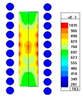
INDUCTO is a coupled 2D/RS magnetic and thermal analysis program for applications involving inductive heating.
It is created by combining in one program the OERSTED and KELVIN solving modules and linking them together so that the eddy current power becomes a heat source for thermal analysis. See the individual module description of OERSTED and KELVIN for more details.
Our powerful parametric solvers allow designers to automatically vary and experiment with geometry, materials and sources – reducing the tedious, repetitive task of fine–tuning multiple design parameters.
Combined Eddy Currents and Thermal Simulation Features:
Choose the Boundary Element Method (BEM), Finite Element Method (FEM) or Hybrid Method Solver that combines the strengths of both BEM and FEM analysis
Static and phasor analysis modes
Simulate non-linear, permanent magnet and lossy magnetic materials
Easily assign boundary conditions such as temperature, heat flux, temperature gradient, convective and radiative heat exchange
Assign heat sources in the form of volume heat and surface heat
Material table stores thermal conductivity, specific heat, mass density or absorption and scattering coefficients
INDUCTO is a coupled 2D/RS magnetic and thermal analysis program for applications involving inductive heating.
It is created by combining in one program the OERSTED and KELVIN solving modules and linking them together so that the eddy current power becomes a heat source for thermal analysis. See the individual module description of OERSTED and KELVIN for more details.
Our powerful parametric solvers allow designers to automatically vary and experiment with geometry, materials and sources – reducing the tedious, repetitive task of fine–tuning multiple design parameters.
Combined Eddy Currents and Thermal Simulation Features:
- Choose the Boundary Element Method (BEM), Finite Element Method (FEM) or Hybrid Method Solver that combines the strengths of both BEM and FEM analysis
- Static and phasor analysis modes
- Simulate non-linear, permanent magnet and lossy magnetic materials
- Easily assign boundary conditions such as temperature, heat flux, temperature gradient, convective and radiative heat exchange
- Assign heat sources in the form of volume heat and surface heat
- Material table stores thermal conductivity, specific heat, mass density or absorption and scattering coefficients