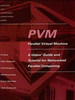
IEEE - Institute of Electrical and Electronics Engineers, Inc. PVM: A Users' Guide and Tutorial for Network Parallel Computing

Description
Written by the team that developed the software, this tutorial is the definitive resource for scientists, engineers, and other computer users who want to use PVM to increase the flexibility and power of their high-performance computing resources. PVM introduces distributed computing, discusses where and how to get the PVM software, provides an overview of PVM and a tutorial on setting up and running existing programs, and introduces basic programming techniques including putting PVM in existing code. There are program examples and details on how PVM works on UNIX and multiprocessor systems, along with advanced topics (portability, debugging, improving performance) and troubleshooting.PVM (Parallel Virtual Machine) is a software package that enables the computer user to define a networked heterogeneous collection of serial, parallel, and vector computers to function as one large computer. It can be used as stand-alone software or as a foundation for other heterogeneous network software. PVM may be configured to contain various machine architectures, including sequential processors, vector processors, and multicomputers, and it can be ported to new computer architectures that may emerge.
Request a Quote
Description
Written by the team that developed the software, this tutorial is the definitive resource for scientists, engineers, and other computer users who want to use PVM to increase the flexibility and power of their high-performance computing resources. PVM introduces distributed computing, discusses where and how to get the PVM software, provides an overview of PVM and a tutorial on setting up and running existing programs, and introduces basic programming techniques including putting PVM in existing code. There are program examples and details on how PVM works on UNIX and multiprocessor systems, along with advanced topics (portability, debugging, improving performance) and troubleshooting.PVM (Parallel Virtual Machine) is a software package that enables the computer user to define a networked heterogeneous collection of serial, parallel, and vector computers to function as one large computer. It can be used as stand-alone software or as a foundation for other heterogeneous network software. PVM may be configured to contain various machine architectures, including sequential processors, vector processors, and multicomputers, and it can be ported to new computer architectures that may emerge.
Request a Quote

Suppliers

Company
Product
Description
Supplier Links
PVM: A Users' Guide and Tutorial for Network Parallel Computing -  - IEEE -  Institute of Electrical and Electronics Engineers, Inc.
Piscataway, NJ, USA
PVM: A Users' Guide and Tutorial for Network Parallel Computing
Written by the team that developed the software, this tutorial is the definitive resource for scientists, engineers, and other computer users who want to use PVM to increase the flexibility and power of their high-performance computing resources. PVM introduces distributed computing, discusses where and how to get the PVM software, provides an overview of PVM and a tutorial on setting up and running existing programs, and introduces basic programming techniques including putting PVM in existing code. There are program examples and details on how PVM works on UNIX and multiprocessor systems, along with advanced topics (portability, debugging, improving performance) and troubleshooting.PVM (Parallel Virtual Machine) is a software package that enables the computer user to define a networked heterogeneous collection of serial, parallel, and vector computers to function as one large computer. It can be used as stand-alone software or as a foundation for other heterogeneous network software. PVM may be configured to contain various machine architectures, including sequential processors, vector processors, and multicomputers, and it can be ported to new computer architectures that may emerge.

Written by the team that developed the software, this tutorial is the definitive resource for scientists, engineers, and other computer users who want to use PVM to increase the flexibility and power of their high-performance computing resources. PVM introduces distributed computing, discusses where and how to get the PVM software, provides an overview of PVM and a tutorial on setting up and running existing programs, and introduces basic programming techniques including putting PVM in existing code. There are program examples and details on how PVM works on UNIX and multiprocessor systems, along with advanced topics (portability, debugging, improving performance) and troubleshooting.PVM (Parallel Virtual Machine) is a software package that enables the computer user to define a networked heterogeneous collection of serial, parallel, and vector computers to function as one large computer. It can be used as stand-alone software or as a foundation for other heterogeneous network software. PVM may be configured to contain various machine architectures, including sequential processors, vector processors, and multicomputers, and it can be ported to new computer architectures that may emerge.

Supplier's Site

Technical Specifications

  IEEE - Institute of Electrical and Electronics Engineers, Inc.
Product Category Technical Books
Product Name PVM: A Users' Guide and Tutorial for Network Parallel Computing
Unlock Full Specs
to access all available technical data

Similar Products

Advances in Electric Propulsion -  - IEEE -  Institute of Electrical and Electronics Engineers, Inc.
IEEE - Institute of Electrical and Electronics Engineers, Inc.
View Details
A Practical Guide to Testing Wireless Smartphone Applications -  - IEEE -  Institute of Electrical and Electronics Engineers, Inc.
IEEE - Institute of Electrical and Electronics Engineers, Inc.
View Details
IEEE - Institute of Electrical and Electronics Engineers, Inc.
View Details