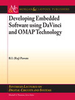
IEEE - Institute of Electrical and Electronics Engineers, Inc. Developing Embedded Software using DaVinci and OMAP Technology

Description
This book discusses how to develop embedded products using DaVinci & OMAP Technology from Texas Instruments Incorporated. It presents a single software platform for diverse hardware platforms. DaVinci & OMAP Technology refers to the family of processors, development tools, software products, and support. While DaVinci Technology is driven by the needs of consumer video products such as IP network cameras, networked projectors, digital signage and portable media players, OMAP Technology is driven by the needs of wireless products such as smart phones. Texas Instruments offers a wide variety of processing devices to meet our users' price and performance needs. These vary from single digital signal processing devices to complex, system-on-chip (SoC) devices with multiple processors and peripherals. As a software developer you question: Do I need to become an expert in signal processing and learn the details of these complex devices before I can use them in my application? As a senior executive you wonder: How can I reduce my engineering development cost? How can I move from one processor to another from Texas Instruments without incurring a significant development cost? This book addresses these questions with sample code and gives an insight into the software architecture and associated component software products that make up this software platform. As an example, we show how we develop an IP network camera. Using this software platform, you can choose to focus on the application and quickly create a product without having to learn the details of the underlying hardware or signal processing algorithms. Alternatively, you can choose to differentiate at both the application as well as the signal processing layer by developing and adding your algorithms using the xDAIS for Digital Media, xDM, guidelines for component software. Finally, you may use one code base across different hardware platforms. Table of Contents: Software Platform / More about xDM, VISA, & CE / Build...
Request a Quote
Description
This book discusses how to develop embedded products using DaVinci & OMAP Technology from Texas Instruments Incorporated. It presents a single software platform for diverse hardware platforms. DaVinci & OMAP Technology refers to the family of processors, development tools, software products, and support. While DaVinci Technology is driven by the needs of consumer video products such as IP network cameras, networked projectors, digital signage and portable media players, OMAP Technology is driven by the needs of wireless products such as smart phones. Texas Instruments offers a wide variety of processing devices to meet our users' price and performance needs. These vary from single digital signal processing devices to complex, system-on-chip (SoC) devices with multiple processors and peripherals. As a software developer you question: Do I need to become an expert in signal processing and learn the details of these complex devices before I can use them in my application? As a senior executive you wonder: How can I reduce my engineering development cost? How can I move from one processor to another from Texas Instruments without incurring a significant development cost? This book addresses these questions with sample code and gives an insight into the software architecture and associated component software products that make up this software platform. As an example, we show how we develop an IP network camera. Using this software platform, you can choose to focus on the application and quickly create a product without having to learn the details of the underlying hardware or signal processing algorithms. Alternatively, you can choose to differentiate at both the application as well as the signal processing layer by developing and adding your algorithms using the xDAIS for Digital Media, xDM, guidelines for component software. Finally, you may use one code base across different hardware platforms. Table of Contents: Software Platform / More about xDM, VISA, & CE / Build...
Request a Quote

Suppliers

Company
Product
Description
Supplier Links
Developing Embedded Software using DaVinci and OMAP Technology -  - IEEE -  Institute of Electrical and Electronics Engineers, Inc.
Piscataway, NJ, USA
Developing Embedded Software using DaVinci and OMAP Technology
This book discusses how to develop embedded products using DaVinci & OMAP Technology from Texas Instruments Incorporated. It presents a single software platform for diverse hardware platforms. DaVinci & OMAP Technology refers to the family of processors, development tools, software products, and support. While DaVinci Technology is driven by the needs of consumer video products such as IP network cameras, networked projectors, digital signage and portable media players, OMAP Technology is driven by the needs of wireless products such as smart phones. Texas Instruments offers a wide variety of processing devices to meet our users' price and performance needs. These vary from single digital signal processing devices to complex, system-on-chip (SoC) devices with multiple processors and peripherals. As a software developer you question: Do I need to become an expert in signal processing and learn the details of these complex devices before I can use them in my application? As a senior executive you wonder: How can I reduce my engineering development cost? How can I move from one processor to another from Texas Instruments without incurring a significant development cost? This book addresses these questions with sample code and gives an insight into the software architecture and associated component software products that make up this software platform. As an example, we show how we develop an IP network camera. Using this software platform, you can choose to focus on the application and quickly create a product without having to learn the details of the underlying hardware or signal processing algorithms. Alternatively, you can choose to differentiate at both the application as well as the signal processing layer by developing and adding your algorithms using the xDAIS for Digital Media, xDM, guidelines for component software. Finally, you may use one code base across different hardware platforms. Table of Contents: Software Platform / More about xDM, VISA, & CE / Build...

This book discusses how to develop embedded products using DaVinci & OMAP Technology from Texas Instruments Incorporated. It presents a single software platform for diverse hardware platforms. DaVinci & OMAP Technology refers to the family of processors, development tools, software products, and support. While DaVinci Technology is driven by the needs of consumer video products such as IP network cameras, networked projectors, digital signage and portable media players, OMAP Technology is driven by the needs of wireless products such as smart phones. Texas Instruments offers a wide variety of processing devices to meet our users' price and performance needs. These vary from single digital signal processing devices to complex, system-on-chip (SoC) devices with multiple processors and peripherals. As a software developer you question: Do I need to become an expert in signal processing and learn the details of these complex devices before I can use them in my application? As a senior executive you wonder: How can I reduce my engineering development cost? How can I move from one processor to another from Texas Instruments without incurring a significant development cost? This book addresses these questions with sample code and gives an insight into the software architecture and associated component software products that make up this software platform. As an example, we show how we develop an IP network camera. Using this software platform, you can choose to focus on the application and quickly create a product without having to learn the details of the underlying hardware or signal processing algorithms. Alternatively, you can choose to differentiate at both the application as well as the signal processing layer by developing and adding your algorithms using the xDAIS for Digital Media, xDM, guidelines for component software. Finally, you may use one code base across different hardware platforms. Table of Contents: Software Platform / More about xDM, VISA, & CE / Build...

Supplier's Site

Technical Specifications

  IEEE - Institute of Electrical and Electronics Engineers, Inc.
Product Category Technical Books
Product Name Developing Embedded Software using DaVinci and OMAP Technology
Unlock Full Specs
to access all available technical data

Similar Products

Anomaly Detection as a Service: Challenges, Advances, and Opportunities -  - IEEE -  Institute of Electrical and Electronics Engineers, Inc.
IEEE - Institute of Electrical and Electronics Engineers, Inc.
View Details
Big Data Integration -  - IEEE -  Institute of Electrical and Electronics Engineers, Inc.
IEEE - Institute of Electrical and Electronics Engineers, Inc.
View Details