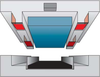
Advantages of using PM flow controllers on guides
The holding strips are often not needed if the load directions permit this, since in many cases with PM flow controllers there is no need for holding strips for simply increasing the stiffness
In the case of guides with no holding strips, the stiffness can also be increased significantly by means of negative pressure pockets
On guides with holding strips, the stiffness of the guide can be adjusted largely independent of the load by varying the pre-loading
No wear with increasing use
Power of ten improvement in damping, resulting in considerably better workpiece surface finish and tool service life
no fluctuations and variations in the friction, as is the case with rolling-element guides due to ball circulation
no feed force backlash when the direction of motion is reversed
practically friction-free at low speeds
no stick-slip effect
capable of travelling less than 0.1 µm
the sliding properties of the material, slide and guideway are unimportant – moulded mineral, aluminium or casting compound can be used
The hydrostatic guide is adjusted for:
gravitational, working and accelerating forces
maximum speed and acceleration as well as the required stiffness and optimum damping
HYPROSTATIK Schönfeld GmbH
Done
Description
Advantages of using PM flow controllers on guides
The holding strips are often not needed if the load directions permit this, since in many cases with PM flow controllers there is no need for holding strips for simply increasing the stiffness
In the case of guides with no holding strips, the stiffness can also be increased significantly by means of negative pressure pockets
On guides with holding strips, the stiffness of the guide can be adjusted largely independent of the load by varying the pre-loading
No wear with increasing use
Power of ten improvement in damping, resulting in considerably better workpiece surface finish and tool service life
no fluctuations and variations in the friction, as is the case with rolling-element guides due to ball circulation
no feed force backlash when the direction of motion is reversed
practically friction-free at low speeds
no stick-slip effect
capable of travelling less than 0.1 µm
the sliding properties of the material, slide and guideway are unimportant – moulded mineral, aluminium or casting compound can be used
The hydrostatic guide is adjusted for:
gravitational, working and accelerating forces
maximum speed and acceleration as well as the required stiffness and optimum damping
Advantages of using PM flow controllers on guides
The holding strips are often not needed if the load directions permit this, since in many cases with PM flow controllers there is no need for holding strips for simply increasing the stiffness
In the case of guides with no holding strips, the stiffness can also be increased significantly by means of negative pressure pockets
On guides with holding strips, the stiffness of the guide can be adjusted largely independent of the load by varying the pre-loading
No wear with increasing use
Power of ten improvement in damping, resulting in considerably better workpiece surface finish and tool service life
no fluctuations and variations in the friction, as is the case with rolling-element guides due to ball circulation
no feed force backlash when the direction of motion is reversed
practically friction-free at low speeds
no stick-slip effect
capable of travelling less than 0.1 µm
the sliding properties of the material, slide and guideway are unimportant – moulded mineral, aluminium or casting compound can be used
The hydrostatic guide is adjusted for:
gravitational, working and accelerating forces
maximum speed and acceleration as well as the required stiffness and optimum damping
Advantages of using PM flow controllers on guides
The holding strips are often not needed if the load directions permit this, since in many cases with PM flow controllers there is no need for holding strips for simply increasing the stiffness
In the case of guides with no holding strips, the stiffness can also be increased significantly by means of negative pressure pockets
On guides with holding strips, the stiffness of the guide can be adjusted largely independent of the load by varying the pre-loading
No wear with increasing use
Power of ten improvement in damping, resulting in considerably better workpiece surface finish and tool service life
no fluctuations and variations in the friction, as is the case with rolling-element guides due to ball circulation
no feed force backlash when the direction of motion is reversed
practically friction-free at low speeds
no stick-slip effect
capable of travelling less than 0.1 µm
the sliding properties of the material, slide and guideway are unimportant – moulded mineral, aluminium or casting compound can be used
The hydrostatic guide is adjusted for:
gravitational, working and accelerating forces
maximum speed and acceleration as well as the required stiffness and optimum damping