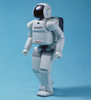
Honda Motor Co., Ltd. Humanoid Robot ASIMO

Description
Honda's ASIMO, an acronym for Advanced Step in Innovative Mobility, was one of the most advanced humanoid robots during its time of active development. Engineered to operate in human environments, ASIMO could walk or run on two legs, with the ability to navigate around people and objects without falling. This capability was highlighted by its ability to maintain balance even when unexpectedly bumped into. ASIMO's design focused on mobility within the same spaces as humans, showcasing a significant stride in robotics aimed at practical daily interactions. ASIMO was also designed to perform tasks using its hands, which allowed it to interact with objects and environments in a human-like manner. It could perform a variety of manual tasks from opening a bottle to operating switches and handling delicate objects, making it a potential assistant in both home and office settings. Furthermore, ASIMO could understand spoken commands and respond to them, facilitating interaction with people that included responding to the intentions and commands of nearby individuals. Beyond its immediate functionalities, ASIMO served as a long-term research project that contributed to Honda's understanding of safe robot-human coexistence. Over its operational period, ASIMO took over 33 million steps and walked a total distance of nearly 7,907 kilometers, providing extensive data on long-term robot use in human environments. This experience informed safety enhancements and highlighted the need for ongoing development to address scenarios like ensuring safety when falling near children, reflecting the complexities of real-world human-robot interaction. Honda's ongoing research now also explores non-bipedal robot mobility to enhance safety and efficiency, underscoring the evolving nature of robotics in adapting to human spaces.
Description
Honda's ASIMO, an acronym for Advanced Step in Innovative Mobility, was one of the most advanced humanoid robots during its time of active development. Engineered to operate in human environments, ASIMO could walk or run on two legs, with the ability to navigate around people and objects without falling. This capability was highlighted by its ability to maintain balance even when unexpectedly bumped into. ASIMO's design focused on mobility within the same spaces as humans, showcasing a significant stride in robotics aimed at practical daily interactions. ASIMO was also designed to perform tasks using its hands, which allowed it to interact with objects and environments in a human-like manner. It could perform a variety of manual tasks from opening a bottle to operating switches and handling delicate objects, making it a potential assistant in both home and office settings. Furthermore, ASIMO could understand spoken commands and respond to them, facilitating interaction with people that included responding to the intentions and commands of nearby individuals. Beyond its immediate functionalities, ASIMO served as a long-term research project that contributed to Honda's understanding of safe robot-human coexistence. Over its operational period, ASIMO took over 33 million steps and walked a total distance of nearly 7,907 kilometers, providing extensive data on long-term robot use in human environments. This experience informed safety enhancements and highlighted the need for ongoing development to address scenarios like ensuring safety when falling near children, reflecting the complexities of real-world human-robot interaction. Honda's ongoing research now also explores non-bipedal robot mobility to enhance safety and efficiency, underscoring the evolving nature of robotics in adapting to human spaces.

Suppliers

Company
Product
Description
Supplier Links
Humanoid Robot - ASIMO - Honda Motor Co., Ltd.
Minato-ku, Tokyo, Japan
Humanoid Robot
ASIMO
Humanoid Robot ASIMO
Honda's ASIMO, an acronym for Advanced Step in Innovative Mobility, was one of the most advanced humanoid robots during its time of active development. Engineered to operate in human environments, ASIMO could walk or run on two legs, with the ability to navigate around people and objects without falling. This capability was highlighted by its ability to maintain balance even when unexpectedly bumped into. ASIMO's design focused on mobility within the same spaces as humans, showcasing a significant stride in robotics aimed at practical daily interactions. ASIMO was also designed to perform tasks using its hands, which allowed it to interact with objects and environments in a human-like manner. It could perform a variety of manual tasks from opening a bottle to operating switches and handling delicate objects, making it a potential assistant in both home and office settings. Furthermore, ASIMO could understand spoken commands and respond to them, facilitating interaction with people that included responding to the intentions and commands of nearby individuals. Beyond its immediate functionalities, ASIMO served as a long-term research project that contributed to Honda's understanding of safe robot-human coexistence. Over its operational period, ASIMO took over 33 million steps and walked a total distance of nearly 7,907 kilometers, providing extensive data on long-term robot use in human environments. This experience informed safety enhancements and highlighted the need for ongoing development to address scenarios like ensuring safety when falling near children, reflecting the complexities of real-world human-robot interaction. Honda's ongoing research now also explores non-bipedal robot mobility to enhance safety and efficiency, underscoring the evolving nature of robotics in adapting to human spaces.

Honda's ASIMO, an acronym for Advanced Step in Innovative Mobility, was one of the most advanced humanoid robots during its time of active development. Engineered to operate in human environments, ASIMO could walk or run on two legs, with the ability to navigate around people and objects without falling. This capability was highlighted by its ability to maintain balance even when unexpectedly bumped into. ASIMO's design focused on mobility within the same spaces as humans, showcasing a significant stride in robotics aimed at practical daily interactions.
ASIMO was also designed to perform tasks using its hands, which allowed it to interact with objects and environments in a human-like manner. It could perform a variety of manual tasks from opening a bottle to operating switches and handling delicate objects, making it a potential assistant in both home and office settings. Furthermore, ASIMO could understand spoken commands and respond to them, facilitating interaction with people that included responding to the intentions and commands of nearby individuals.
Beyond its immediate functionalities, ASIMO served as a long-term research project that contributed to Honda's understanding of safe robot-human coexistence. Over its operational period, ASIMO took over 33 million steps and walked a total distance of nearly 7,907 kilometers, providing extensive data on long-term robot use in human environments. This experience informed safety enhancements and highlighted the need for ongoing development to address scenarios like ensuring safety when falling near children, reflecting the complexities of real-world human-robot interaction. Honda's ongoing research now also explores non-bipedal robot mobility to enhance safety and efficiency, underscoring the evolving nature of robotics in adapting to human spaces.

Supplier's Site

Technical Specifications

  Honda Motor Co., Ltd.
Product Category Robots
Product Number ASIMO
Product Name Humanoid Robot
Robot Type Service Robot; Humanoid Robot
Unlock Full Specs
to access all available technical data

Similar Products

Autonomous Mobile Robots - AMR - ElectroCraft
Specs
Robot Type Service Robot
Industry / Application  Material Handling (e.g., Loading/Unloading, Palletizing)
Features Mobile
View Details
Autobonder Desktop Series 3X - 110020201 - Hernon Manufacturing, Inc.
Specs
Robot Type Gantry
View Details
Automated Robotic Melt Shop - ARMS® - Inductotherm Group
Specs
Robot Type (Robot System)
Industry / Application Foundry, Melt Shop
Load Capacity 30 to 500 kg (66.15 to 1102 lbs)
View Details
Hexapod, Vacuum Compatible, 200 mm Diameter Platform, 20 kg Load, M6 - HXP100V6-MECA - Newport MKS
Specs
Robot Type Parallel Robot (Delta/Hexapod)
Drive System Electric
# of Axes 6 #
View Details