Features:
• Double concave structure recommended for absolute conjugate ratio close to 1:1 • Made of UV Fused Silica (superior transmission from UV to NIR) • Standardized focal lengths and diameters convenient for OEM • Various standard and custom coating options, focal lengths (standard -6 to -100mm) • Applications: Galilean laser beam expander, optical character readers, viewers, and projectors • Custom Biconcave Lenses made from different materials are available
Description:
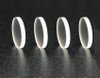
Abiconcave lensordouble concave lensis an optical lens with two identical inward-bent spherical surfaces with equal radii of curvature. A double concave lens has a negative focal length and diverges a collimated light beam to the virtual focal point (that is the point at which the extension lines of the diverging light path intersect at the object side of the concave lens). The usages of Biconcave lenses are diverse, encompassing divergence of collimated or focused light beams, beam diameter modulation (e.g., Galilean beam expanders), the correction of spherical aberration of optical assemblies, and increasing the focal lengths of a lens group, etc. Due to its symmetric structure, a double concave lens works best when the conjugate ratio (object distance: image distance) is close or equal to 1:1. In such situations, the distortion, spherical/chromatic aberration, and coma could be offset as a result of the equilibrium of the lenses. Whilst, when the intended magnification ratio is 1/5 or 5/1, a plano concave lens will be a better alternative.
This page features Shalom EO’s Off-the-shelf UV Fused Silica Double Concave Lenses.
UV Fused Silica, equivalently known as JGS1, is an optical glass material with exception transmittance to the UV wavelengths, meanwhile also being widely transparent to visible and NIR wavelengths (transmission range 200-2200 nm). UV Grade Fused Silica is one of the best ultraviolet-transmit
ting media. The thermal properties of UVFS are prominent, too, including high-temperature endurance and low thermal expansion. Other benefits of UV-fused silica lenses encompass few bubbles/striae, high homogeneities, chemical inertness, mechanical hardness, and advantages of birefringent properties. Therefore, the UVFS lens is a superior option for building a stable optical device under harsh working conditions.
Shalom EO’s stock UV Fused Silica Bi-concave Lenses only have uncoated versions so far. While custom V-coatings that exhibit optimized transmission and low-cost MgF2 AR coatings with various transmission wavelengths could be furnished onto UVFS biconcave lenses upon request. Besides the stocked N-BK7 and UV Fused Silica Biconcave lenses, Shalom EO also provides Standard N-BK7 biconcave lenses and custom biconcave lenses made from BaF2, CaF2, MgF2, Ge, ZnSe, Sapphire, and other optical materials.
Features:
• Double concave structure recommended for absolute conjugate ratio close to 1:1
• Made of UV Fused Silica (superior transmission from UV to NIR)
• Standardized focal lengths and diameters convenient for OEM
• Various standard and custom coating options, focal lengths (standard -6 to -100mm)
• Applications: Galilean laser beam expander, optical character readers, viewers, and projectors
• Custom Biconcave Lenses made from different materials are available
Description:
Abiconcave lensordouble concave lensis an optical lens with two identical inward-bent spherical surfaces with equal radii of curvature. A double concave lens has a negative focal length and diverges a collimated light beam to the virtual focal point (that is the point at which the extension lines of the diverging light path intersect at the object side of the concave lens). The usages of Biconcave lenses are diverse, encompassing divergence of collimated or focused light beams, beam diameter modulation (e.g., Galilean beam expanders), the correction of spherical aberration of optical assemblies, and increasing the focal lengths of a lens group, etc. Due to its symmetric structure, a double concave lens works best when the conjugate ratio (object distance: image distance) is close or equal to 1:1. In such situations, the distortion, spherical/chromatic aberration, and coma could be offset as a result of the equilibrium of the lenses. Whilst, when the intended magnification ratio is 1/5 or 5/1, a plano concave lens will be a better alternative.
This page features Shalom EO’s Off-the-shelf UV Fused Silica Double Concave Lenses.
UV Fused Silica, equivalently known as JGS1, is an optical glass material with exception transmittance to the UV wavelengths, meanwhile also being widely transparent to visible and NIR wavelengths (transmission range 200-2200 nm). UV Grade Fused Silica is one of the best ultraviolet-transmitting media. The thermal properties of UVFS are prominent, too, including high-temperature endurance and low thermal expansion. Other benefits of UV-fused silica lenses encompass few bubbles/striae, high homogeneities, chemical inertness, mechanical hardness, and advantages of birefringent properties. Therefore, the UVFS lens is a superior option for building a stable optical device under harsh working conditions.
Shalom EO’s stock UV Fused Silica Bi-concave Lenses only have uncoated versions so far. While custom V-coatings that exhibit optimized transmission and low-cost MgF2 AR coatings with various transmission wavelengths could be furnished onto UVFS biconcave lenses upon request. Besides the stocked N-BK7 and UV Fused Silica Biconcave lenses, Shalom EO also provides Standard N-BK7 biconcave lenses and custom biconcave lenses made from BaF2, CaF2, MgF2, Ge, ZnSe, Sapphire, and other optical materials.