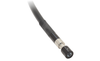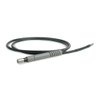
Fiberguide Industries, Inc. Aluminum Jacketed Fiber SFS300/330A

Description
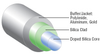
Optical fibers are typically manufactured from a preform consisting of a silica core which may be doped silica or pure silica and a cladding classically of silica having a lower refractive index than the core. An additional layer or coating/buffer is added to prevent the ingress of moisture and other contaminants which would lead to very early failure of the fiber, and increase tensile strength. These coatings/buffers are usually polymers of various types, such as Polyimide, Acrylate, Nylon, and Tefzel™. Metal coated/buffered fibers were originally developed for ultra high reliability telecommunications applications. The metal coating preserves the high initial mechanical strength and provides resistance against static fatigue (the failure under long term tensile loading), and in particular Aluminum, a hermetic coating to the fiber. In addition to high strength, metal coated fibers can be used at very high temperatures. Aluminum coated optical fibers have a rated operating range of -269°C to +400°C. Tight buffered Gold coated fibers have a rated operating range of -269°C to +700°C. Aluminum and Gold coating can be applied on continuous lengths to a wide variety of multimode, step index, graded index, and single mode fibers.
Description
Optical fibers are typically manufactured from a preform consisting of a silica core which may be doped silica or pure silica and a cladding classically of silica having a lower refractive index than the core. An additional layer or coating/buffer is added to prevent the ingress of moisture and other contaminants which would lead to very early failure of the fiber, and increase tensile strength. These coatings/buffers are usually polymers of various types, such as Polyimide, Acrylate, Nylon, and Tefzel™. Metal coated/buffered fibers were originally developed for ultra high reliability telecommunications applications. The metal coating preserves the high initial mechanical strength and provides resistance against static fatigue (the failure under long term tensile loading), and in particular Aluminum, a hermetic coating to the fiber. In addition to high strength, metal coated fibers can be used at very high temperatures. Aluminum coated optical fibers have a rated operating range of -269°C to +400°C. Tight buffered Gold coated fibers have a rated operating range of -269°C to +700°C. Aluminum and Gold coating can be applied on continuous lengths to a wide variety of multimode, step index, graded index, and single mode fibers.

Suppliers

Company
Product
Description
Supplier Links
Aluminum Jacketed Fiber - SFS300/330A - Fiberguide Industries, Inc.
Stirling, NJ, USA
Aluminum Jacketed Fiber
SFS300/330A
Aluminum Jacketed Fiber SFS300/330A
Optical fibers are typically manufactured from a preform consisting of a silica core which may be doped silica or pure silica and a cladding classically of silica having a lower refractive index than the core. An additional layer or coating/buffer is added to prevent the ingress of moisture and other contaminants which would lead to very early failure of the fiber, and increase tensile strength. These coatings/buffers are usually polymers of various types, such as Polyimide, Acrylate, Nylon, and Tefzel™. Metal coated/buffered fibers were originally developed for ultra high reliability telecommunications applications. The metal coating preserves the high initial mechanical strength and provides resistance against static fatigue (the failure under long term tensile loading), and in particular Aluminum, a hermetic coating to the fiber. In addition to high strength, metal coated fibers can be used at very high temperatures. Aluminum coated optical fibers have a rated operating range of -269°C to +400°C. Tight buffered Gold coated fibers have a rated operating range of -269°C to +700°C. Aluminum and Gold coating can be applied on continuous lengths to a wide variety of multimode, step index, graded index, and single mode fibers.

Optical fibers are typically manufactured from a preform consisting of a silica core which may be doped silica or pure silica and a cladding classically of silica having a lower refractive index than the core. An additional layer or coating/buffer is added to prevent the ingress of moisture and other contaminants which would lead to very early failure of the fiber, and increase tensile strength. These coatings/buffers are usually polymers of various types, such as Polyimide, Acrylate, Nylon, and Tefzel™. Metal coated/buffered fibers were originally developed for ultra high reliability telecommunications applications. The metal coating preserves the high initial mechanical strength and provides resistance against static fatigue (the failure under long term tensile loading), and in particular Aluminum, a hermetic coating to the fiber. In addition to high strength, metal coated fibers can be used at very high temperatures. Aluminum coated optical fibers have a rated operating range of -269°C to +400°C. Tight buffered Gold coated fibers have a rated operating range of -269°C to +700°C. Aluminum and Gold coating can be applied on continuous lengths to a wide variety of multimode, step index, graded index, and single mode fibers.

Technical Specifications

  Fiberguide Industries, Inc.
Product Category Light Guides
Product Number SFS300/330A
Product Name Aluminum Jacketed Fiber
Light Guide Type Fiber Optic
Angle Flexible
Diameter 0.3000 mm (0.0118 inch)
Core Material Silica / Quartz
Unlock Full Specs
to access all available technical data

Similar Products

UV Curing Light Guides and Adapters - OmniCure S Series - Excelitas Technologies Corp.
Specs
Light Guide Type Liquid (optional feature); Fiber Optic (optional feature)
Angle Flexible
View Details
Light Pipes - 2007099-4 - TE Connectivity
Specs
Operating Temp -55 to 105 C (-67 to 221 F)
View Details
Liquid Light Guide, 79 in., 340-800 nm, 0.2 in. Core, 0.59 NA - 77569 - Newport MKS
Specs
Light Guide Type Liquid; Fiber Optic
Length 2000 mm (78.74 inch)
Diameter 5.1 mm (0.2008 inch)
View Details