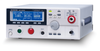
The GPT-9903 is a HiPot from Instek. HiPot, or high potential, is a class of electronic test equipment used to verify electrical insulation. Engineers use HiPot-testing instruments on cables, wires, circuit boards, appliances, electric motors, and transformers. As a product ages, its insulation may break down and result in current flow leakage. HiPot testers keep engineers safe from current leakages by detecting gaps and defects in the electronic device. Dielectric Testers, Insulation Testers, and Megohmmeters are similar to HiPot testers. Popular manufacturers include Biddle, Megger, Fluke, Associated Research, Quadtech, Instek, and Slaughter.
Additional Features:
AC 500VA AC/DC Withstanding Voltage/Insulation Resistance Tester
240 x 64 Ice Blue Dot matrix LCD
Sweep Function for DUT characteristic analysis
Manual/Auto Mode
Function Key for quick selection
High intensity flash for caution & Status indication
Safety INTERLOCK function
Zero Crossing Turn-on Operation
Controllable Ramp-up Time
True RMS Current Measurement
High resolution: 1uA for measuring current, 2V for setting voltage
PWM amplifier to enhance the power efficiency and reliable testing
Max. 100 memory block for test condition (step) setting
Each step can be named individually
Remote terminal on the front panel for “start” and “stop” control
Rear panel output available
Interface: RS-232C, USB device, Signal I/O and GPIB (optional)
The Instek GPT-9903 AC 500VA AC/DC Withstanding Voltage/ Insulation Resistance Tester supports the major test items among all the needed for the compliance of the safety standards such as IEC, EN, UL, CSA, GB, JIS and other safety regulations.
The high-efficiency PWM amplifier is the core of Instek GPT-9903 platform design to impede the influence from the voltage fluctuation of input AC source. The output voltage is automatically cut off (within 150μs) upon the detection of an abnormal output voltage or a trip of current limits during test to protect the operator from hazardous injury. It automatically discharges the DUT after each test to eliminate excessive voltage that remains on the DUT.
The GPT-9903 is a HiPot from Instek. HiPot, or high potential, is a class of electronic test equipment used to verify electrical insulation. Engineers use HiPot-testing instruments on cables, wires, circuit boards, appliances, electric motors, and transformers. As a product ages, its insulation may break down and result in current flow leakage. HiPot testers keep engineers safe from current leakages by detecting gaps and defects in the electronic device. Dielectric Testers, Insulation Testers, and Megohmmeters are similar to HiPot testers. Popular manufacturers include Biddle, Megger, Fluke, Associated Research, Quadtech, Instek, and Slaughter.
Additional Features:
- AC 500VA AC/DC Withstanding Voltage/Insulation Resistance Tester
- 240 x 64 Ice Blue Dot matrix LCD
- Sweep Function for DUT characteristic analysis
- Manual/Auto Mode
- Function Key for quick selection
- High intensity flash for caution & Status indication
- Safety INTERLOCK function
- Zero Crossing Turn-on Operation
- Controllable Ramp-up Time
- True RMS Current Measurement
- High resolution: 1uA for measuring current, 2V for setting voltage
- PWM amplifier to enhance the power efficiency and reliable testing
- Max. 100 memory block for test condition (step) setting
- Each step can be named individually
- Remote terminal on the front panel for “start” and “stop” control
- Rear panel output available
- Interface: RS-232C, USB device, Signal I/O and GPIB (optional)
The Instek GPT-9903 AC 500VA AC/DC Withstanding Voltage/ Insulation Resistance Tester supports the major test items among all the needed for the compliance of the safety standards such as IEC, EN, UL, CSA, GB, JIS and other safety regulations.
The high-efficiency PWM amplifier is the core of Instek GPT-9903 platform design to impede the influence from the voltage fluctuation of input AC source. The output voltage is automatically cut off (within 150μs) upon the detection of an abnormal output voltage or a trip of current limits during test to protect the operator from hazardous injury. It automatically discharges the DUT after each test to eliminate excessive voltage that remains on the DUT.