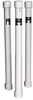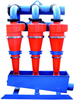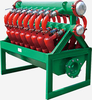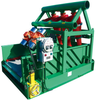
GN Solids control Co., Ltd. Desander

Description
GN Solids Control offers desanders for two different industry and system. Their desanders are used for oil gas drilling, CBM drilling mud solids control, as well as contruction operations for No dig, Bored Pile drilling deander for bentonite recycling. Oil and Gas GN desander is the second class and the third class solid control equipment to treat the drilling fluid. According to the size of the cone diameter, it is divided into Desander and Desilter. Usually the cone diameter is more than 6′is called Desander, and used as the second-control equipment in drilling operation. We commonly used 8 "and 10" cones desander to separate solid-phase particle size 47-76μm in the drilling fluids Hydrocyclones are also called cyclone separators. Hydrocyclones consist of a desander(10 in. cone) and a desilter(4 in. cone) and are used to separate sand and silt from the drilling fluid. The desander is installed after shakers and degasser units but before the desilter. Desanders remove abrassive solids from the drilling mud which cannot be removed by shakers. Desanders, as stated earlier, have no moving parts. The larger the internal diameter (ID) of the desander is, the greater the amount of fluid it is able to process and the larger the size of the solids removed. Desanders (10 in.cone) are able to remove roughly 50 percent of those solids within the 40-50 micron range at a flow rate of 500 gallons per min (gal/min), while desilters (4 in. Cone) are able to remove approximately 50 percent of those solids within the 15-20 micron range at a flow rate of 60 gal/min. Micro fine separators are able to remove around 50 percent of those solids within the 10-15 micron range at a flow rate of 15 gal/min. Desanders are typically positioned next-to-last in the arrangement of solids control equipment, with a decanting centrifuge as the subsequent processing unit. Desander are preceded by gas busters, gumbo removal equipment (if utilized), shale shakers, mud cleaners (if utilized) and vacuum degassers. Desanders are widely used in oilfield drilling. Construction Bored piles are cast in place cylindrical piles excavated either by use of rotary equipment operated augers , buckets, under static drilling fluid or large drill bit (for hard rock) with reverse circulation.The reason to use desander unit is that Bored piles installed in common soil with the presence of water table, generally require the use of a short temporary steel casing and a drilling fluid as static suspension to provide support to the surrounding soil while excavating the pile and until complete backfill of the pile excavation with concrete, in order to prevent cave-in of the excavation and destabilizing the surrounding soil formation.GN Bored Pile desander is to separate the sands from the drilling fluids and recycling the drilling fluids for use.
Description
GN Solids Control offers desanders for two different industry and system. Their desanders are used for oil gas drilling, CBM drilling mud solids control, as well as contruction operations for No dig, Bored Pile drilling deander for bentonite recycling. Oil and Gas GN desander is the second class and the third class solid control equipment to treat the drilling fluid. According to the size of the cone diameter, it is divided into Desander and Desilter. Usually the cone diameter is more than 6′is called Desander, and used as the second-control equipment in drilling operation. We commonly used 8 "and 10" cones desander to separate solid-phase particle size 47-76μm in the drilling fluids Hydrocyclones are also called cyclone separators. Hydrocyclones consist of a desander(10 in. cone) and a desilter(4 in. cone) and are used to separate sand and silt from the drilling fluid. The desander is installed after shakers and degasser units but before the desilter. Desanders remove abrassive solids from the drilling mud which cannot be removed by shakers. Desanders, as stated earlier, have no moving parts. The larger the internal diameter (ID) of the desander is, the greater the amount of fluid it is able to process and the larger the size of the solids removed. Desanders (10 in.cone) are able to remove roughly 50 percent of those solids within the 40-50 micron range at a flow rate of 500 gallons per min (gal/min), while desilters (4 in. Cone) are able to remove approximately 50 percent of those solids within the 15-20 micron range at a flow rate of 60 gal/min. Micro fine separators are able to remove around 50 percent of those solids within the 10-15 micron range at a flow rate of 15 gal/min. Desanders are typically positioned next-to-last in the arrangement of solids control equipment, with a decanting centrifuge as the subsequent processing unit. Desander are preceded by gas busters, gumbo removal equipment (if utilized), shale shakers, mud cleaners (if utilized) and vacuum degassers. Desanders are widely used in oilfield drilling. Construction Bored piles are cast in place cylindrical piles excavated either by use of rotary equipment operated augers , buckets, under static drilling fluid or large drill bit (for hard rock) with reverse circulation.The reason to use desander unit is that Bored piles installed in common soil with the presence of water table, generally require the use of a short temporary steel casing and a drilling fluid as static suspension to provide support to the surrounding soil while excavating the pile and until complete backfill of the pile excavation with concrete, in order to prevent cave-in of the excavation and destabilizing the surrounding soil formation.GN Bored Pile desander is to separate the sands from the drilling fluids and recycling the drilling fluids for use.

Suppliers

Company
Product
Description
Supplier Links
Desander -  - GN Solids control Co., Ltd.
Langfang, China
Desander
Desander
GN Solids Control offers desanders for two different industry and system. Their desanders are used for oil gas drilling, CBM drilling mud solids control, as well as contruction operations for No dig, Bored Pile drilling deander for bentonite recycling. Oil and Gas GN desander is the second class and the third class solid control equipment to treat the drilling fluid. According to the size of the cone diameter, it is divided into Desander and Desilter. Usually the cone diameter is more than 6′is called Desander, and used as the second-control equipment in drilling operation. We commonly used 8 "and 10" cones desander to separate solid-phase particle size 47-76μm in the drilling fluids Hydrocyclones are also called cyclone separators. Hydrocyclones consist of a desander(10 in. cone) and a desilter(4 in. cone) and are used to separate sand and silt from the drilling fluid. The desander is installed after shakers and degasser units but before the desilter. Desanders remove abrassive solids from the drilling mud which cannot be removed by shakers. Desanders, as stated earlier, have no moving parts. The larger the internal diameter (ID) of the desander is, the greater the amount of fluid it is able to process and the larger the size of the solids removed. Desanders (10 in.cone) are able to remove roughly 50 percent of those solids within the 40-50 micron range at a flow rate of 500 gallons per min (gal/min), while desilters (4 in. Cone) are able to remove approximately 50 percent of those solids within the 15-20 micron range at a flow rate of 60 gal/min. Micro fine separators are able to remove around 50 percent of those solids within the 10-15 micron range at a flow rate of 15 gal/min. Desanders are typically positioned next-to-last in the arrangement of solids control equipment, with a decanting centrifuge as the subsequent processing unit. Desander are preceded by gas busters, gumbo removal equipment (if utilized), shale shakers, mud cleaners (if utilized) and vacuum degassers. Desanders are widely used in oilfield drilling. Construction Bored piles are cast in place cylindrical piles excavated either by use of rotary equipment operated augers , buckets, under static drilling fluid or large drill bit (for hard rock) with reverse circulation.The reason to use desander unit is that Bored piles installed in common soil with the presence of water table, generally require the use of a short temporary steel casing and a drilling fluid as static suspension to provide support to the surrounding soil while excavating the pile and until complete backfill of the pile excavation with concrete, in order to prevent cave-in of the excavation and destabilizing the surrounding soil formation.GN Bored Pile desander is to separate the sands from the drilling fluids and recycling the drilling fluids for use.

GN Solids Control offers desanders for two different industry and system. Their desanders are used for oil gas drilling, CBM drilling mud solids control, as well as contruction operations for No dig, Bored Pile drilling deander for bentonite recycling.

Oil and Gas

GN desander is the second class and the third class solid control equipment to treat the drilling fluid. According to the size of the cone diameter, it is divided into Desander and Desilter. Usually the cone diameter is more than 6″is called Desander, and used as the second-control equipment in drilling operation. We commonly used 8 "and 10" cones desander to separate solid-phase particle size 47-76μm in the drilling fluids

Hydrocyclones are also called cyclone separators. Hydrocyclones consist of a desander(10 in. cone) and a desilter(4 in. cone) and are used to separate sand and silt from the drilling fluid. The desander is installed after shakers and degasser units but before the desilter. Desanders remove abrassive solids from the drilling mud which cannot be removed by shakers.

Desanders, as stated earlier, have no moving parts. The larger the internal diameter (ID) of the desander is, the greater the amount of fluid it is able to process and the larger the size of the solids removed. Desanders (10 in.cone) are able to remove roughly 50 percent of those solids within the 40-50 micron range at a flow rate of 500 gallons per min (gal/min), while desilters (4 in. Cone) are able to remove approximately 50 percent of those solids within the 15-20 micron range at a flow rate of 60 gal/min. Micro fine separators are able to remove around 50 percent of those solids within the 10-15 micron range at a flow rate of 15 gal/min. Desanders are typically positioned next-to-last in the arrangement of solids control equipment, with a decanting centrifuge as the subsequent processing unit. Desander are preceded by gas busters, gumbo removal equipment (if utilized), shale shakers, mud cleaners (if utilized) and vacuum degassers. Desanders are widely used in oilfield drilling.

Construction

Bored piles are cast in place cylindrical piles excavated either by use of rotary equipment operated augers , buckets, under static drilling fluid or large drill bit (for hard rock) with reverse circulation.The reason to use desander unit is that Bored piles installed in common soil with the presence of water table, generally require the use of a short temporary steel casing and a drilling fluid as static suspension to provide support to the surrounding soil while excavating the pile and until complete backfill of the pile excavation with concrete, in order to prevent cave-in of the excavation and destabilizing the surrounding soil formation.GN Bored Pile desander is to separate the sands from the drilling fluids and recycling the drilling fluids for use.

Supplier's Site

Technical Specifications

  GN Solids control Co., Ltd.
Product Category Desanders and Desilters
Product Name Desander
Unlock Full Specs
to access all available technical data

Similar Products

Hydrocyclones -  - National Oilwell Varco
National Oilwell Varco
View Details
Desilter -  - GN Solids control Co., Ltd.
GN Solids control Co., Ltd.
View Details
Pump Protection Desanders (PPD) -  - LAKOS Separators and Filtration Systems
LAKOS Separators and Filtration Systems
View Details