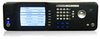
The 2540B is a 40 GHz RF Generator from Gigatronics. An RF generator is a tool engineers use to generate sinusoidal outputs while testing electronic equipment. The output will automatically have its frequency varied or swept between frequencies. A “sweep” is one complete cycle of a frequency variation. Engineers use RF signal generators as test equipment, mostly to measure responses of filters, amplifiers, and electrical components.
Additional Features:
Frequency range: 2 GHz to 40 GHz
Output power: +13 dBm at 40 GHz
+10 dBm with Step Attenuator option at 50 GHz
Standard Low Phase Noise: -109 dBc/Hz at 10 GHz and 10 kHz offset
High Stability Time Base for outstanding frequency accuracy
Frequency resolution: 0.001 Hz
Harmonics: < -55 dBc
Sub-harmonics: < -60 dBc
Spurious: < -58 dBc
Phase Modulation Rate: 100 Hz to 100 kHz; Peak Dev 10 rad-pk/N
Pulse Burst mode: 1 to 300 pulses/burst
Set pulse width, rep rate and burst period
Power Boost mode option
USB and Ethernet LAN interface
Emulation Modes, now standard on all 2500B series Microwave Signal Generators (not all of the commands are available)
The 2540B Microwave Signal Generator is a high-performance CW and swept frequency signal source covering the frequency range of 100 kHz to 40 GHz, with high signal purity, high output power, fast frequency switching speed and a full suite of analog modulation capability. The 2540B Microwave Signal Generator features high time base stability, frequency resolution of 0.001 Hz and ultra-low phase noise, harmonics and spurious for applications requiring clean pure signals. Modulation capability includes amplitude modulation (AM), frequency modulation (FM), phase modulation and high-speed pulse modulation (PM) with pulse width as low as 10 ns. Remote programming capability is over GPIB (IEEE-488) or Ethernet LAN.
The 2540B is a 40 GHz RF Generator from Gigatronics. An RF generator is a tool engineers use to generate sinusoidal outputs while testing electronic equipment. The output will automatically have its frequency varied or swept between frequencies. A “sweep” is one complete cycle of a frequency variation. Engineers use RF signal generators as test equipment, mostly to measure responses of filters, amplifiers, and electrical components.
Additional Features:
- Frequency range: 2 GHz to 40 GHz
- Output power: +13 dBm at 40 GHz
- +10 dBm with Step Attenuator option at 50 GHz
- Standard Low Phase Noise: -109 dBc/Hz at 10 GHz and 10 kHz offset
- High Stability Time Base for outstanding frequency accuracy
- Frequency resolution: 0.001 Hz
- Harmonics: < -55 dBc
- Sub-harmonics: < -60 dBc
- Spurious: < -58 dBc
- Phase Modulation Rate: 100 Hz to 100 kHz; Peak Dev 10 rad-pk/N
- Pulse Burst mode: 1 to 300 pulses/burst
- Set pulse width, rep rate and burst period
- Power Boost mode option
- USB and Ethernet LAN interface
- Emulation Modes, now standard on all 2500B series Microwave Signal Generators (not all of the commands are available)
The 2540B Microwave Signal Generator is a high-performance CW and swept frequency signal source covering the frequency range of 100 kHz to 40 GHz, with high signal purity, high output power, fast frequency switching speed and a full suite of analog modulation capability. The 2540B Microwave Signal Generator features high time base stability, frequency resolution of 0.001 Hz and ultra-low phase noise, harmonics and spurious for applications requiring clean pure signals. Modulation capability includes amplitude modulation (AM), frequency modulation (FM), phase modulation and high-speed pulse modulation (PM) with pulse width as low as 10 ns. Remote programming capability is over GPIB (IEEE-488) or Ethernet LAN.