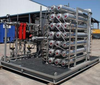
GENERON Natural Gas Dehydration Systems

Description
At the rig, natural gases are nearly always saturated with water. When water-saturated natural gas flows in a pipeline the following problems can occur: Water can collect in pipelines and increase the pressure drop and/or cause slug flow. Water can freeze and/or form solid hydrates, consequently reducing the gas flow or plugging the line. Acid gases (H2S & CO2) dissolve in free water and will cause severe corrosion. Ideally dehydrating the gas by heating, chemical addition, solid desiccant and membrane dehydration mitigates these problems and improves safety. GENERON offers the following efficient and cost effective solutions for process gas: Membrane Dehydration In GENERON® membrane gas dehydration systems, the feed gas is filtered to remove any trapped liquids and aerosols. The gas then enters the GENERON® membrane filters, where the H2O, CO2 and H2S permeate through the membrane. The non-permeated gas, mainly CH4, remains at process pressure and becomes the product gas. Membrane Dehydration Ideal Pressure: Up to 1,000 psig Ideal Temperature: < 160°F / 71°C Flow Rate: 0.01 to 500 MMSCFD Dew Point: -40°F / -40°C
Description
At the rig, natural gases are nearly always saturated with water. When water-saturated natural gas flows in a pipeline the following problems can occur: Water can collect in pipelines and increase the pressure drop and/or cause slug flow. Water can freeze and/or form solid hydrates, consequently reducing the gas flow or plugging the line. Acid gases (H2S & CO2) dissolve in free water and will cause severe corrosion. Ideally dehydrating the gas by heating, chemical addition, solid desiccant and membrane dehydration mitigates these problems and improves safety. GENERON offers the following efficient and cost effective solutions for process gas: Membrane Dehydration In GENERON® membrane gas dehydration systems, the feed gas is filtered to remove any trapped liquids and aerosols. The gas then enters the GENERON® membrane filters, where the H2O, CO2 and H2S permeate through the membrane. The non-permeated gas, mainly CH4, remains at process pressure and becomes the product gas. Membrane Dehydration Ideal Pressure: Up to 1,000 psig Ideal Temperature: < 160°F / 71°C Flow Rate: 0.01 to 500 MMSCFD Dew Point: -40°F / -40°C

Suppliers

Company
Product
Description
Supplier Links
Natural Gas Dehydration Systems -  - GENERON
Houston, TX, USA
Natural Gas Dehydration Systems
At the rig, natural gases are nearly always saturated with water. When water-saturated natural gas flows in a pipeline the following problems can occur: Water can collect in pipelines and increase the pressure drop and/or cause slug flow. Water can freeze and/or form solid hydrates, consequently reducing the gas flow or plugging the line. Acid gases (H2S & CO2) dissolve in free water and will cause severe corrosion. Ideally dehydrating the gas by heating, chemical addition, solid desiccant and membrane dehydration mitigates these problems and improves safety. GENERON offers the following efficient and cost effective solutions for process gas: Membrane Dehydration In GENERON® membrane gas dehydration systems, the feed gas is filtered to remove any trapped liquids and aerosols. The gas then enters the GENERON® membrane filters, where the H2O, CO2 and H2S permeate through the membrane. The non-permeated gas, mainly CH4, remains at process pressure and becomes the product gas. Membrane Dehydration Ideal Pressure: Up to 1,000 psig Ideal Temperature: < 160°F / 71°C Flow Rate: 0.01 to 500 MMSCFD Dew Point: -40°F / -40°C

At the rig, natural gases are nearly always saturated with water. When water-saturated natural gas flows in a pipeline the following problems can occur:

  • Water can collect in pipelines and increase the pressure drop and/or cause slug flow.
  • Water can freeze and/or form solid hydrates, consequently reducing the gas flow or plugging the line.
  • Acid gases (H2S & CO2) dissolve in free water and will cause severe corrosion.

Ideally dehydrating the gas by heating, chemical addition, solid desiccant and membrane dehydration mitigates these problems and improves safety. GENERON offers the following efficient and cost effective solutions for process gas:

Membrane Dehydration

In GENERON® membrane gas dehydration systems, the feed gas is filtered to remove any trapped liquids and aerosols. The gas then enters the GENERON® membrane filters, where the H2O, CO2 and H2S permeate through the membrane. The non-permeated gas, mainly CH4, remains at process pressure and becomes the product gas.

Membrane Dehydration

  • Ideal Pressure: Up to 1,000 psig
  • Ideal Temperature: < 160°F / 71°C
  • Flow Rate: 0.01 to 500 MMSCFD
  • Dew Point: -40°F / -40°C
Supplier's Site

Technical Specifications

  GENERON
Product Category Gas Dryers, Filters, and Purifiers
Product Name Natural Gas Dehydration Systems
Type Gas Dryer; In-line
Unlock Full Specs
to access all available technical data

Similar Products

Thermon EnviroDyne™ Methane Destruction Unit - MDH101 - Thermon, Inc
Specs
Type WireMesh
Flow Rate (Gas) 0 SCFM (0.2833 m³/hr)
View Details
PRISM® PA Nitrogen Membrane Separator Module with ⅜-inch BSPP Connections - PA3020-N1-3B-00 - Air Products PRISM Membranes
Specs
Type In-line
Application / Industry Aerospace / Defense; Food or Beverage Processing; Medical; Marine, Oil & Gas, Military, Packaging, and Transportation
Filter Medium Material Synthetic Fiber
View Details
Barb to Barb Standard In-line Filter - AP19FV0018P2L - ARKPLAS
Specs
Type In-line
Application / Industry Food or Beverage Processing
Filter Medium Material HDPE 4913
View Details
Specs
Application / Industry Biopharmaceutical
Housing Material Steel - Stainless
Additional Features FDA
View Details