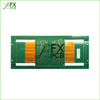
FX PCB Co., Ltd. Rigid Flex PCB 2L

Description
Description Rigid-Flex PCB Capability: Contents show 1 Rigid-Flex PCB Capability: 2 Rigid-flex Attributes: 3 Why you need to choose the Flex PCB? Items Mass Production Low Volume Total Layers 2~16L 20L Layers of sofe 10L 16L PCB Thickness ≤2.4mm / Line width/Line space Inner layer 3mil/3mil (HOz) 2.5mil/2.5mil (HOz) Outer layer 4mil/4mil (1Oz) 3mil/3mil (1Oz) Hole Ring ≥6mil 4mil Impedance Control +/-10% / Drilling Machine drilling ≥8mil 6mil Laser drilling 5mil/6mil 4mil Aspect Ratio 10:01 16:01 Surface Coating ENIG, Immersion Silver, Immersion Tin, OSP Rigid-flex Attributes: Material Fr4+PI Layers 2L Copper thickness 1oz Board thickness 1.6mm Surface treatment HAL Leadfree Track width/Space 5/5mil Hole size 0.3mm Why you need to choose the Flex PCB? Flex PCBs are incredibly space-saving. In fact, it only requires 10% of space compared to the conventional standard PCBs. It offers great freedom when it comes to packaging and installation. You can achieve the tightest blend capacity with the flex PCBs. Its permeability and flexibility offer such bending. The flex boards work with only a minimal number of interconnections. Fewer connections mean the PCB will need fewer solder joints and contact crimps. It implies that fewer loopholes are resulting in the least failures. Thus, it dramatically enhances the reliability of the components. It works with every possible connector and component available in the market. Also, it works better with ZIP connectors. So, you get enhanced capabilities with the use of these circuits. The flexible circuits are made to function under extreme and challenging conditions. So, these circuits won’t face reduced performance even when the temperature is high or in the presence of chemicals and radiation. To put it simply, these are temperature, chemical, and radiation-resistant. Flexible circuits have fewer connections and components. Also, it comes in a smaller size. All these results in an extreme saving of flexible PCB cost. So, you can save a considerable amount with the flexible circuits.
Request a Quote
Description
Description Rigid-Flex PCB Capability: Contents show 1 Rigid-Flex PCB Capability: 2 Rigid-flex Attributes: 3 Why you need to choose the Flex PCB? Items Mass Production Low Volume Total Layers 2~16L 20L Layers of sofe 10L 16L PCB Thickness ≤2.4mm / Line width/Line space Inner layer 3mil/3mil (HOz) 2.5mil/2.5mil (HOz) Outer layer 4mil/4mil (1Oz) 3mil/3mil (1Oz) Hole Ring ≥6mil 4mil Impedance Control +/-10% / Drilling Machine drilling ≥8mil 6mil Laser drilling 5mil/6mil 4mil Aspect Ratio 10:01 16:01 Surface Coating ENIG, Immersion Silver, Immersion Tin, OSP Rigid-flex Attributes: Material Fr4+PI Layers 2L Copper thickness 1oz Board thickness 1.6mm Surface treatment HAL Leadfree Track width/Space 5/5mil Hole size 0.3mm Why you need to choose the Flex PCB? Flex PCBs are incredibly space-saving. In fact, it only requires 10% of space compared to the conventional standard PCBs. It offers great freedom when it comes to packaging and installation. You can achieve the tightest blend capacity with the flex PCBs. Its permeability and flexibility offer such bending. The flex boards work with only a minimal number of interconnections. Fewer connections mean the PCB will need fewer solder joints and contact crimps. It implies that fewer loopholes are resulting in the least failures. Thus, it dramatically enhances the reliability of the components. It works with every possible connector and component available in the market. Also, it works better with ZIP connectors. So, you get enhanced capabilities with the use of these circuits. The flexible circuits are made to function under extreme and challenging conditions. So, these circuits won’t face reduced performance even when the temperature is high or in the presence of chemicals and radiation. To put it simply, these are temperature, chemical, and radiation-resistant. Flexible circuits have fewer connections and components. Also, it comes in a smaller size. All these results in an extreme saving of flexible PCB cost. So, you can save a considerable amount with the flexible circuits.
Request a Quote

Suppliers

Company
Product
Description
Supplier Links
Rigid Flex PCB 2L -  - FX PCB Co., Ltd.
Shenzhen, Guangdong, China
Rigid Flex PCB 2L
Rigid Flex PCB 2L
Description Rigid-Flex PCB Capability: Contents show 1 Rigid-Flex PCB Capability: 2 Rigid-flex Attributes: 3 Why you need to choose the Flex PCB? Items Mass Production Low Volume Total Layers 2~16L 20L Layers of sofe 10L 16L PCB Thickness ≤2.4mm / Line width/Line space Inner layer 3mil/3mil (HOz) 2.5mil/2.5mil (HOz) Outer layer 4mil/4mil (1Oz) 3mil/3mil (1Oz) Hole Ring ≥6mil 4mil Impedance Control +/-10% / Drilling Machine drilling ≥8mil 6mil Laser drilling 5mil/6mil 4mil Aspect Ratio 10:01 16:01 Surface Coating ENIG, Immersion Silver, Immersion Tin, OSP Rigid-flex Attributes: Material Fr4+PI Layers 2L Copper thickness 1oz Board thickness 1.6mm Surface treatment HAL Leadfree Track width/Space 5/5mil Hole size 0.3mm Why you need to choose the Flex PCB? Flex PCBs are incredibly space-saving. In fact, it only requires 10% of space compared to the conventional standard PCBs. It offers great freedom when it comes to packaging and installation. You can achieve the tightest blend capacity with the flex PCBs. Its permeability and flexibility offer such bending. The flex boards work with only a minimal number of interconnections. Fewer connections mean the PCB will need fewer solder joints and contact crimps. It implies that fewer loopholes are resulting in the least failures. Thus, it dramatically enhances the reliability of the components. It works with every possible connector and component available in the market. Also, it works better with ZIP connectors. So, you get enhanced capabilities with the use of these circuits. The flexible circuits are made to function under extreme and challenging conditions. So, these circuits won’t face reduced performance even when the temperature is high or in the presence of chemicals and radiation. To put it simply, these are temperature, chemical, and radiation-resistant. Flexible circuits have fewer connections and components. Also, it comes in a smaller size. All these results in an extreme saving of flexible PCB cost. So, you can save a considerable amount with the flexible circuits.

Description


Rigid-Flex PCB Capability:

Contents show
1 Rigid-Flex PCB Capability:
2 Rigid-flex Attributes:
3 Why you need to choose the Flex PCB?
Items Mass Production Low Volume
Total Layers 2~16L 20L
Layers of sofe 10L 16L
PCB Thickness ≤2.4mm /
Line width/Line space Inner layer 3mil/3mil (HOz) 2.5mil/2.5mil (HOz)
Outer layer 4mil/4mil (1Oz) 3mil/3mil (1Oz)
Hole Ring ≥6mil 4mil
Impedance Control +/-10% /
Drilling Machine drilling ≥8mil 6mil
Laser drilling 5mil/6mil 4mil
Aspect Ratio 10:01 16:01
Surface Coating ENIG, Immersion Silver, Immersion Tin, OSP

Rigid-flex Attributes:

Material Fr4+PI
Layers 2L
Copper thickness 1oz
Board thickness 1.6mm
Surface treatment HAL Leadfree
Track width/Space 5/5mil
Hole size 0.3mm

Why you need to choose the Flex PCB?

  1. Flex PCBs are incredibly space-saving. In fact, it only requires 10% of space compared to the conventional standard PCBs. It offers great freedom when it comes to packaging and installation.
  2. You can achieve the tightest blend capacity with the flex PCBs. Its permeability and flexibility offer such bending.
  3. The flex boards work with only a minimal number of interconnections. Fewer connections mean the PCB will need fewer solder joints and contact crimps. It implies that fewer loopholes are resulting in the least failures. Thus, it dramatically enhances the reliability of the components.
  4. It works with every possible connector and component available in the market. Also, it works better with ZIP connectors. So, you get enhanced capabilities with the use of these circuits.
  5. The flexible circuits are made to function under extreme and challenging conditions. So, these circuits won’t face reduced performance even when the temperature is high or in the presence of chemicals and radiation. To put it simply, these are temperature, chemical, and radiation-resistant.
  6. Flexible circuits have fewer connections and components. Also, it comes in a smaller size. All these results in an extreme saving of flexible PCB cost. So, you can save a considerable amount with the flexible circuits.

Supplier's Site

Technical Specifications

  FX PCB Co., Ltd.
Product Category Printed Circuit Substrate Materials (PCB / PWB)
Product Name Rigid Flex PCB 2L
Type Film / Flexible; Rigid
Unlock Full Specs
to access all available technical data

Similar Products

Rigid PCB / Fr4 PCB Manufacturer -  - FX PCB Co., Ltd.
Specs
Type Rigid
Materials FR-4, Kingboard, Nanya, Shengyi, Rogers, Isola, ITEQ, Ventec, Arlon
Thickness 0.0079 to 0.3150 inches (0.2000 to 8 mm)
View Details
400W/MK Copper Base PCB -  - FX PCB Co., Ltd.
Specs
Materials Aluminum Foil; Copper Foil; Domestic Aluminum,Domestic copper,lmported aluminum, lmported copper
Thickness 0.0197 to 0.1969 inches (0.5000 to 5 mm)
View Details