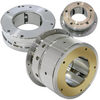
FTL Technology Composite Bearings

Description
Composite bearings are manufactured from thermosetting resins reinforced with synthetic fibres. The physical and mechanical properties of this composite material make it an excellent bearing material. By varying the fabric reinforcement and the resin used, the physical and chemical properties of the semi-finished compound can be adjusted to suit a wide range of applications, including the Food & Pharmaceuticals, Oil & Gas and Transportation industries. All grades can be manufactured to include a solid lubricant for applications that are either dry running or have only marginal levels of system lubrication. Grades contain either graphite, PTFE or molybdenum disulphide, dispersed evenly throughout the material so that surface wear continually releases additional lubrication. FTL Technology composite bearings are highly recommended for use where traditional types of lubricant are not permitted, or are intermittent. The chemical resistance of FTL Technology composite materials allows many process liquors and solvents to be used as lubricants. Light or heavy mineral oils, vegetable oils, soluble oils and greases are satisfactory as lubrication media. The surface texture of a resin bonded composite material helps to retain lubricant and as a consequence, maintains a continuous lubrication film on the working surface. Certain grades of composite bearing material have extremely low rates of moisture absorption and therefore negligible dimensional change. This makes them ideally suited for use in submerged water applications. Composite bearings achieve their finished dimensions using traditional machining systems. This gives the designer a high degree of flexibility to produce a finished part which is perfectly aligned to the application in question. Advantages of Composite Bearings: High strength High rigidity Low water absorption High dimensional stability High solvent resistance Low coefficient of friction Common Applications of Composite Bearings: Hydraulic cylinder bearings Valve spindles Hot and cold water pumps Vertical pumps Chemical pumps Passenger lifts Suspension struts

Suppliers

Company
Product
Description
Supplier Links
Composite Bearings -  - FTL Technology
Morley, United Kingdom
Composite Bearings
Composite Bearings
Composite bearings are manufactured from thermosetting resins reinforced with synthetic fibres. The physical and mechanical properties of this composite material make it an excellent bearing material. By varying the fabric reinforcement and the resin used, the physical and chemical properties of the semi-finished compound can be adjusted to suit a wide range of applications, including the Food & Pharmaceuticals, Oil & Gas and Transportation industries. All grades can be manufactured to include a solid lubricant for applications that are either dry running or have only marginal levels of system lubrication. Grades contain either graphite, PTFE or molybdenum disulphide, dispersed evenly throughout the material so that surface wear continually releases additional lubrication. FTL Technology composite bearings are highly recommended for use where traditional types of lubricant are not permitted, or are intermittent. The chemical resistance of FTL Technology composite materials allows many process liquors and solvents to be used as lubricants. Light or heavy mineral oils, vegetable oils, soluble oils and greases are satisfactory as lubrication media. The surface texture of a resin bonded composite material helps to retain lubricant and as a consequence, maintains a continuous lubrication film on the working surface. Certain grades of composite bearing material have extremely low rates of moisture absorption and therefore negligible dimensional change. This makes them ideally suited for use in submerged water applications. Composite bearings achieve their finished dimensions using traditional machining systems. This gives the designer a high degree of flexibility to produce a finished part which is perfectly aligned to the application in question. Advantages of Composite Bearings: High strength High rigidity Low water absorption High dimensional stability High solvent resistance Low coefficient of friction Common Applications of Composite Bearings: Hydraulic cylinder bearings Valve spindles Hot and cold water pumps Vertical pumps Chemical pumps Passenger lifts Suspension struts

Composite bearings are manufactured from thermosetting resins reinforced with synthetic fibres. The physical and mechanical properties of this composite material make it an excellent bearing material. By varying the fabric reinforcement and the resin used, the physical and chemical properties of the semi-finished compound can be adjusted to suit a wide range of applications, including the Food & Pharmaceuticals, Oil & Gas and Transportation industries.

All grades can be manufactured to include a solid lubricant for applications that are either dry running or have only marginal levels of system lubrication.

Grades contain either graphite, PTFE or molybdenum disulphide, dispersed evenly throughout the material so that surface wear continually releases additional lubrication. FTL Technology composite bearings are highly recommended for use where traditional types of lubricant are not permitted, or are intermittent.

The chemical resistance of FTL Technology composite materials allows many process liquors and solvents to be used as lubricants. Light or heavy mineral oils, vegetable oils, soluble oils and greases are satisfactory as lubrication media. The surface texture of a resin bonded composite material helps to retain lubricant and as a consequence, maintains a continuous lubrication film on the working surface.

Certain grades of composite bearing material have extremely low rates of moisture absorption and therefore negligible dimensional change. This makes them ideally suited for use in submerged water applications.

Composite bearings achieve their finished dimensions using traditional machining systems. This gives the designer a high degree of flexibility to produce a finished part which is perfectly aligned to the application in question.

Advantages of Composite Bearings:

  • High strength
  • High rigidity
  • Low water absorption
  • High dimensional stability
  • High solvent resistance
  • Low coefficient of friction

Common Applications of Composite Bearings:

  • Hydraulic cylinder bearings
  • Valve spindles
  • Hot and cold water pumps
  • Vertical pumps
  • Chemical pumps
  • Passenger lifts
  • Suspension struts
Supplier's Site

Technical Specifications

  FTL Technology
Product Category Plain Bearings and Sleeve Bearings
Product Name Composite Bearings
Bushing Type Sleeve
Unlock Full Specs
to access all available technical data

Similar Products

Taper Lock Bushes - 1465456 - RS Components, Ltd.
RS Components, Ltd.
Specs
Design Units Metric
Shaft OD 1.6535 inch (42.00 mm)
Bearing OD 3.3661 inch (85.50 mm)
View Details
Custom Tilt Pad Fluid Film Journal Bearings -  - Waukesha Bearings
Specs
Bushing Type Sleeve; Flanged
Bearing Surface Standard Pads Have Babbitt Lining; (Lined Bearing Surface)
Body Standard Pads are Steel
View Details
Guide Roller Bushings Eccentric - BX-1 - Modern Linear Incorporated
Modern Linear Incorporated
Specs
Bushing Type Flanged
Design Units Inch
Bearing ID 0.1400 inch (3.56 mm)
View Details
IRR: Inner Ring Races - IRR-1/2-1 - Accurate Bushing Company, Inc.
Accurate Bushing Company, Inc.
Specs
Bushing Type Sleeve
Design Units Inch
Bearing ID 0.5000 inch (12.70 mm)
View Details