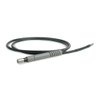
Fiberoptics Technology, Inc. Photoelectric Control Cable GDS-125-BF-36

Description
For some types of sensing applications, fiber optic components are used to transmit and receive a light signal, carrying the signal back to a photo sensor, which in turn, actuates an electric control. The overall process senses and reacts to a difference in light intensity to confirm the absence/presence/pos ition of an object. Fiber optic components protect photoelectric sensors (from heat and harsh environments) and facilitates their use in space-restrictive areas. They may also be used to isolate vibration, keeping the sensor stable in continuous motion applications. Because fiber optic components can be shaped to match the profile of the object being sensed, they help improve the accuracy of photoelectric control. Application potential is extensive, sometimes requiring special treatment of the fiber for high temperature, high vacuum and wet/corrosive environments. Fiber optic cables may be made from plastic or glass fibers. Glass cables can transmit infrared wavelengths, and will withstand more abuse. Plastic has better resistance to fatigue in constant motion applications, and may be less expensive to produce.
Datasheet
Description
For some types of sensing applications, fiber optic components are used to transmit and receive a light signal, carrying the signal back to a photo sensor, which in turn, actuates an electric control. The overall process senses and reacts to a difference in light intensity to confirm the absence/presence/pos ition of an object. Fiber optic components protect photoelectric sensors (from heat and harsh environments) and facilitates their use in space-restrictive areas. They may also be used to isolate vibration, keeping the sensor stable in continuous motion applications. Because fiber optic components can be shaped to match the profile of the object being sensed, they help improve the accuracy of photoelectric control. Application potential is extensive, sometimes requiring special treatment of the fiber for high temperature, high vacuum and wet/corrosive environments. Fiber optic cables may be made from plastic or glass fibers. Glass cables can transmit infrared wavelengths, and will withstand more abuse. Plastic has better resistance to fatigue in constant motion applications, and may be less expensive to produce.
Datasheet

Suppliers

Company
Product
Description
Supplier Links
Photoelectric Control Cable - GDS-125-BF-36 - Fiberoptics Technology, Inc.
Pomfret, CT, USA
Photoelectric Control Cable
GDS-125-BF-36
Photoelectric Control Cable GDS-125-BF-36
For some types of sensing applications, fiber optic components are used to transmit and receive a light signal, carrying the signal back to a photo sensor, which in turn, actuates an electric control. The overall process senses and reacts to a difference in light intensity to confirm the absence/presence/pos ition of an object. Fiber optic components protect photoelectric sensors (from heat and harsh environments) and facilitates their use in space-restrictive areas. They may also be used to isolate vibration, keeping the sensor stable in continuous motion applications. Because fiber optic components can be shaped to match the profile of the object being sensed, they help improve the accuracy of photoelectric control. Application potential is extensive, sometimes requiring special treatment of the fiber for high temperature, high vacuum and wet/corrosive environments. Fiber optic cables may be made from plastic or glass fibers. Glass cables can transmit infrared wavelengths, and will withstand more abuse. Plastic has better resistance to fatigue in constant motion applications, and may be less expensive to produce.

For some types of sensing applications, fiber optic components are used to transmit and receive a light signal, carrying the signal back to a photo sensor, which in turn, actuates an electric control. The overall process senses and reacts to a difference in light intensity to confirm the absence/presence/position of an object.

Fiber optic components protect photoelectric sensors (from heat and harsh environments) and facilitates their use in space-restrictive areas. They may also be used to isolate vibration, keeping the sensor stable in continuous motion applications.

Because fiber optic components can be shaped to match the profile of the object being sensed, they help improve the accuracy of photoelectric control.

Application potential is extensive, sometimes requiring special treatment of the fiber for high temperature, high vacuum and wet/corrosive environments.

Fiber optic cables may be made from plastic or glass fibers. Glass cables can transmit infrared wavelengths, and will withstand more abuse. Plastic has better resistance to fatigue in constant motion applications, and may be less expensive to produce.

Supplier's Site Datasheet

Technical Specifications

  Fiberoptics Technology, Inc.
Product Category Light Guides
Product Number GDS-125-BF-36
Product Name Photoelectric Control Cable
Light Guide Type Fiber Optic
Angle Straight
Light Guide Features Multileg
Length 914 mm (36 inch)
Diameter 6.35 mm (0.2500 inch)
Unlock Full Specs
to access all available technical data

Similar Products

Liquid Light Guide, 79 in., 220-600 nm, 0.2 in. Core, 0.43 NA - 76843 - Newport MKS
Specs
Light Guide Type Liquid; Fiber Optic
Length 2000 mm (78.74 inch)
Diameter 5.1 mm (0.2008 inch)
View Details
Light Guides -  - Dymax
Specs
Angle Flexible
View Details
Light Pipes - 2325080-6 - TE Connectivity
Specs
Operating Temp -55 to 85 C (-67 to 185 F)
View Details
UV Curing Light Guides and Adapters - OmniCure S Series - Excelitas Technologies Corp.
Specs
Light Guide Type Liquid (optional feature); Fiber Optic (optional feature)
Angle Flexible
View Details