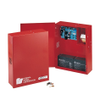
Electro Standards Laboratories Hybrid Power Management Unit (HPMU) Model 1041

Description
Hybrid Unit allows Battery Life to be Extended Applicable to Portable Communications Devices Military Communications & Other Applications The Model 1041 Hybrid Power Management Unit combines the strength of a high-power capacitor and a high energy battery. A power management board integrates the two energy-storage devices and provides the user with a light-weight, high performance, and safe power source. This hybrid technology greatly benefits pulsed power load systems that are typically supported by “battery-only” systems. Battery technologies are inherently energy dense systems with limited power capability. Where energy transfer to the load is equal, primary and secondary chemistries have shown reduced performance when subjected to pulsed loading as compared to operation at low constant rates. Primary chemistries exhibit reduced discharge time or usable capacity while secondary chemistries suffer from both reduced usable capacity as well as reduced cycle life. The hybrid technology pairs the energy dense battery system with the power dense ESL Hybrid Power Management Unit (HPMU) to improve overall system performance. The HPMU contains ESL’s hybrid power management circuitry and a high-power Super Capacitor (SCap) element. The HPMU enables the battery system to operate at a reduced rate supporting the baseline load and the recharge of the SCap while the SCap is utilized to support peak pulse requirements of the load. The result is improved lifetime, reduced battery heating, and extended cycle life of the battery system.
Datasheet
Description
Hybrid Unit allows Battery Life to be Extended Applicable to Portable Communications Devices Military Communications & Other Applications The Model 1041 Hybrid Power Management Unit combines the strength of a high-power capacitor and a high energy battery. A power management board integrates the two energy-storage devices and provides the user with a light-weight, high performance, and safe power source. This hybrid technology greatly benefits pulsed power load systems that are typically supported by “battery-only” systems. Battery technologies are inherently energy dense systems with limited power capability. Where energy transfer to the load is equal, primary and secondary chemistries have shown reduced performance when subjected to pulsed loading as compared to operation at low constant rates. Primary chemistries exhibit reduced discharge time or usable capacity while secondary chemistries suffer from both reduced usable capacity as well as reduced cycle life. The hybrid technology pairs the energy dense battery system with the power dense ESL Hybrid Power Management Unit (HPMU) to improve overall system performance. The HPMU contains ESL’s hybrid power management circuitry and a high-power Super Capacitor (SCap) element. The HPMU enables the battery system to operate at a reduced rate supporting the baseline load and the recharge of the SCap while the SCap is utilized to support peak pulse requirements of the load. The result is improved lifetime, reduced battery heating, and extended cycle life of the battery system.
Datasheet

Suppliers

Company
Product
Description
Supplier Links
Hybrid Power Management Unit (HPMU) - Model 1041 - Electro Standards Laboratories
Cranston, RI, USA
Hybrid Power Management Unit (HPMU)
Model 1041
Hybrid Power Management Unit (HPMU) Model 1041
Hybrid Unit allows Battery Life to be Extended Applicable to Portable Communications Devices Military Communications & Other Applications The Model 1041 Hybrid Power Management Unit combines the strength of a high-power capacitor and a high energy battery. A power management board integrates the two energy-storage devices and provides the user with a light-weight, high performance, and safe power source. This hybrid technology greatly benefits pulsed power load systems that are typically supported by “battery-only” systems. Battery technologies are inherently energy dense systems with limited power capability. Where energy transfer to the load is equal, primary and secondary chemistries have shown reduced performance when subjected to pulsed loading as compared to operation at low constant rates. Primary chemistries exhibit reduced discharge time or usable capacity while secondary chemistries suffer from both reduced usable capacity as well as reduced cycle life. The hybrid technology pairs the energy dense battery system with the power dense ESL Hybrid Power Management Unit (HPMU) to improve overall system performance. The HPMU contains ESL’s hybrid power management circuitry and a high-power Super Capacitor (SCap) element. The HPMU enables the battery system to operate at a reduced rate supporting the baseline load and the recharge of the SCap while the SCap is utilized to support peak pulse requirements of the load. The result is improved lifetime, reduced battery heating, and extended cycle life of the battery system.
  • Hybrid Unit allows Battery Life to be Extended
  • Applicable to Portable Communications Devices
  • Military Communications & Other Applications

The Model 1041 Hybrid Power Management Unit combines the strength of a high-power capacitor and a high energy battery. A power management board integrates the two energy-storage devices and provides the user with a light-weight, high performance, and safe power source. This hybrid technology greatly benefits pulsed power load systems that are typically supported by “battery-only” systems. Battery technologies are inherently energy dense systems with limited power capability. Where energy transfer to the load is equal, primary and secondary chemistries have shown reduced performance when subjected to pulsed loading as compared to operation at low constant rates. Primary chemistries exhibit reduced discharge time or usable capacity while secondary chemistries suffer from both reduced usable capacity as well as reduced cycle life. The hybrid technology pairs the energy dense battery system with the power dense ESL Hybrid Power Management Unit (HPMU) to improve overall system performance. The HPMU contains ESL’s hybrid power management circuitry and a high-power Super Capacitor (SCap) element. The HPMU enables the battery system to operate at a reduced rate supporting the baseline load and the recharge of the SCap while the SCap is utilized to support peak pulse requirements of the load. The result is improved lifetime, reduced battery heating, and extended cycle life of the battery system.

Supplier's Site Datasheet

Technical Specifications

  Electro Standards Laboratories
Product Category Power Supplies
Product Number Model 1041
Product Name Hybrid Power Management Unit (HPMU)
Type DC Power System
Form Factor Desktop / Free Standing
Applications Portable Communications Devices, Military Communications, and More
Features Adjustable Voltage; Contains a 1500F Lithium Ion Capacitor (LiC)
DC Output Voltage 12.0 to 24.0 volts
Unlock Full Specs
to access all available technical data

Similar Products

Type 78.1D - Switch mode power supply - 781D12302415 - Finder S.p.A. con unico socio
Specs
Type DC Power Supply
Technology Switching Power Supply
Operating Temperature -20 to 70 C (-4 to 158 F)
View Details
Industrial Power Adaptor - IRA-90 - Volktek Corporation
Specs
Operating Temperature -30 to 70 C (-22 to 158 F)
DC Output Voltage 48.0 volts
DC Output Current 1.87 amps
View Details
Current Source Power Unit - 4102C - Hottinger Brüel & Kjær A/S
Hottinger Brüel & Kjær A/S
Specs
Type Current Source
View Details