Electro Optical Components, Inc. Lyot Depolarizer

Description
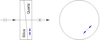
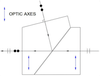
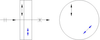
The Lyot depolarizer is assembled from two or more plates of birefringent material. In each plate the optic axis of the crystal lies in the plane of the plate and is orientated at 45° to the axis of the previous plate. The plates are manufactured in a geometric sequence of thicknesses, each plate being twice the thickness of the next thinnest plate. In the simplest case of two plates, one is just twice the thickness of the other. A three plate Lyot depolarizer requires one plate of thickness “t”, one of thickness “2.t” and one of thickness “4.t”. Depolarization is obtained through the production of varying amounts of circular and elliptical polarization states at different wavelengths. The depolarization effect is poor for monochromatic light as even with a large number of plates in the stack there are only a limited number of polarization states produced. By contrast, a polychromatic source will produce an effectively infinite number of polarization states and thus depolarization is strong, even with just two plates. Lyot depolarizer, available in Quartz, calcite etc. Lyot depolarizers can be manufactured in just about any birefringent material, but most applications are covered by either quartz or calcite. Quartz is particularly suitable for applications extending into the ultra-violet and we can provide optically contacted components for minimum insertion loss. For applications where calcite is more suitable, we can provide either cemented or even air spaced components (but calcite is not suitable for optical contacting).
Request a Quote
Description
The Lyot depolarizer is assembled from two or more plates of birefringent material. In each plate the optic axis of the crystal lies in the plane of the plate and is orientated at 45° to the axis of the previous plate. The plates are manufactured in a geometric sequence of thicknesses, each plate being twice the thickness of the next thinnest plate. In the simplest case of two plates, one is just twice the thickness of the other. A three plate Lyot depolarizer requires one plate of thickness “t”, one of thickness “2.t” and one of thickness “4.t”. Depolarization is obtained through the production of varying amounts of circular and elliptical polarization states at different wavelengths. The depolarization effect is poor for monochromatic light as even with a large number of plates in the stack there are only a limited number of polarization states produced. By contrast, a polychromatic source will produce an effectively infinite number of polarization states and thus depolarization is strong, even with just two plates. Lyot depolarizer, available in Quartz, calcite etc. Lyot depolarizers can be manufactured in just about any birefringent material, but most applications are covered by either quartz or calcite. Quartz is particularly suitable for applications extending into the ultra-violet and we can provide optically contacted components for minimum insertion loss. For applications where calcite is more suitable, we can provide either cemented or even air spaced components (but calcite is not suitable for optical contacting).
Request a Quote

Suppliers

Company
Product
Description
Supplier Links
Lyot Depolarizer -  - Electro Optical Components, Inc.
Santa Rosa, CA, USA
Lyot Depolarizer
Lyot Depolarizer
The Lyot depolarizer is assembled from two or more plates of birefringent material. In each plate the optic axis of the crystal lies in the plane of the plate and is orientated at 45° to the axis of the previous plate. The plates are manufactured in a geometric sequence of thicknesses, each plate being twice the thickness of the next thinnest plate. In the simplest case of two plates, one is just twice the thickness of the other. A three plate Lyot depolarizer requires one plate of thickness “t”, one of thickness “2.t” and one of thickness “4.t”. Depolarization is obtained through the production of varying amounts of circular and elliptical polarization states at different wavelengths. The depolarization effect is poor for monochromatic light as even with a large number of plates in the stack there are only a limited number of polarization states produced. By contrast, a polychromatic source will produce an effectively infinite number of polarization states and thus depolarization is strong, even with just two plates. Lyot depolarizer, available in Quartz, calcite etc. Lyot depolarizers can be manufactured in just about any birefringent material, but most applications are covered by either quartz or calcite. Quartz is particularly suitable for applications extending into the ultra-violet and we can provide optically contacted components for minimum insertion loss. For applications where calcite is more suitable, we can provide either cemented or even air spaced components (but calcite is not suitable for optical contacting).

The Lyot depolarizer is assembled from two or more plates of birefringent material. In each plate the optic axis of the crystal lies in the plane of the plate and is orientated at 45° to the axis of the previous plate. The plates are manufactured in a geometric sequence of thicknesses, each plate being twice the thickness of the next thinnest plate. In the simplest case of two plates, one is just twice the thickness of the other. A three plate Lyot depolarizer requires one plate of thickness “t”, one of thickness “2.t” and one of thickness “4.t”.

Depolarization is obtained through the production of varying amounts of circular and elliptical polarization states at different wavelengths. The depolarization effect is poor for monochromatic light as even with a large number of plates in the stack there are only a limited number of polarization states produced. By contrast, a polychromatic source will produce an effectively infinite number of polarization states and thus depolarization is strong, even with just two plates.

Lyot depolarizer, available in Quartz, calcite etc.
Lyot depolarizers can be manufactured in just about any birefringent material, but most applications are covered by either quartz or calcite. Quartz is particularly suitable for applications extending into the ultra-violet and we can provide optically contacted components for minimum insertion loss. For applications where calcite is more suitable, we can provide either cemented or even air spaced components (but calcite is not suitable for optical contacting).

Supplier's Site

Technical Specifications

  Electro Optical Components, Inc.
Product Category Optical Polarizers
Product Name Lyot Depolarizer
Optical Polarizer Depolarizer
Unlock Full Specs
to access all available technical data

Similar Products

Wedge Depolarizer -  - Electro Optical Components, Inc.
Electro Optical Components, Inc.
Specs
Optical Polarizer Depolarizer
View Details
Quartz Optical Rotators -  - Electro Optical Components, Inc.
Electro Optical Components, Inc.
Specs
Optical Polarizer Polarization Rotator
View Details
Low Order Quartz Retardation Plates -  - Electro Optical Components, Inc.
Electro Optical Components, Inc.
Specs
Optical Polarizer Waveplate / Retardation Plate
Polarizer Features Anti-Reflection Coating (optional feature)
Surface Quality 20-10 Scratch / Dig
View Details
Savart Plates -  - Electro Optical Components, Inc.
Electro Optical Components, Inc.
Specs
Optical Polarizer Waveplate / Retardation Plate
Clear Aperture 10 to 50 mm (0.3937 to 1.97 inch)
View Details