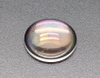
These lenses are thicker at the edge than in the centre and flat on one side. The plano-concave lenses are used to expand light beams or to increase focal lengths in optical systems. They are often employed for beam expansion of high peak power pulsed lasers. A beam incident on a concave surface will be focused to a point outside the instrument.
Air heating and ionization at the unwanted focal point are possible with attendant mode disruption or material damage. To avoid this problem, the input lens should be reversed so that no concave surface faces a parallel beam.
A variety of anti-reflection coatings is available for these lenses.
Have negative focal lengths
Diverge collimated incident light
Forms only virtual images which are seen through the lens
Reduce spherical aberration, coma and distortion at negative-infinite or near-infinite conjugate ratios
With the concave surface facing the longest conjugate distance
These lenses are thicker at the edge than in the centre and flat on one side. The plano-concave lenses are used to expand light beams or to increase focal lengths in optical systems. They are often employed for beam expansion of high peak power pulsed lasers. A beam incident on a concave surface will be focused to a point outside the instrument.
Air heating and ionization at the unwanted focal point are possible with attendant mode disruption or material damage. To avoid this problem, the input lens should be reversed so that no concave surface faces a parallel beam.
A variety of anti-reflection coatings is available for these lenses.
- Have negative focal lengths
- Diverge collimated incident light
- Forms only virtual images which are seen through the lens
- Reduce spherical aberration, coma and distortion at negative-infinite or near-infinite conjugate ratios
- With the concave surface facing the longest conjugate distance