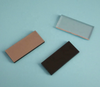
Edmund Optics Inc. Mounted Absorptive ND Filter 0.6 OD M72.0 x 0.75 NT65-020

Description
Spectrally Flat from 400-700nm Homogeneous Glass: Blocks by Absorption Light/Exposure Control for Imaging Neutral Density (ND) filters appear gray in color and reduce the amount of light reaching the camera's sensor. Since the transmission value only varies over a small percent in the visible, there is no effect on color balance. Instead of just stopping down the lens aperture due to high light levels, ND filters allow for wider apertures which can be used to decrease the depth of field. This allows the important information to be separated from the background. Compared to polarizing filters, ND filters are ideal for overall light reduction in cases of extreme light intensity. By stacking filters, it is possible to achieve other Optical Density (OD) values. All mounted filters can be threaded together with identical male and female threads on each mount. Optical Density exhibits an additive relationship; for example, stacking filters with OD values of 0.6 and 0.9 yields a resultant density of 1.5. The optical density is related to the transmission by the following equation: T = 10-D x 100 = percent transmission.
Description
Spectrally Flat from 400-700nm Homogeneous Glass: Blocks by Absorption Light/Exposure Control for Imaging Neutral Density (ND) filters appear gray in color and reduce the amount of light reaching the camera's sensor. Since the transmission value only varies over a small percent in the visible, there is no effect on color balance. Instead of just stopping down the lens aperture due to high light levels, ND filters allow for wider apertures which can be used to decrease the depth of field. This allows the important information to be separated from the background. Compared to polarizing filters, ND filters are ideal for overall light reduction in cases of extreme light intensity. By stacking filters, it is possible to achieve other Optical Density (OD) values. All mounted filters can be threaded together with identical male and female threads on each mount. Optical Density exhibits an additive relationship; for example, stacking filters with OD values of 0.6 and 0.9 yields a resultant density of 1.5. The optical density is related to the transmission by the following equation: T = 10-D x 100 = percent transmission.

Suppliers

Company
Product
Description
Supplier Links
Barrington, NJ, USA
Mounted Absorptive ND Filter 0.6 OD M72.0 x 0.75
NT65-020
Mounted Absorptive ND Filter 0.6 OD M72.0 x 0.75 NT65-020
Spectrally Flat from 400-700nm Homogeneous Glass: Blocks by Absorption Light/Exposure Control for Imaging Neutral Density (ND) filters appear gray in color and reduce the amount of light reaching the camera's sensor. Since the transmission value only varies over a small percent in the visible, there is no effect on color balance. Instead of just stopping down the lens aperture due to high light levels, ND filters allow for wider apertures which can be used to decrease the depth of field. This allows the important information to be separated from the background. Compared to polarizing filters, ND filters are ideal for overall light reduction in cases of extreme light intensity. By stacking filters, it is possible to achieve other Optical Density (OD) values. All mounted filters can be threaded together with identical male and female threads on each mount. Optical Density exhibits an additive relationship; for example, stacking filters with OD values of 0.6 and 0.9 yields a resultant density of 1.5. The optical density is related to the transmission by the following equation: T = 10-D x 100 = percent transmission.
  • Spectrally Flat from 400-700nm
  • Homogeneous Glass: Blocks by Absorption
  • Light/Exposure Control for Imaging

Neutral Density (ND) filters appear gray in color and reduce the amount of light reaching the camera's sensor. Since the transmission value only varies over a small percent in the visible, there is no effect on color balance. Instead of just stopping down the lens aperture due to high light levels, ND filters allow for wider apertures which can be used to decrease the depth of field. This allows the important information to be separated from the background. Compared to polarizing filters, ND filters are ideal for overall light reduction in cases of extreme light intensity. By stacking filters, it is possible to achieve other Optical Density (OD) values. All mounted filters can be threaded together with identical male and female threads on each mount. Optical Density exhibits an additive relationship; for example, stacking filters with OD values of 0.6 and 0.9 yields a resultant density of 1.5. The optical density is related to the transmission by the following equation: T = 10-D x 100 = percent transmission.

Supplier's Site

Technical Specifications

  Edmund Optics Inc.
Product Category Optical Filters
Product Number NT65-020
Product Name Mounted Absorptive ND Filter 0.6 OD M72.0 x 0.75
Filter Type Neutral Density Filters
Unlock Full Specs
to access all available technical data

Similar Products

ND Filter for Camera Lens on the Drone -  - Suzhou Jiujon Optics Co., Ltd
Suzhou Jiujon Optics Co., Ltd
Specs
Filter Type Neutral Density Filters
Application Visible
Filter Shape Circular
View Details
Colored Glass Filters -  - CeNing Optics Co., Ltd.
CeNing Optics Co., Ltd.
Specs
Filter Type Color Filters; Bandpass / Interference Filters; Broadband, Long-wave
Application Infrared; Visible; Ultraviolet
Filter Shape Circular; Square; Rectangular
View Details
Gurley Precision Instruments
Specs
Filter Type Neutral Density Filters
Application Infrared; Visible
Filter Shape Circular
View Details
607.6-1 OD7 Ultra Narrow Bandpass Filter - 7087 - Alluxa, Inc.
Specs
Filter Type Bandpass / Interference Filters
Filter Shape Circular
Filter Diameter, Side Length, or Rectangular Length 25.3 mm (0.9961 inch)
View Details