Edmund Optics Inc. 1200 Grooves, 36.9 Deg Dispersion Angle Grating, 12.7mm Sq NT49-578

Description
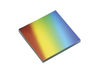
Low Polarization Sensitivity Ideal for In-Line Configurations Transmission Gratings are designed to disperse incident light at specific angles. Angular dispersion is a function of angle of incidence and groove spacing. Dispersion increases as angle of incidence increases or as groove spacing decreases. Coarse groove spacing maintains high efficiency while fine groove spacing reduces transmission at long wavelengths resulting in low efficiency.Transmiss ion gratings offer low polarization sensitivity as opposed to reflection gratings because incident light is not reflected by a mirror coating such as aluminum. Since light is transmitted through the grating, transmission gratings can be used in compact, in-line configurations. They are ideal for use in monochromators and spectrometers.Transm ission gratings are manufactured in the same way as ruled reflection gratings in which a replica of a master grating is created by duplicating its grooved surface with a thin, vacuum deposition-coated layer, except they have no reflective overcoat. Uncoated transmission gratings provide high efficiency over a long wavelength range while Anti-Reflection (AR) coated gratings increase performance at a specific wavelength. AR coated versions are available upon request; please contact our Applications Engineering Department.
Description
Low Polarization Sensitivity Ideal for In-Line Configurations Transmission Gratings are designed to disperse incident light at specific angles. Angular dispersion is a function of angle of incidence and groove spacing. Dispersion increases as angle of incidence increases or as groove spacing decreases. Coarse groove spacing maintains high efficiency while fine groove spacing reduces transmission at long wavelengths resulting in low efficiency.Transmiss ion gratings offer low polarization sensitivity as opposed to reflection gratings because incident light is not reflected by a mirror coating such as aluminum. Since light is transmitted through the grating, transmission gratings can be used in compact, in-line configurations. They are ideal for use in monochromators and spectrometers.Transm ission gratings are manufactured in the same way as ruled reflection gratings in which a replica of a master grating is created by duplicating its grooved surface with a thin, vacuum deposition-coated layer, except they have no reflective overcoat. Uncoated transmission gratings provide high efficiency over a long wavelength range while Anti-Reflection (AR) coated gratings increase performance at a specific wavelength. AR coated versions are available upon request; please contact our Applications Engineering Department.

Suppliers

Company
Product
Description
Supplier Links
Barrington, NJ, USA
1200 Grooves, 36.9 Deg Dispersion Angle Grating, 12.7mm Sq
NT49-578
1200 Grooves, 36.9 Deg Dispersion Angle Grating, 12.7mm Sq NT49-578
Low Polarization Sensitivity Ideal for In-Line Configurations Transmission Gratings are designed to disperse incident light at specific angles. Angular dispersion is a function of angle of incidence and groove spacing. Dispersion increases as angle of incidence increases or as groove spacing decreases. Coarse groove spacing maintains high efficiency while fine groove spacing reduces transmission at long wavelengths resulting in low efficiency.Transmiss ion gratings offer low polarization sensitivity as opposed to reflection gratings because incident light is not reflected by a mirror coating such as aluminum. Since light is transmitted through the grating, transmission gratings can be used in compact, in-line configurations. They are ideal for use in monochromators and spectrometers.Transm ission gratings are manufactured in the same way as ruled reflection gratings in which a replica of a master grating is created by duplicating its grooved surface with a thin, vacuum deposition-coated layer, except they have no reflective overcoat. Uncoated transmission gratings provide high efficiency over a long wavelength range while Anti-Reflection (AR) coated gratings increase performance at a specific wavelength. AR coated versions are available upon request; please contact our Applications Engineering Department.

  • Low Polarization Sensitivity
  • Ideal for In-Line Configurations

Transmission Gratings are designed to disperse incident light at specific angles. Angular dispersion is a function of angle of incidence and groove spacing. Dispersion increases as angle of incidence increases or as groove spacing decreases. Coarse groove spacing maintains high efficiency while fine groove spacing reduces transmission at long wavelengths resulting in low efficiency.Transmission gratings offer low polarization sensitivity as opposed to reflection gratings because incident light is not reflected by a mirror coating such as aluminum. Since light is transmitted through the grating, transmission gratings can be used in compact, in-line configurations. They are ideal for use in monochromators and spectrometers.Transmission gratings are manufactured in the same way as ruled reflection gratings in which a replica of a master grating is created by duplicating its grooved surface with a thin, vacuum deposition-coated layer, except they have no reflective overcoat. Uncoated transmission gratings provide high efficiency over a long wavelength range while Anti-Reflection (AR) coated gratings increase performance at a specific wavelength. AR coated versions are available upon request; please contact our Applications Engineering Department.

Supplier's Site

Technical Specifications

  Edmund Optics Inc.
Product Category Diffraction Gratings
Product Number NT49-578
Product Name 1200 Grooves, 36.9 Deg Dispersion Angle Grating, 12.7mm Sq
Wavelength Range Visible
Unlock Full Specs
to access all available technical data

Similar Products

Optics Grating - FRG-1200-2 - CASTECH, Inc.
Specs
Grating Design Spherical Reflection
Wavelength Range Infrared
View Details
Ruled Diffraction Grating, 50 x 50 mm, 500 nm, 2.2° Blaze, 150 g/mm - 33010FL01-201R - Newport MKS
Specs
Grating Type Ruled
Grating Design Plane Reflection
Groove Frequency 150 grooves per mm (3810 grooves per inch)
View Details
Specs
Wavelength Range Visible
Groove Frequency 2400 grooves per mm (60960 grooves per inch)
View Details
Specs
Wavelength Range Visible
Groove Frequency 830 grooves per mm (21082 grooves per inch)
View Details