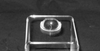
Edmund Optics Inc. Ruby Ball Lens 0.4mm Diameter NT46-224

Description
Excellent for Severe Environments High Strength and Hardness High Chemical Stability Sapphire and Ruby ball lenses are both made from AL203. Ruby or Ruby-Doped sapphire owes its red color to traces of chromium oxide (chromium content for ruby balls is typically <0.5%). While their physical and chemical properties are basically the same, their optical properties are somewhat different. Sapphire has superior optical transmission qualities. Ruby Balls are easier to see and therefore easier to handle for physical applications.For general information about ball lens, as well as how to calculate the NA and Focal Length, view Understanding Ball Lenses.
Description
Excellent for Severe Environments High Strength and Hardness High Chemical Stability Sapphire and Ruby ball lenses are both made from AL203. Ruby or Ruby-Doped sapphire owes its red color to traces of chromium oxide (chromium content for ruby balls is typically <0.5%). While their physical and chemical properties are basically the same, their optical properties are somewhat different. Sapphire has superior optical transmission qualities. Ruby Balls are easier to see and therefore easier to handle for physical applications.For general information about ball lens, as well as how to calculate the NA and Focal Length, view Understanding Ball Lenses.

Suppliers

Company
Product
Description
Supplier Links
Barrington, NJ, USA
Ruby Ball Lens 0.4mm Diameter
NT46-224
Ruby Ball Lens 0.4mm Diameter NT46-224
Excellent for Severe Environments High Strength and Hardness High Chemical Stability Sapphire and Ruby ball lenses are both made from AL203. Ruby or Ruby-Doped sapphire owes its red color to traces of chromium oxide (chromium content for ruby balls is typically <0.5%). While their physical and chemical properties are basically the same, their optical properties are somewhat different. Sapphire has superior optical transmission qualities. Ruby Balls are easier to see and therefore easier to handle for physical applications.For general information about ball lens, as well as how to calculate the NA and Focal Length, view Understanding Ball Lenses.
  • Excellent for Severe Environments
  • High Strength and Hardness
  • High Chemical Stability

Sapphire and Ruby ball lenses are both made from AL203. Ruby or Ruby-Doped sapphire owes its red color to traces of chromium oxide (chromium content for ruby balls is typically <0.5%). While their physical and chemical properties are basically the same, their optical properties are somewhat different. Sapphire has superior optical transmission qualities. Ruby Balls are easier to see and therefore easier to handle for physical applications.For general information about ball lens, as well as how to calculate the NA and Focal Length, view Understanding Ball Lenses.

Supplier's Site

Technical Specifications

  Edmund Optics Inc.
Product Category Optical Lenses
Product Number NT46-224
Product Name Ruby Ball Lens 0.4mm Diameter
Lens Type Ball
Unlock Full Specs
to access all available technical data

Similar Products

Cylindrical Lens, Plano-Convex, N-BK7, 50.8x25.4mm, 75.6mm, 650-1000nm - CKX075AR.16 - Newport MKS
Specs
Lens Type Cylindrical Lens; Spherical Lens
Focal Length 72.27 mm (2.85 inch)
Center Thickness 5.12 mm (0.2016 inch)
View Details
Optical Lenses - Powell Lenses - CeNing Optics Co., Ltd.
CeNing Optics Co., Ltd.
Specs
Lens Type Aspheric; Powell
Lens Application Visible
Center Thickness 7 to 9 mm (0.2756 to 0.3543 inch)
View Details
Precision Aspherical Lenses - G949 - Gurley Precision Instruments
Gurley Precision Instruments
Specs
Lens Type Aspheric; Spherical Lens
Focal Length 12 mm (0.4724 inch)
Center Thickness 8 mm (0.3150 inch)
View Details
Laser Lenses - 6973579 - RS Components, Ltd.
RS Components, Ltd.
Specs
Lens Type Doe
Lens Features Laser / Heat Resistant
View Details