Stock Drive Products & Sterling Instrument - SDP/SI Working Torque is Based on Non-Reversing Applications S50HAM-125P1212

Description
Couplings Types Couplings can be divided into two categories: flexible and rigid. Both types are used to connect two rotating shafts driven by a motor and transmit torque and angular velocity; however, flexible couplings and shafts are designed to accommodate angular misalignment, angular offset, axial movement, and a variety of load conditions. A flexible coupling is pliable due to the twisting and compression of a durable, adaptable material, like neoprene, rubber, or silicone. Flexibility can also be achieved with thin metal disks, corrugated aluminum bellows (bellows couplings), or even a stainless-steel ball (miniature ball couplings). Some materials can provide vibration reduction, as in our precision flexible antivibration couplings. Rigid couplings are limited by comparison; rigid couplings are used when shafts are already positioned in precise lateral and angular alignment. Their rigid design inhibits shaft misalignment. They can generally transmit more power than flexible couplings due to their rigidity. Even the most complicated application challenges can be solved by our skilled engineers, they will identify the best coupling solution for your application. SDP/SI provides a comprehensive range of rigid and flexible couplings. Many of our precision couplings, including the Miniature Bellows Coupling and the Neo-Flex Coupling, have our patented Fairloc® Hub design, which solves phasing, timing, positioning, and frequent removal problems. For more about the easily adjustable Fairloc® hub design click here. Precision Magnetic Disk Couplings Precision Flexible Bellows Couplings Precision Miniature Ball Couplings Precision Flexible Antivibration Couplings 1 2 3 4
Request a Quote
Datasheet
Datasheet Summary
Powered by GS/AI

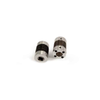
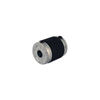
The S50HAM-125P1212 is a flexible helical coupling with one-piece construction, made from 7075-T6 aluminum and alloy steel set screws, finished in clear anodized coating. It has a bore diameter of 0.375 inch for both shafts, an outer diameter of 1.25 inch, and a length of 2.37 inches. It accommodates a maximum angular offset of 5°, lateral offset of 0.030 inch, and axial motion of ±0.010 inch. For non-reversing applications, its dynamic torque rating is 47 lbf·in; for reversing applications, it is 1/4 of that value. The torsional inertia is 1.3 lbf·in·sec² based on the smallest standard bore. It is nonmagnetic, provides constant velocity, and is rated for non-reversing use only.

Suppliers

Company
Product
Description
Supplier Links
Working Torque is Based on Non-Reversing Applications - S50HAM-125P1212 - Stock Drive Products & Sterling Instrument - SDP/SI
Hicksville, NY, United States
Working Torque is Based on Non-Reversing Applications
S50HAM-125P1212
Working Torque is Based on Non-Reversing Applications S50HAM-125P1212
Couplings Types Couplings can be divided into two categories: flexible and rigid. Both types are used to connect two rotating shafts driven by a motor and transmit torque and angular velocity; however, flexible couplings and shafts are designed to accommodate angular misalignment, angular offset, axial movement, and a variety of load conditions. A flexible coupling is pliable due to the twisting and compression of a durable, adaptable material, like neoprene, rubber, or silicone. Flexibility can also be achieved with thin metal disks, corrugated aluminum bellows (bellows couplings), or even a stainless-steel ball (miniature ball couplings). Some materials can provide vibration reduction, as in our precision flexible antivibration couplings. Rigid couplings are limited by comparison; rigid couplings are used when shafts are already positioned in precise lateral and angular alignment. Their rigid design inhibits shaft misalignment. They can generally transmit more power than flexible couplings due to their rigidity. Even the most complicated application challenges can be solved by our skilled engineers, they will identify the best coupling solution for your application. SDP/SI provides a comprehensive range of rigid and flexible couplings. Many of our precision couplings, including the Miniature Bellows Coupling and the Neo-Flex Coupling, have our patented Fairloc® Hub design, which solves phasing, timing, positioning, and frequent removal problems. For more about the easily adjustable Fairloc® hub design click here. Precision Magnetic Disk Couplings Precision Flexible Bellows Couplings Precision Miniature Ball Couplings Precision Flexible Antivibration Couplings 1 2 3 4

Couplings Types

Couplings can be divided into two categories: flexible and rigid. Both types are used to connect two rotating shafts driven by a motor and transmit torque and angular velocity; however, flexible couplings and shafts are designed to accommodate angular misalignment, angular offset, axial movement, and a variety of load conditions. A flexible coupling is pliable due to the twisting and compression of a durable, adaptable material, like neoprene, rubber, or silicone.


Flexibility can also be achieved with thin metal disks, corrugated aluminum bellows (bellows couplings), or even a stainless-steel ball (miniature ball couplings). Some materials can provide vibration reduction, as in our precision flexible antivibration couplings.

Rigid couplings are limited by comparison; rigid couplings are used when shafts are already positioned in precise lateral and angular alignment. Their rigid design inhibits shaft misalignment. They can generally transmit more power than flexible couplings due to their rigidity.

Even the most complicated application challenges can be solved by our skilled engineers, they will identify the best coupling solution for your application. SDP/SI provides a comprehensive range of rigid and flexible couplings. Many of our precision couplings, including the Miniature Bellows Coupling and the Neo-Flex Coupling, have our patented Fairloc® Hub design, which solves phasing, timing, positioning, and frequent removal problems. For more about the easily adjustable Fairloc® hub design click here.


Precision Magnetic Disk Couplings


Precision Flexible Bellows Couplings


Precision Miniature Ball Couplings


Precision Flexible Antivibration Couplings


  • 1
  • 2
  • 3
  • 4
Supplier's Site Datasheet

Technical Specifications

  Stock Drive Products & Sterling Instrument - SDP/SI
Product Category Flexible Couplings
Product Number S50HAM-125P1212
Product Name Working Torque is Based on Non-Reversing Applications
Coupling Type Helical / Slit
Rated Torque 23.5 In-lbs (27.1 kg-cm)
Units English Design
Bore Diameter 0.3750 inch (9.52 mm)
Unlock Full Specs
to access all available technical data

Similar Products

Spider Type Flexible Coupling, 0.25
Specs
Coupling Type Gear / Multi-Jaw; Spider
Rated Torque 48 In-lbs (55.35 kg-cm)
Units English Design
View Details
Any combination of A 5A15M333308,A 5A15M333310,A 5A15M333312, with A 5P15M3333 can be used to form a coupling - A 5A15M333310 - Stock Drive Products & Sterling Instrument - SDP/SI
Specs
Coupling Type Sliding Block
Units Metric Design
Bore Diameter 0.3937 inch (10 mm)
View Details
35mm Overall Length zero Backlash Lattice Type Coupling with 4mm Bore on side A & 4mm Bore on side B - S50CLMM190X04X04 - Stock Drive Products & Sterling Instrument - SDP/SI
Specs
Rated Torque 12.39 In-lbs (14.29 kg-cm)
Units Metric Design
Bore Diameter 0.1575 inch (4 mm)
View Details
PURCHASE WITH A 5Z 1-1112 - A 5Z 1-1112 - Stock Drive Products & Sterling Instrument - SDP/SI
Stock Drive Products & Sterling Instrument - SDP/SI
Specs
Rated Torque 4 In-lbs (4.61 kg-cm)
Rated Speed 25000 rpm
Coupling Diameter 0.8000 inch (20.32 mm)
View Details