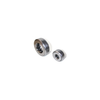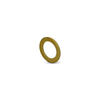
Stock Drive Products & Sterling Instrument - SDP/SI 3.2mm I.D., 9.5mm O.D., 1.6mm Thick, Oil Impregnated Bronze A 7B 7M0316

Description
A bearing is a device that reduces friction between moving components by preventing metal-to-metal contact while assisting components (shafts, axles, and wheels) to freely rotate around a fixed axis, cutting down on heat generation and the amount of energy that is consumed. By replacing sliding motion with low-friction rolling motion, the life of the rotating components is increased. A bearing also keeps the shaft in the proper position, providing support and alignment and transferring the axial or radial loads to the housing. The types of bearings that we offer include rolling element bearings, which consist of both ball bearings and roller bearings. Balls are utilized as the rolling element in ball bearings; a retainer holds the balls in place and allows them to freely rotate. The balls are kept inside channels cut in both the inner and outer races. Because there is no surface contact between the balls and races, precision ball bearings have a lower load capacity for their size than other bearings.
Request a Quote Datasheet
Description
A bearing is a device that reduces friction between moving components by preventing metal-to-metal contact while assisting components (shafts, axles, and wheels) to freely rotate around a fixed axis, cutting down on heat generation and the amount of energy that is consumed. By replacing sliding motion with low-friction rolling motion, the life of the rotating components is increased. A bearing also keeps the shaft in the proper position, providing support and alignment and transferring the axial or radial loads to the housing. The types of bearings that we offer include rolling element bearings, which consist of both ball bearings and roller bearings. Balls are utilized as the rolling element in ball bearings; a retainer holds the balls in place and allows them to freely rotate. The balls are kept inside channels cut in both the inner and outer races. Because there is no surface contact between the balls and races, precision ball bearings have a lower load capacity for their size than other bearings.
Request a Quote Datasheet

Suppliers

Company
Product
Description
Supplier Links
3.2mm I.D., 9.5mm O.D., 1.6mm Thick, Oil Impregnated Bronze - A 7B 7M0316 - Stock Drive Products & Sterling Instrument - SDP/SI
Hicksville, NY, United States
3.2mm I.D., 9.5mm O.D., 1.6mm Thick, Oil Impregnated Bronze
A 7B 7M0316
3.2mm I.D., 9.5mm O.D., 1.6mm Thick, Oil Impregnated Bronze A 7B 7M0316
A bearing is a device that reduces friction between moving components by preventing metal-to-metal contact while assisting components (shafts, axles, and wheels) to freely rotate around a fixed axis, cutting down on heat generation and the amount of energy that is consumed. By replacing sliding motion with low-friction rolling motion, the life of the rotating components is increased. A bearing also keeps the shaft in the proper position, providing support and alignment and transferring the axial or radial loads to the housing. The types of bearings that we offer include rolling element bearings, which consist of both ball bearings and roller bearings. Balls are utilized as the rolling element in ball bearings; a retainer holds the balls in place and allows them to freely rotate. The balls are kept inside channels cut in both the inner and outer races. Because there is no surface contact between the balls and races, precision ball bearings have a lower load capacity for their size than other bearings.

A bearing is a device that reduces friction between moving components by preventing metal-to-metal contact while assisting components (shafts, axles, and wheels) to freely rotate around a fixed axis, cutting down on heat generation and the amount of energy that is consumed. By replacing sliding motion with low-friction rolling motion, the life of the rotating components is increased. A bearing also keeps the shaft in the proper position, providing support and alignment and transferring the axial or radial loads to the housing.

The types of bearings that we offer include rolling element bearings, which consist of both ball bearings and roller bearings.

Balls are utilized as the rolling element in ball bearings; a retainer holds the balls in place and allows them to freely rotate. The balls are kept inside channels cut in both the inner and outer races. Because there is no surface contact between the balls and races, precision ball bearings have a lower load capacity for their size than other bearings.

Supplier's Site Datasheet

Technical Specifications

  Stock Drive Products & Sterling Instrument - SDP/SI
Product Category Thrust Bearings
Product Number A 7B 7M0316
Product Name 3.2mm I.D., 9.5mm O.D., 1.6mm Thick, Oil Impregnated Bronze
Type Thrust Washer
Unlock Full Specs
to access all available technical data

Similar Products

0.05
Stock Drive Products & Sterling Instrument - SDP/SI
Specs
Type Thrust Washer
Design Units Inch
Bore 0.1880 inch (4.775 mm)
View Details