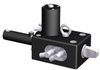
The Dellner Brakes locking devices (LM) have a specially designed tapered pawl that is engaged into a machined slot on the outer peripheral of a brake disc or a shaft flange. The LM devices are equipped with proximity switches for ON/OFF detection. The LM devices are fail safe and can be used to mechanically lock a shaft which allows for safe maintenance procedures to be conducted on or around entire shaft line arrangement.
Examples of applications where Locking Devices (LM) can be used:
Propulsion Shaft lines
Grinding, Rod & Ball Mills etc.
Conveyors
Wind Mills
Dredgers
Advantages
The Dellner Brakes locking devices (LM-series) are compact, tested and delivered as one unit with one mounting interface.
If only a holding function of the shaftline is required, a locking device will be more cost effective and compact when compared to a holding brake solution.
The Dellner LM-series will achieve a higher locking torque compared to other holding brake solutions, as these will involve some friction co-efficient depending on which material is used for holding.
The Dellner Brakes locking devices (LM) have a specially designed tapered pawl that is engaged into a machined slot on the outer peripheral of a brake disc or a shaft flange. The LM devices are equipped with proximity switches for ON/OFF detection.
The LM devices are fail safe and can be used to mechanically lock a shaft which allows for safe maintenance procedures to be conducted on or around entire shaft line arrangement.
Examples of applications where Locking Devices (LM) can be used:
- Propulsion Shaft lines
- Grinding, Rod & Ball Mills etc.
- Conveyors
- Wind Mills
- Dredgers
Advantages
- The Dellner Brakes locking devices (LM-series) are compact, tested and delivered as one unit with one mounting interface.
- If only a holding function of the shaftline is required, a locking device will be more cost effective and compact when compared to a holding brake solution.
- The Dellner LM-series will achieve a higher locking torque compared to other holding brake solutions, as these will involve some friction co-efficient depending on which material is used for holding.