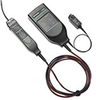
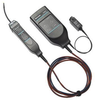
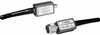
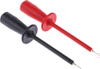
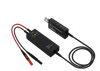
The TIVM02L is a 200 MHz differential probe from Tektronix. A differential probe is an active probe that has two inputs. A negative and positive input along with a ground lead that drives a 50 Ohm cable to transmit the output ot a digital oscilloscope channel.
Additional Features:
Bandwidth/Rise time (Typical): 200 MHz / ≤ 1.8 ns
Fiber cable length: 10 m (32.8 ft)
2,000 V Common Mode Voltage
Up to ±50 V Differential (DC + pk AC)
Output Clamping
Safety Certified
Standard Warranty: 1 year
Applications:
Half/Full Bridge designs using GaN, SiC, IGBTs
Floating Measurements
Power Converter Design
Power Device Evaluation
Switching Power Supply Design
Inverter Design
Motor Drive Design
Electronic Ballast Design
EMI
ESD
Current shunt measurements
Remote probing capability
IsoVu is an ideal solution for users making the following measurements:
Differential measurements in the following conditions: Complete galvanic isolation is required, High common mode voltage, High frequency common mode interference, High frequency measurements.
Measurements in high EMI environments
EMI compliance testing
ESD testing
The Tektronix TIVM Series IsoVu™ Measurement System offers a galvanically isolated measurement solution for accurately resolving high bandwidth, differential signals up to ±50 Vpk in the presence of large common mode voltages with the best in class common mode rejection performance across its bandwidth.
The TIVM Series (IsoVu) products can be used on most Tektronix oscilloscopes with the TekVPI interface and on MSO/DPO70K series oscilloscopes with the TCA-VPI50 adapter. IsoVu utilizes an electro-optic sensor that converts the electrical signal from the sensor tip cables to an optical signal, which electrically isolates the device-under-test from the oscilloscope. IsoVu incorporates four separate lasers, an optical sensor, five optical fibers, and sophisticated feedback and control techniques. The sensor head, which connects to the test point, has complete electrical isolation and is powered over one of the optical fibers (No batteries required).
The TIVM02L is a 200 MHz differential probe from Tektronix. A differential probe is an active probe that has two inputs. A negative and positive input along with a ground lead that drives a 50 Ohm cable to transmit the output ot a digital oscilloscope channel.
Additional Features:
- Bandwidth/Rise time (Typical): 200 MHz / ≤ 1.8 ns
- Fiber cable length: 10 m (32.8 ft)
- 2,000 V Common Mode Voltage
- Up to ±50 V Differential (DC + pk AC)
- Output Clamping
- Safety Certified
- Standard Warranty: 1 year
Applications:
- Half/Full Bridge designs using GaN, SiC, IGBTs
- Floating Measurements
- Power Converter Design
- Power Device Evaluation
- Switching Power Supply Design
- Inverter Design
- Motor Drive Design
- Electronic Ballast Design
- EMI
- ESD
- Current shunt measurements
- Remote probing capability
IsoVu is an ideal solution for users making the following measurements:
- Differential measurements in the following conditions: Complete galvanic isolation is required, High common mode voltage, High frequency common mode interference, High frequency measurements.
- Measurements in high EMI environments
- EMI compliance testing
- ESD testing
The Tektronix TIVM Series IsoVu™ Measurement System offers a galvanically isolated measurement solution for accurately resolving high bandwidth, differential signals up to ±50 Vpk in the presence of large common mode voltages with the best in class common mode rejection performance across its bandwidth.
The TIVM Series (IsoVu) products can be used on most Tektronix oscilloscopes with the TekVPI interface and on MSO/DPO70K series oscilloscopes with the TCA-VPI50 adapter. IsoVu utilizes an electro-optic sensor that converts the electrical signal from the sensor tip cables to an optical signal, which electrically isolates the device-under-test from the oscilloscope. IsoVu incorporates four separate lasers, an optical sensor, five optical fibers, and sophisticated feedback and control techniques. The sensor head, which connects to the test point, has complete electrical isolation and is powered over one of the optical fibers (No batteries required).