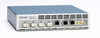
The K18HW-E1 is a probe from Tektronix.
Additional Features:
8x RJ-45 ports for 16 E1/DS1/J1 receivers
(8x bi-directional links)
High-impedance connection
RJ-45 connectors with cables to adapt to all standards (Coax, Bantam, RJ-45, open ends)
Supports ATM monitoring:
HW-based AAL-2 and AAL-5 Reassembly
HW-based Filters (VPI/VCI, UTRAN protocolspecific such as User Plane)
IMA Inverse multiplexing for ATM
Supports PCM monitoring:
512 Timeslots
HW-Based HDLC Framing
HW-based Filters (FISU, FISU and LSSU duplicates, Duplicated MSU due to PCR)
The Tektronix K18HW-E1 probe connects to a PC via Fast/Gigabit Ethernet. The PC performs application measurements and acts as a data archive server. The K18 probes connect to the PC using 10/100/1000Base-T ports. Basic configurations with a laptop or desktop PC and one or two probes are suitable for most field troubleshooting and many design verification activities. In order to meet more demanding needs, larger configurations are made possible through the use of multiple probes, and are controlled by single or multiple users.
The K18HW-E1 is a probe from Tektronix.
Additional Features:
- 8x RJ-45 ports for 16 E1/DS1/J1 receivers
- (8x bi-directional links)
- High-impedance connection
- RJ-45 connectors with cables to adapt to all standards (Coax, Bantam, RJ-45, open ends)
- Supports ATM monitoring:
- HW-based AAL-2 and AAL-5 Reassembly
- HW-based Filters (VPI/VCI, UTRAN protocolspecific such as User Plane)
- IMA Inverse multiplexing for ATM
- Supports PCM monitoring:
- 512 Timeslots
- HW-Based HDLC Framing
- HW-based Filters (FISU, FISU and LSSU duplicates, Duplicated MSU due to PCR)
The Tektronix K18HW-E1 probe connects to a PC via Fast/Gigabit Ethernet. The PC performs application measurements and acts as a data archive server. The K18 probes connect to the PC using 10/100/1000Base-T ports. Basic configurations with a laptop or desktop PC and one or two probes are suitable for most field troubleshooting and many design verification activities. In order to meet more demanding needs, larger configurations are made possible through the use of multiple probes, and are controlled by single or multiple users.