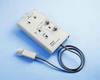
The ADA400A is a 1 MHz Probe Amplifier from Tektronix. Amplify RF and Microwave signals to measure, test, and design circuits. Applications include radio communications, cellphones, EMI testing, and much more.
Additional Features:
Active Differential Preamplifier
10 µV/div Sensitivity
Typically 100 dB CMRR DC to 10 kHz
Integral Probe Power with TEKPROBE™ BNC
Mechanical Analysis
Audio Design
Biomedical Research (Not Certified For Patient Connection)
Medical Equipment (Not Certified For Patient Connection)
The ADA400A Differential Preamplifier allows direct oscilloscope measurements of very low amplitude voltages and signals which are not ground referenced. The high impedance of both inputs eliminates the need to add additional ground points in the DUT, thereby avoiding circulating currents which disturb the measurement or the circuit.
The high gain and extremely high common mode rejection provide usable measurements of voltages as low as 5 µV, even in high noise environments. Selectable bandwidth limiting reduces normal mode noise from digital logic, switch mode power supplies and line frequency sources.
Adjustable differential offset allows the user to null out transducer bridge bias and galvanic potential from the test setup. An "infinite impedance" mode can be selected in the two highest gain ranges allowing accurate measurements of signals with high source impedance.
The ADA400A is a 1 MHz Probe Amplifier from Tektronix. Amplify RF and Microwave signals to measure, test, and design circuits. Applications include radio communications, cellphones, EMI testing, and much more.
Additional Features:
- Active Differential Preamplifier
- 10 µV/div Sensitivity
- Typically 100 dB CMRR DC to 10 kHz
- Integral Probe Power with TEKPROBE™ BNC
- Mechanical Analysis
- Audio Design
- Biomedical Research (Not Certified For Patient Connection)
- Medical Equipment (Not Certified For Patient Connection)
The ADA400A Differential Preamplifier allows direct oscilloscope measurements of very low amplitude voltages and signals which are not ground referenced. The high impedance of both inputs eliminates the need to add additional ground points in the DUT, thereby avoiding circulating currents which disturb the measurement or the circuit.
The high gain and extremely high common mode rejection provide usable measurements of voltages as low as 5 µV, even in high noise environments. Selectable bandwidth limiting reduces normal mode noise from digital logic, switch mode power supplies and line frequency sources.
Adjustable differential offset allows the user to null out transducer bridge bias and galvanic potential from the test setup. An "infinite impedance" mode can be selected in the two highest gain ranges allowing accurate measurements of signals with high source impedance.