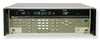
The 6061A is a 1.05 GHz RF Generator from Fluke. An RF generator is a tool engineers use to generate sinusoidal outputs while testing electronic equipment. The output will automatically have its frequency varied or swept between frequencies. A “sweep” is one complete cycle of a frequency variation. Engineers use RF signal generators as test equipment, mostly to measure responses of filters, amplifiers, and electrical components.
Additional Features:
Frequency Range: .01 to 245 MHz; 245 to 512 MHz; 512 to 1050 MHz
1 dB amplitude accuracy
IEEE-488 standard interface
Relative frequency and amplitude modes
“Step” programming and “Bright-Digit” editing
50 watt reverse power protection
Non-volatile memory that can store 50 instrument set-ups
Low microphonics due to heavy weight constructionself diagnostics
Applications
Some appllcation benefits include:
Signal Simulation-a more perfect source: The 6061A's low SSB phase noise: typically -123 dBc/Hz at 500 MHz and 20 kHz offset, reducing to approximately -150 dBc/Hz at 1 MHz offset, combined with low out-of-band spurious makes the 6061A suitable for laboratory simulations
Large dynamic-range measurements: The same noise properties that make the 6061A desirable for signal simulations, also make it an excellent choice as the RF source used in large dynamic-range measurements. For example, the characterization of bandpass devices having large stopband attenuations.
SINAD measurement of high performance FM receivers: Measurement of modern receivers requires low-distortion frequency modulation and low residual FM. The 6061A's FM distortion is conservatively specified at 1 percent, and its Residual FM is typically 8 Hz when measured in a .3 to 3 kHz bandwidth (the guaranteed specification is 12 Hz} at 1000 MHz. In practical measurements, this places the noise level 50 dB below a 3.5 kHz deviation reference test tone.
The Fluke 6061A synthesized signal generator operates between 10 kHz to 1050 MHz, and offers 10 Hz resolution. The 6061A Programmable (.01 to 1050MHz) Synthesized Signal Generator takes the field-proven performance of the Fluke 6060 line of signal generators and extends it into RF applications that place greater demands on spectral purity.
The IEEE-488 interface is supplied standard on the 6061A, making it fully bus programmable. Its programming commands are compatible with the 6060B and with the 6070 signal generator family.
The switching speed for program commands and settling time of both frequency and amplitude is less than 100 mS, giving you fast throughput in automated test situations.
The 6061A complements the successful 6060B signal generator introduced last year. Both have a frequency range of .01 to 1050 MHz with 10 Hz resolution. Amplitude range is from +13 dBm to -127 dBm with 0.1 dB resolution and an absolute accuracy of 1 dB. Internal and external FM can be used in combination or separately.
The 6061A is a 1.05 GHz RF Generator from Fluke. An RF generator is a tool engineers use to generate sinusoidal outputs while testing electronic equipment. The output will automatically have its frequency varied or swept between frequencies. A “sweep” is one complete cycle of a frequency variation. Engineers use RF signal generators as test equipment, mostly to measure responses of filters, amplifiers, and electrical components.
Additional Features:
- Frequency Range: .01 to 245 MHz; 245 to 512 MHz; 512 to 1050 MHz
- 1 dB amplitude accuracy
- IEEE-488 standard interface
- Relative frequency and amplitude modes
- “Step” programming and “Bright-Digit” editing
- 50 watt reverse power protection
- Non-volatile memory that can store 50 instrument set-ups
- Low microphonics due to heavy weight constructionself diagnostics
Applications
Some appllcation benefits include:
- Signal Simulation-a more perfect source: The 6061A's low SSB phase noise: typically -123 dBc/Hz at 500 MHz and 20 kHz offset, reducing to approximately -150 dBc/Hz at 1 MHz offset, combined with low out-of-band spurious makes the 6061A suitable for laboratory simulations
- Large dynamic-range measurements: The same noise properties that make the 6061A desirable for signal simulations, also make it an excellent choice as the RF source used in large dynamic-range measurements. For example, the characterization of bandpass devices having large stopband attenuations.
- SINAD measurement of high performance FM receivers: Measurement of modern receivers requires low-distortion frequency modulation and low residual FM. The 6061A's FM distortion is conservatively specified at 1 percent, and its Residual FM is typically 8 Hz when measured in a .3 to 3 kHz bandwidth (the guaranteed specification is 12 Hz} at 1000 MHz. In practical measurements, this places the noise level 50 dB below a 3.5 kHz deviation reference test tone.
The Fluke 6061A synthesized signal generator operates between 10 kHz to 1050 MHz, and offers 10 Hz resolution. The 6061A Programmable (.01 to 1050MHz) Synthesized Signal Generator takes the field-proven performance of the Fluke 6060 line of signal generators and extends it into RF applications that place greater demands on spectral purity.
The IEEE-488 interface is supplied standard on the 6061A, making it fully bus programmable. Its programming commands are compatible with the 6060B and with the 6070 signal generator family.
The switching speed for program commands and settling time of both frequency and amplitude is less than 100 mS, giving you fast throughput in automated test situations.
The 6061A complements the successful 6060B signal generator introduced last year. Both have a frequency range of .01 to 1050 MHz with 10 Hz resolution. Amplitude range is from +13 dBm to -127 dBm with 0.1 dB resolution and an absolute accuracy of 1 dB. Internal and external FM can be used in combination or separately.