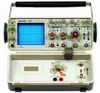
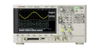
The 2337 is a 100 MHz analog oscilloscope from Tektronix. Measure voltage or current signals over time in an electronic ciruit or component to display amplitude, frequency and rise times, etc. Applications include troubleshooting, production test, and design.
Additional Features:
Bandwidth: 100 MHz
Rise time: 3.5 ns
Number of Channels: 2 ch
Includes a DMM
Min. Vertical Sensitivity: 5 mV/div
Maximum Vertical Sensitivity: 5 V/div
Vertical(or Deflection Factor): Accuracy 3 %
Input Coupling: AC,DC
Input Impedance: 1 MOhm
Maximum Input Voltage: 400 V(DC+p
Main time base - lowest: 50 ns/div
Main time base - highest: 0.5 s/div
B Sweep Time Base (low): 50 ns/div
B Sweep Time Base (high): 50 ms/div
Time base Magnification factor (X): x10
Timebase accuracy: 2 %
Trigger Source: External,Internal
Trigger Sensitivity: 0.3 mV
The Tektronix 2337 is a ruggedized portable dual channel analog oscilloscope with 100 MHz bandwidth. A digital display is included to measure time intervals and display a DMM reading.
The 2337 is a 100 MHz analog oscilloscope from Tektronix. Measure voltage or current signals over time in an electronic ciruit or component to display amplitude, frequency and rise times, etc. Applications include troubleshooting, production test, and design.
Additional Features:
- Bandwidth: 100 MHz
- Rise time: 3.5 ns
- Number of Channels: 2 ch
- Includes a DMM
- Min. Vertical Sensitivity: 5 mV/div
- Maximum Vertical Sensitivity: 5 V/div
- Vertical(or Deflection Factor): Accuracy 3 %
- Input Coupling: AC,DC
- Input Impedance: 1 MOhm
- Maximum Input Voltage: 400 V(DC+p
- Main time base - lowest: 50 ns/div
- Main time base - highest: 0.5 s/div
- B Sweep Time Base (low): 50 ns/div
- B Sweep Time Base (high): 50 ms/div
- Time base Magnification factor (X): x10
- Timebase accuracy: 2 %
- Trigger Source: External,Internal
- Trigger Sensitivity: 0.3 mV
The Tektronix 2337 is a ruggedized portable dual channel analog oscilloscope with 100 MHz bandwidth. A digital display is included to measure time intervals and display a DMM reading.