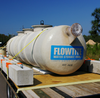
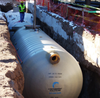
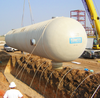
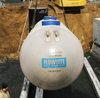
Containment Solutions, Inc. (CSI) Grease Interceptor Tank 4' Diameter

Description
Grease Interceptors Grease interceptors (also referred to as grease traps for smaller applications) are temporary storage/disposal tanks for wastewater in grease producing environments. Contaminants in this particular type of wastewater are made up of "fats, oils, and grease" (FOG). As FOG materials cool they congeal in sewer lines causing massive blockages and costly back-ups. A grease interceptor is designed to store wastewater long enough for the immiscible materials to naturally separate and float to the top of the water level where the FOG can be collected and disposed of properly. Typically this wastewater flows directly from a sink drain or wash area. Due to the unpredictable nature of contaminants, the storage vessel should be rust proof and non-corrosive which makes fiberglass an ideal structural material. Any establishment that introduces grease, oil or any other FOG material into the sewer system in quantities large enough to cause line blockages is required to install a grease trap or interceptor. Flowtite tanks are engineered to meet and exceed current requirements and standards. We offer IAPMO approved grease interceptors in various sizes up to 12' diameter including fiberglass baffles and other accessories. Typical Applications Restaurants Hotels Hospitals Schools Grocery Stores/Chains Food Service Kitchens Industrial Complexes
Description
Grease Interceptors Grease interceptors (also referred to as grease traps for smaller applications) are temporary storage/disposal tanks for wastewater in grease producing environments. Contaminants in this particular type of wastewater are made up of "fats, oils, and grease" (FOG). As FOG materials cool they congeal in sewer lines causing massive blockages and costly back-ups. A grease interceptor is designed to store wastewater long enough for the immiscible materials to naturally separate and float to the top of the water level where the FOG can be collected and disposed of properly. Typically this wastewater flows directly from a sink drain or wash area. Due to the unpredictable nature of contaminants, the storage vessel should be rust proof and non-corrosive which makes fiberglass an ideal structural material. Any establishment that introduces grease, oil or any other FOG material into the sewer system in quantities large enough to cause line blockages is required to install a grease trap or interceptor. Flowtite tanks are engineered to meet and exceed current requirements and standards. We offer IAPMO approved grease interceptors in various sizes up to 12' diameter including fiberglass baffles and other accessories. Typical Applications Restaurants Hotels Hospitals Schools Grocery Stores/Chains Food Service Kitchens Industrial Complexes

Suppliers

Company
Product
Description
Supplier Links
Grease Interceptor Tank - 4' Diameter - Containment Solutions, Inc. (CSI)
Conroe, TX, USA
Grease Interceptor Tank
4' Diameter
Grease Interceptor Tank 4' Diameter
Grease Interceptors Grease interceptors (also referred to as grease traps for smaller applications) are temporary storage/disposal tanks for wastewater in grease producing environments. Contaminants in this particular type of wastewater are made up of "fats, oils, and grease" (FOG). As FOG materials cool they congeal in sewer lines causing massive blockages and costly back-ups. A grease interceptor is designed to store wastewater long enough for the immiscible materials to naturally separate and float to the top of the water level where the FOG can be collected and disposed of properly. Typically this wastewater flows directly from a sink drain or wash area. Due to the unpredictable nature of contaminants, the storage vessel should be rust proof and non-corrosive which makes fiberglass an ideal structural material. Any establishment that introduces grease, oil or any other FOG material into the sewer system in quantities large enough to cause line blockages is required to install a grease trap or interceptor. Flowtite tanks are engineered to meet and exceed current requirements and standards. We offer IAPMO approved grease interceptors in various sizes up to 12' diameter including fiberglass baffles and other accessories. Typical Applications Restaurants Hotels Hospitals Schools Grocery Stores/Chains Food Service Kitchens Industrial Complexes

Grease Interceptors

Grease interceptors (also referred to as grease traps for smaller applications) are temporary storage/disposal tanks for wastewater in grease producing environments. Contaminants in this particular type of wastewater are made up of "fats, oils, and grease" (FOG). As FOG materials cool they congeal in sewer lines causing massive blockages and costly back-ups.

A grease interceptor is designed to store wastewater long enough for the immiscible materials to naturally separate and float to the top of the water level where the FOG can be collected and disposed of properly. Typically this wastewater flows directly from a sink drain or wash area. Due to the unpredictable nature of contaminants, the storage vessel should be rust proof and non-corrosive which makes fiberglass an ideal structural material.

Any establishment that introduces grease, oil or any other FOG material into the sewer system in quantities large enough to cause line blockages is required to install a grease trap or interceptor.

Flowtite tanks are engineered to meet and exceed current requirements and standards. We offer IAPMO approved grease interceptors in various sizes up to 12' diameter including fiberglass baffles and other accessories.

Typical Applications

  • Restaurants
  • Hotels
  • Hospitals
  • Schools
  • Grocery Stores/Chains
  • Food Service Kitchens
  • Industrial Complexes
Supplier's Site
Rainwater Harvesting Underground Double-wall Tank - 4' Diameter - Containment Solutions, Inc. (CSI)
Conroe, TX, USA
Rainwater Harvesting Underground Double-wall Tank
4' Diameter
Rainwater Harvesting Underground Double-wall Tank 4' Diameter
Underground Rainwater Tanks Rainwater harvesting (RWH) captures, diverts and stores rainwater for later use. With proper planning and design, your system can be built to capture up to 100% of the surface area rainwater. Flowtite fiberglass tanks can store wastewater, graywater, rainwater, stormwater, even potable drinking water. The tanks can also be fit with filtering components to separate oil and other contaminants so the rain collected can be reused for landscaping and other applications. Calculating how much water you need to store depends upon several factors like annual rainfall, typical usage totals and specific intent for collected water. For instance you could simply reuse rainwater for a small garden, or to irrigate landscaping or even as an alternative plumbing water supply for toilet flushing. For an in depth study you should consult a professional system designer but for a simple calculation you can use the following guideline: During a one inch rain, approximately 620 gallons of water can be collected for every 1,000 sq. ft. of surface area. That means an average house roof will collect over 1,000 gallons for every inch of rainfall. Commercial buildings will often have flat open roofs perfect for collecting rainwater and although rainwater cannot be used for every potable water application, the majority of potable water usage can be offset using recycled rainwater. Rainwater harvesting can make a dramatic impact through financial tax incentives, compliance with current and future regulations and additional credits toward certification of "green" building.

Underground Rainwater Tanks

Rainwater harvesting (RWH) captures, diverts and stores rainwater for later use. With proper planning and design, your system can be built to capture up to 100% of the surface area rainwater. Flowtite fiberglass tanks can store wastewater, graywater, rainwater, stormwater, even potable drinking water. The tanks can also be fit with filtering components to separate oil and other contaminants so the rain collected can be reused for landscaping and other applications.

Calculating how much water you need to store depends upon several factors like annual rainfall, typical usage totals and specific intent for collected water. For instance you could simply reuse rainwater for a small garden, or to irrigate landscaping or even as an alternative plumbing water supply for toilet flushing. For an in depth study you should consult a professional system designer but for a simple calculation you can use the following guideline:

During a one inch rain, approximately 620 gallons of water can be collected for every 1,000 sq. ft. of surface area. That means an average house roof will collect over 1,000 gallons for every inch of rainfall. Commercial buildings will often have flat open roofs perfect for collecting rainwater and although rainwater cannot be used for every potable water application, the majority of potable water usage can be offset using recycled rainwater.

Rainwater harvesting can make a dramatic impact through financial tax incentives, compliance with current and future regulations and additional credits toward certification of "green" building.

Supplier's Site
Compartment Underground Double-wall Tank - 4' Diameter - Containment Solutions, Inc. (CSI)
Conroe, TX, USA
Compartment Underground Double-wall Tank
4' Diameter
Compartment Underground Double-wall Tank 4' Diameter
Compartment Tanks Compartment tanks are built by dividing a single or double-wall storage tank with a bulkhead creating two independent storage areas. They are a popular choice for retail petroleum marketers interested in storing multiple blends for fuel including diesel. Since compartment tanks can be divided internally to accommodate two or more grades of fuel, they allow the site designer to plan for any ratio of fuel storage. These tanks are often used for sites where property is limited and installing multiple tanks is difficult. The design versatility of a CSI compartment tank can meet unique customer requests as well as local requirements. All of our tanks are manufactured using the same advanced technology which means our compartment tanks offer the same reliability, corrosion resistance and advanced engineering design as provided with our single and double-wall tank product lines. A standard compartment tank consists of one double-wall bulkhead but complex designs can include more forming multiple storage areas. Benefits: Reduced shipping costs with fewer tanks Fuel grade storage ratios maximized Smaller excavation sites and fewer labor man hours during installation Site is more adaptable to changing consumer demands Bulkheads The single-wall bulkhead is a solid fiberglass separator that forms a non-porous wall between two compartments. These are typically specified for non-potable water storage and other non-hazardous and non-flammable materials. Double-wall bulkheads are required between compartments storing gasoline adjacent to fuel oil, potable water and petroleum products. The open channel between the two bulkheads is connected directly to the tank's annular space. This allows the bulkhead and double-wall tank to be monitored concurrently. Double-wall models with brine can be hydrostatically monitored, offering the very best protection for your compartment tank storage system.

Compartment Tanks

Compartment tanks are built by dividing a single or double-wall storage tank with a bulkhead creating two independent storage areas. They are a popular choice for retail petroleum marketers interested in storing multiple blends for fuel including diesel.

Since compartment tanks can be divided internally to accommodate two or more grades of fuel, they allow the site designer to plan for any ratio of fuel storage. These tanks are often used for sites where property is limited and installing multiple tanks is difficult. The design versatility of a CSI compartment tank can meet unique customer requests as well as local requirements.

All of our tanks are manufactured using the same advanced technology which means our compartment tanks offer the same reliability, corrosion resistance and advanced engineering design as provided with our single and double-wall tank product lines. A standard compartment tank consists of one double-wall bulkhead but complex designs can include more forming multiple storage areas.

Benefits:

  • Reduced shipping costs with fewer tanks
  • Fuel grade storage ratios maximized
  • Smaller excavation sites and fewer labor man hours during installation
  • Site is more adaptable to changing consumer demands

Bulkheads

The single-wall bulkhead is a solid fiberglass separator that forms a non-porous wall between two compartments. These are typically specified for non-potable water storage and other non-hazardous and non-flammable materials.

Double-wall bulkheads are required between compartments storing gasoline adjacent to fuel oil, potable water and petroleum products. The open channel between the two bulkheads is connected directly to the tank's annular space. This allows the bulkhead and double-wall tank to be monitored concurrently. Double-wall models with brine can be hydrostatically monitored, offering the very best protection for your compartment tank storage system.

Supplier's Site
Fire Protection Underground Double-wall Tank - 4' Diameter - Containment Solutions, Inc. (CSI)
Conroe, TX, USA
Fire Protection Underground Double-wall Tank
4' Diameter
Fire Protection Underground Double-wall Tank 4' Diameter
Fire Protection Lightweight Flowtite tanks can be custom built for any fire protection system design. We understand the requirements of fire protection systems, and manufacture our tanks to National Fire Protection Association (NFPA) specifications. By providing a dedicated source of water required by local codes in residential development, CSI fiberglass tanks are a preferred way to have access to large volumes of water. The tanks provide unseen protection for the residents, yet are easily accessible for fire and municipal vehicles. Flowtite tanks are often used for commercial fire protection due to the inherent water tight properties of fiberglass and the large volume capacities. The benefit of having concealed underground emergency water storage will help protect property values and thus protect your business investment.

Fire Protection

Lightweight Flowtite tanks can be custom built for any fire protection system design. We understand the requirements of fire protection systems, and manufacture our tanks to National Fire Protection Association (NFPA) specifications.

By providing a dedicated source of water required by local codes in residential development, CSI fiberglass tanks are a preferred way to have access to large volumes of water. The tanks provide unseen protection for the residents, yet are easily accessible for fire and municipal vehicles.

Flowtite tanks are often used for commercial fire protection due to the inherent water tight properties of fiberglass and the large volume capacities.

The benefit of having concealed underground emergency water storage will help protect property values and thus protect your business investment.

Supplier's Site
Potable Water Tank - 4' Diameter - Containment Solutions, Inc. (CSI)
Conroe, TX, USA
Potable Water Tank
4' Diameter
Potable Water Tank 4' Diameter
Potable Water CSI manufactures Flowtite® fiberglass tanks according to NSF 61 and AWWA standards for potable water storage. Because of their lightweight design, Flowtite tanks are easy to transport and easy to install making them popular in remote areas where a dependable, drinkable water source is critical. Fiberglass tanks can be manufactured to store potable water directly without liners or bladders common in both steel and concrete tanks. According to the World Health Organization, less than 1% of the water on Earth is readily available for human use and consumption. With this finite supply of resource it is clear why conserving potable water is a key focus of green building projects. Flowtite water tanks have the advantage of being adaptable. Many customers install a tank for a combination of uses. For instance fire protection tanks are often built to store potable water. Typical Applications Rural properties Commercial business complexes Livestock feeding stations Emergency water supplies Large private resorts

Potable Water

CSI manufactures Flowtite® fiberglass tanks according to NSF 61 and AWWA standards for potable water storage. Because of their lightweight design, Flowtite tanks are easy to transport and easy to install making them popular in remote areas where a dependable, drinkable water source is critical. Fiberglass tanks can be manufactured to store potable water directly without liners or bladders common in both steel and concrete tanks.

According to the World Health Organization, less than 1% of the water on Earth is readily available for human use and consumption. With this finite supply of resource it is clear why conserving potable water is a key focus of green building projects.

Flowtite water tanks have the advantage of being adaptable. Many customers install a tank for a combination of uses. For instance fire protection tanks are often built to store potable water.

Typical Applications

  • Rural properties
  • Commercial business complexes
  • Livestock feeding stations
  • Emergency water supplies
  • Large private resorts
Supplier's Site
Double-Wall Fuel Storage Tank - 4' Diameter - Containment Solutions, Inc. (CSI)
Conroe, TX, USA
Double-Wall Fuel Storage Tank
4' Diameter
Double-Wall Fuel Storage Tank 4' Diameter
Double-Wall Fuel Storage Tanks CSI's advanced double-wall technology gives storage tank owners, municipalities, counties, provinces, and states proven protection against petroleum contamination of underground water supplies. In addition to our UL listing, our tanks comply with the EPA's recommendation for secondary containment systems wherever underground tanks are located near underground water supplies. Containment Solutions double-wall tanks give you two levels of protection, so you have twice the assurance and twice the risk management that any single-wall tank can offer. The primary tank is designed to contain your fuel. In the unlikely event that there is a breach in this wall, the secondary wall is designed to contain your product and prevent seepage into the environment. With more alternative fuels being introduced to the marketplace and steel tank providers decreasing warranties due to corrosion issues, fuel storage decisions can get complicated. Containment Solutions is there to simplify the problem. CSI manufactures the finest quality fuel storage tanks for underground systems. Our double-wall fiberglass tanks are inherently non-corrosive, safely storing standard petroleum fluids, biofuels and biodiesels, ethanol and ethanol blends, ultra-low sulfur diesel (ULSD), even diesel exhaust fluid (DEF). And unlike underground steel tanks, CSI's fuel storage tanks are backed by an industry best 30-year corrosion warranty. Containment Solutions is a trusted name with a dependable product. With more than 300,000 tanks installed around the world, CSI is the largest American fiberglass tank manufacturer. Long-term corrosion and material properties testing is done at our Research and Development Center (R&D). Laminate testing includes current fuels, blends and other oxygenates, but we do not stop there. We also test alternative products and blends that could be stored in our tanks in the future; as fuel options change, your fuel storage tank compatibility will not. Many of the newest industry fuels and bio fuels are alcohol based. Alcohol blends, including ethanol, increase the likelihood of water in a storage tank, resulting in rust and microbial-induced corrosion (MIC) in steel tanks. The inherent non-corrosive nature of a fiberglass CSI double-wall tank eliminates the possibility of rust on all tank wall surfaces. Choosing the right fueling location is an important decision, choosing the right fuel storage tank is imperative. Tank related issues are costly and can lead to environmental catastrophes. Trust the tank that changed the industry, trust a CSI double-wall fuel storage tank. At CSI, we can handle that.™ Across the country, the following CSI products are in use in private industry and public municipalities where petroleum-based fluids are required: Fiberglass Fuel and Biofuels Storage (underground) Double-Wall Tanks Hydro Guard® System Compartment Tanks Triple-Wall Tanks

Double-Wall Fuel Storage Tanks

CSI's advanced double-wall technology gives storage tank owners, municipalities, counties, provinces, and states proven protection against petroleum contamination of underground water supplies. In addition to our UL listing, our tanks comply with the EPA's recommendation for secondary containment systems wherever underground tanks are located near underground water supplies.

Containment Solutions double-wall tanks give you two levels of protection, so you have twice the assurance and twice the risk management that any single-wall tank can offer. The primary tank is designed to contain your fuel. In the unlikely event that there is a breach in this wall, the secondary wall is designed to contain your product and prevent seepage into the environment.

With more alternative fuels being introduced to the marketplace and steel tank providers decreasing warranties due to corrosion issues, fuel storage decisions can get complicated. Containment Solutions is there to simplify the problem. CSI manufactures the finest quality fuel storage tanks for underground systems. Our double-wall fiberglass tanks are inherently non-corrosive, safely storing standard petroleum fluids, biofuels and biodiesels, ethanol and ethanol blends, ultra-low sulfur diesel (ULSD), even diesel exhaust fluid (DEF). And unlike underground steel tanks, CSI's fuel storage tanks are backed by an industry best 30-year corrosion warranty. Containment Solutions is a trusted name with a dependable product. With more than 300,000 tanks installed around the world, CSI is the largest American fiberglass tank manufacturer.

Long-term corrosion and material properties testing is done at our Research and Development Center (R&D). Laminate testing includes current fuels, blends and other oxygenates, but we do not stop there. We also test alternative products and blends that could be stored in our tanks in the future; as fuel options change, your fuel storage tank compatibility will not. Many of the newest industry fuels and bio fuels are alcohol based. Alcohol blends, including ethanol, increase the likelihood of water in a storage tank, resulting in rust and microbial-induced corrosion (MIC) in steel tanks. The inherent non-corrosive nature of a fiberglass CSI double-wall tank eliminates the possibility of rust on all tank wall surfaces.

Choosing the right fueling location is an important decision, choosing the right fuel storage tank is imperative. Tank related issues are costly and can lead to environmental catastrophes. Trust the tank that changed the industry, trust a CSI double-wall fuel storage tank. At CSI, we can handle that.™

Across the country, the following CSI products are in use in private industry and public municipalities where petroleum-based fluids are required:

Fiberglass Fuel and Biofuels Storage (underground)

  • Double-Wall Tanks
  • Hydro Guard® System
  • Compartment Tanks
  • Triple-Wall Tanks
Supplier's Site
Onsite Septic Underground Double-wall Tank - 4' Diameter - Containment Solutions, Inc. (CSI)
Conroe, TX, USA
Onsite Septic Underground Double-wall Tank
4' Diameter
Onsite Septic Underground Double-wall Tank 4' Diameter
Onsite Septic EPA statistics show that onsite septic systems serve approximately 25% of the U.S. population and 40% of all new housing development. Conventional systems can leak, causing "blackwater" to contaminate soil and ground water. The key to the onsite market's growth is a watertight tank. CSI manufactures fiberglass tanks for both aerobic and anaerobic septic applications. Our watertight tanks are a cost-effective, long-term solution for private homes, commercial developments, industrial and municipal applications. Government and state regulation of septic storage and distribution is changing to help reduce infiltration and exfiltration contamination. CSI Flowtite septic tanks, sometimes referred to as cisterns, eliminate leakage problems inherent in concrete septic systems. Flowtite tanks are engineered to meet and exceed current requirements and standards. We offer IAPMO approved tanks in various sizes up to 12' diameter including fiberglass baffles and other accessories. Typical Applications Resorts and spas Suburban developments Rural developments Rest areas Truck stops Municipalities

Onsite Septic

EPA statistics show that onsite septic systems serve approximately 25% of the U.S. population and 40% of all new housing development. Conventional systems can leak, causing "blackwater" to contaminate soil and ground water. The key to the onsite market's growth is a watertight tank.

CSI manufactures fiberglass tanks for both aerobic and anaerobic septic applications. Our watertight tanks are a cost-effective, long-term solution for private homes, commercial developments, industrial and municipal applications.

Government and state regulation of septic storage and distribution is changing to help reduce infiltration and exfiltration contamination. CSI Flowtite septic tanks, sometimes referred to as cisterns, eliminate leakage problems inherent in concrete septic systems.

Flowtite tanks are engineered to meet and exceed current requirements and standards. We offer IAPMO approved tanks in various sizes up to 12' diameter including fiberglass baffles and other accessories.

Typical Applications

  • Resorts and spas
  • Suburban developments
  • Rural developments
  • Rest areas
  • Truck stops
  • Municipalities
Supplier's Site
Triple-Wall Tank - 4' Diameter - Containment Solutions, Inc. (CSI)
Conroe, TX, USA
Triple-Wall Tank
4' Diameter
Triple-Wall Tank 4' Diameter
Triple-Wall Tanks In 1997, CSI designed the UL listed triple-wall fiberglass tank for use in environmentally sensitive areas where tertiary containment is required. The triple-wall tank design provides secondary containment for the standard secondary containment system. Triple-wall tanks offer three levels of containment protection: the proven strength and performance of a primary fiberglass tank, and in the unlikely event that there is a breach, secondary and tertiary walls designed to contain the fuel and prevent any spill into the environment. Triple-wall petroleum tanks, like single and double-wall models, come with a standard 30-year structural and corrosion warranty.

Triple-Wall Tanks

In 1997, CSI designed the UL listed triple-wall fiberglass tank for use in environmentally sensitive areas where tertiary containment is required. The triple-wall tank design provides secondary containment for the standard secondary containment system. Triple-wall tanks offer three levels of containment protection: the proven strength and performance of a primary fiberglass tank, and in the unlikely event that there is a breach, secondary and tertiary walls designed to contain the fuel and prevent any spill into the environment.

Triple-wall petroleum tanks, like single and double-wall models, come with a standard 30-year structural and corrosion warranty.

Supplier's Site
Stormwater Collection Underground Double-wall Tank - 4' Diameter - Containment Solutions, Inc. (CSI)
Conroe, TX, USA
Stormwater Collection Underground Double-wall Tank
4' Diameter
Stormwater Collection Underground Double-wall Tank 4' Diameter
Stormwater Collection In many rural areas of the world water can be scarce where annual rainfall is low. Although stormwater is a proven water collection source for these abnormally dry rural communities, similar water shortages can occur in urban areas as well even where average rainfall amounts should be sufficient. Urban development introduces impervious surfaces to an environment, which prevent stormwater from soaking into the ground. Common impervious surfaces include parking lots, highways, rooftops, etc. These surfaces cause runoff water to funnel through waterways and out of the city too quickly to be absorbed naturally. The result is a unique situation where areas with average rainfall suffer from flooding during normal rains and unnecessary drought conditions during expected dry periods. The solution of course is to collect and store the flooding water for drier times. Collecting stormwater often begins with storm drains built directly into streets and parking lots. These drains would then channel the water to a Flowtite® Stormwater tank. With the proper accessories attached to your storage tank, collected water can be filtered and reused in both indoor and outdoor applications thus minimizing overall potable water use. Typical Applications Stormwater runoff collection Gray water reuse Irrigation systems Chilled water storage

Stormwater Collection

In many rural areas of the world water can be scarce where annual rainfall is low. Although stormwater is a proven water collection source for these abnormally dry rural communities, similar water shortages can occur in urban areas as well even where average rainfall amounts should be sufficient.

Urban development introduces impervious surfaces to an environment, which prevent stormwater from soaking into the ground. Common impervious surfaces include parking lots, highways, rooftops, etc. These surfaces cause runoff water to funnel through waterways and out of the city too quickly to be absorbed naturally.

The result is a unique situation where areas with average rainfall suffer from flooding during normal rains and unnecessary drought conditions during expected dry periods. The solution of course is to collect and store the flooding water for drier times.

Collecting stormwater often begins with storm drains built directly into streets and parking lots. These drains would then channel the water to a Flowtite® Stormwater tank. With the proper accessories attached to your storage tank, collected water can be filtered and reused in both indoor and outdoor applications thus minimizing overall potable water use.

Typical Applications

  • Stormwater runoff collection
  • Gray water reuse
  • Irrigation systems
  • Chilled water storage
Supplier's Site

Technical Specifications

  Containment Solutions, Inc. (CSI) Containment Solutions, Inc. (CSI) Containment Solutions, Inc. (CSI) Containment Solutions, Inc. (CSI) Containment Solutions, Inc. (CSI) Containment Solutions, Inc. (CSI) Containment Solutions, Inc. (CSI)
Product Category Storage Tanks and Process Tanks Storage Tanks and Process Tanks Storage Tanks and Process Tanks Storage Tanks and Process Tanks Storage Tanks and Process Tanks Storage Tanks and Process Tanks Storage Tanks and Process Tanks
Product Number 4' Diameter 4' Diameter 4' Diameter 4' Diameter 4' Diameter 4' Diameter 4' Diameter
Product Name Grease Interceptor Tank Rainwater Harvesting Underground Double-wall Tank Compartment Underground Double-wall Tank Fire Protection Underground Double-wall Tank Double-Wall Fuel Storage Tank Onsite Septic Underground Double-wall Tank Triple-Wall Tank
Type Water Tank Water Tank Fuel/Oil Tank Chemical Tank Fuel/Oil Tank Hazardous Tank; Septic Tank Fuel/Oil Tank
Unlock Full Specs
to access all available technical data

Similar Products

Custom Tanks and Pressure Vessels -  - Charles Ross & Son Company
Charles Ross & Son Company
Specs
Type General Purpose/ Bulk Storage Tank; Chemical Tank; Drug/Pharmaceutical Tank; Hazardous Tank; Pressure Vessel; Process Tank
Material Aluminum; Exotic Metals; Steel; Stainless Steel
Features Insulated; Outdoor Use; Portable; Temperature Controlled; Underground Use
View Details
60 Gallon Receiver Tank -  - EXAIR
Specs
Type Air Receiver; Pressure Vessel
Volume Capacity 60 gallons (227 liters)
Pressure Rating 200 psi (141 m H2O)
View Details
Air Receiver Tank -  - Kaeser Compressors, Inc.
Kaeser Compressors, Inc.
Specs
Type Air Receiver
Volume Capacity 30 to 8000 gallons (114 to 30283 liters)
View Details