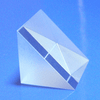
Changchun Sunday Optics Co., Ltd. Equilateral Triangular Prism

Description
Fluorescence Filters refer to a variety of Filters applied to a Fluorescence system, including the extraction of fluorescent energy or the acquisition of fluorescent images.Its main characteristics are good isolation degree of interference light and less spontaneous fluorescence interference.Fluores cent filters are used in various medical analysis and testing instruments, such as PCR, fluorescence immunoanalyzer, fluorescence microscope and so on.The cut-off depth of the fluorescent filter is usually required to be above OD5 (optical density, OD=-lgT). Fluorescent filter is a key component of biomedical and life science instruments.The typical characteristics of fluorescent filters are deep cutoff depth, small spontaneous fluorescence, and good transmittance surface shape, which is beneficial to the extraction of fluorescence imaging.Therefore, the better fluorescent filter use a single piece of colorless transparent glass as the base, coating the two surfaces of the glass.Compared with conventional fluorescent filters with multi-film gluing or color-glass assisted cutoff, single-chip fluorescent filters have obvious advantagesin fluorescence imaging. However, the single-chip fluorescent filters have high cost due to the high difficulty in production. Fluorescent filter generally consists of three combinations, namely excitation filter, emission filter and dichromatic mirror.Some systems do not have dichromatic mirrors, because of the optical path structure.Other systems use lasers for excitation, without the need for excitation filters. Excitation Filter:In the fluorescence microscope, only the Excitation wavelength is passable.In the past, short-wave pass filters were used, but now band pass filters are basically used.The shell is engraved with arrows indicating the recommended direction of light travel. Emitting Filter : Selects and transmits the fluorescence emitted by the sample, and the light in other ranges is cut off.The wavelength of the emitted light is longer than that of the excited light (closer to the red).The band pass filter or long wave pass filter can be selected as the emission filter.The shell is engraved with arrows indicating the recommended direction of light travel. Dichroic Mirror (Dichroic Beamsplitter,Dichrom atic Beamsplitter) : Also known as Dichroic filter or color separator.Place at an Angle of 45° to the light path of the microscope.This filter reflects light of one color (excitation light) and transmits light of another color (emission light), which has a reflectivity greater than 90% and a transmittance greater than 90%.The impenetrable part of the spectrum is reflected rather than absorbed.The color of filter in transmitted light and reflected light complement each other, so it is also called dichromatic filter.
Description
Fluorescence Filters refer to a variety of Filters applied to a Fluorescence system, including the extraction of fluorescent energy or the acquisition of fluorescent images.Its main characteristics are good isolation degree of interference light and less spontaneous fluorescence interference.Fluores cent filters are used in various medical analysis and testing instruments, such as PCR, fluorescence immunoanalyzer, fluorescence microscope and so on.The cut-off depth of the fluorescent filter is usually required to be above OD5 (optical density, OD=-lgT). Fluorescent filter is a key component of biomedical and life science instruments.The typical characteristics of fluorescent filters are deep cutoff depth, small spontaneous fluorescence, and good transmittance surface shape, which is beneficial to the extraction of fluorescence imaging.Therefore, the better fluorescent filter use a single piece of colorless transparent glass as the base, coating the two surfaces of the glass.Compared with conventional fluorescent filters with multi-film gluing or color-glass assisted cutoff, single-chip fluorescent filters have obvious advantagesin fluorescence imaging. However, the single-chip fluorescent filters have high cost due to the high difficulty in production. Fluorescent filter generally consists of three combinations, namely excitation filter, emission filter and dichromatic mirror.Some systems do not have dichromatic mirrors, because of the optical path structure.Other systems use lasers for excitation, without the need for excitation filters. Excitation Filter:In the fluorescence microscope, only the Excitation wavelength is passable.In the past, short-wave pass filters were used, but now band pass filters are basically used.The shell is engraved with arrows indicating the recommended direction of light travel. Emitting Filter : Selects and transmits the fluorescence emitted by the sample, and the light in other ranges is cut off.The wavelength of the emitted light is longer than that of the excited light (closer to the red).The band pass filter or long wave pass filter can be selected as the emission filter.The shell is engraved with arrows indicating the recommended direction of light travel. Dichroic Mirror (Dichroic Beamsplitter,Dichrom atic Beamsplitter) : Also known as Dichroic filter or color separator.Place at an Angle of 45° to the light path of the microscope.This filter reflects light of one color (excitation light) and transmits light of another color (emission light), which has a reflectivity greater than 90% and a transmittance greater than 90%.The impenetrable part of the spectrum is reflected rather than absorbed.The color of filter in transmitted light and reflected light complement each other, so it is also called dichromatic filter.

Suppliers

Company
Product
Description
Supplier Links
Equilateral Triangular Prism -  - Changchun Sunday Optics Co., Ltd.
Changchun, China
Equilateral Triangular Prism
Fluorescence Filters refer to a variety of Filters applied to a Fluorescence system, including the extraction of fluorescent energy or the acquisition of fluorescent images.Its main characteristics are good isolation degree of interference light and less spontaneous fluorescence interference.Fluores cent filters are used in various medical analysis and testing instruments, such as PCR, fluorescence immunoanalyzer, fluorescence microscope and so on.The cut-off depth of the fluorescent filter is usually required to be above OD5 (optical density, OD=-lgT). Fluorescent filter is a key component of biomedical and life science instruments.The typical characteristics of fluorescent filters are deep cutoff depth, small spontaneous fluorescence, and good transmittance surface shape, which is beneficial to the extraction of fluorescence imaging.Therefore, the better fluorescent filter use a single piece of colorless transparent glass as the base, coating the two surfaces of the glass.Compared with conventional fluorescent filters with multi-film gluing or color-glass assisted cutoff, single-chip fluorescent filters have obvious advantagesin fluorescence imaging. However, the single-chip fluorescent filters have high cost due to the high difficulty in production. Fluorescent filter generally consists of three combinations, namely excitation filter, emission filter and dichromatic mirror.Some systems do not have dichromatic mirrors, because of the optical path structure.Other systems use lasers for excitation, without the need for excitation filters. Excitation Filter:In the fluorescence microscope, only the Excitation wavelength is passable.In the past, short-wave pass filters were used, but now band pass filters are basically used.The shell is engraved with arrows indicating the recommended direction of light travel. Emitting Filter : Selects and transmits the fluorescence emitted by the sample, and the light in other ranges is cut off.The wavelength of the emitted light is longer than that of the excited light (closer to the red).The band pass filter or long wave pass filter can be selected as the emission filter.The shell is engraved with arrows indicating the recommended direction of light travel. Dichroic Mirror (Dichroic Beamsplitter,Dichrom atic Beamsplitter) : Also known as Dichroic filter or color separator.Place at an Angle of 45° to the light path of the microscope.This filter reflects light of one color (excitation light) and transmits light of another color (emission light), which has a reflectivity greater than 90% and a transmittance greater than 90%.The impenetrable part of the spectrum is reflected rather than absorbed.The color of filter in transmitted light and reflected light complement each other, so it is also called dichromatic filter.

Fluorescence Filters refer to a variety of Filters applied to a Fluorescence system, including the extraction of fluorescent energy or the acquisition of fluorescent images.Its main characteristics are good isolation degree of interference light and less spontaneous fluorescence interference.Fluorescent filters are used in various medical analysis and testing instruments, such as PCR, fluorescence immunoanalyzer, fluorescence microscope and so on.The cut-off depth of the fluorescent filter is usually required to be above OD5 (optical density, OD=-lgT).
Fluorescent filter is a key component of biomedical and life science instruments.The typical characteristics of fluorescent filters are deep cutoff depth, small spontaneous fluorescence, and good transmittance surface shape, which is beneficial to the extraction of fluorescence imaging.Therefore, the better fluorescent filter use a single piece of colorless transparent glass as the base, coating the two surfaces of the glass.Compared with conventional fluorescent filters with multi-film gluing or color-glass assisted cutoff, single-chip fluorescent filters have obvious advantagesin fluorescence imaging. However, the single-chip fluorescent filters have high cost due to the high difficulty in production.
Fluorescent filter generally consists of three combinations, namely excitation filter, emission filter and dichromatic mirror.Some systems do not have dichromatic mirrors, because of the optical path structure.Other systems use lasers for excitation, without the need for excitation filters.
Excitation Filter:In the fluorescence microscope, only the Excitation wavelength is passable.In the past, short-wave pass filters were used, but now band pass filters are basically used.The shell is engraved with arrows indicating the recommended direction of light travel.
Emitting Filter : Selects and transmits the fluorescence emitted by the sample, and the light in other ranges is cut off.The wavelength of the emitted light is longer than that of the excited light (closer to the red).The band pass filter or long wave pass filter can be selected as the emission filter.The shell is engraved with arrows indicating the recommended direction of light travel.
Dichroic Mirror (Dichroic Beamsplitter,Dichromatic Beamsplitter) : Also known as Dichroic filter or color separator.Place at an Angle of 45° to the light path of the microscope.This filter reflects light of one color (excitation light) and transmits light of another color (emission light), which has a reflectivity greater than 90% and a transmittance greater than 90%.The impenetrable part of the spectrum is reflected rather than absorbed.The color of filter in transmitted light and reflected light complement each other, so it is also called dichromatic filter.

Supplier's Site

Technical Specifications

  Changchun Sunday Optics Co., Ltd.
Product Category Optical Prisms
Product Name Equilateral Triangular Prism
Prism Type Equilateral
Unlock Full Specs
to access all available technical data

Similar Products

Fresnel Prism - PR 727 - ORAFOL Fresnel Optics GmbH
ORAFOL Fresnel Optics GmbH
View Details
Right Angle Prism with 90°±5”Beam Deviation -  - Suzhou Jiujon Optics Co., Ltd
Specs
Prism Type Right Angle
Prism Material CDGM / SCHOTT
Surface Quality 40-20 Scratch / Dig
View Details
Prisms -  - CRYSTECH, Inc.
CRYSTECH, Inc.
Specs
Prism Type Corner Cube Retroreflector; Dove; Equilateral; Right Angle; Wedge
Prism Material BK7 Glass; UV Grade Fused Silica
Surface Flatness λ/4
View Details
Equilateral Dispersive Prisms - EQP-600-NSF10 - CASTECH, Inc.
Specs
Prism Type Equilateral
Largest Dimension 60 mm (2.36 inch)
Prism Material SF10 Glass
View Details