Boeing Company (The) Military Transport Aircraft C-17 Globemaster III

Description
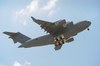
A high-wing, four-engine, T-tailed military transport aircraft, the multi-service C-17 can carry large equipment, supplies and troops directly to small airfields in harsh terrain anywhere in the world. The massive, sturdy, long-haul aircraft tackles distance, destination and heavy, oversized payloads in unpredictable conditions. It has delivered cargo in every worldwide operation since the 1990s. Boeing builds and maintains the aircraft for nine countries worldwide. C-17 Quick Facts The C-17 can: Take off from a 7,740-foot (2359.15-meter) airfield Carry a payload of up to 164,900 pounds (74,797 kg) Fly 6,230 nautical miles with no payload Refuel while in flight Land in 3,000 feet (914 meters) or less on a small unpaved or paved airfield in day or night. Carry a cargo of wheeled U.S. Army vehicles in two side-by-side rows, including the U.S. Army's main battle tank, the M-1 Drop a single 60,000-pound (27,216-kilogram) payload, with sequential load drops of 110,000 pounds (49,895 kilograms) Back up a 2-percent slope Seat 54 on the sidewall and 48 in the centerline C-17 Globemaster III Technical Specifications External Dimensions Wingspan to Winglet Tip 169.8 ft (51.74 m) Length 174 ft (53.04 m) Height at Tail 55.1 ft (16.79 m) Fuselage Diameter 22.5 ft (6.86 m) Engines Four Pratt & Whitney PW2040 (military designation F117-PW-100) 40,440 pounds thrust each Seating Sidewall (Permanently Installed) 54 (27 each side, 18 inches wide, 24 inch spacing center to center) Centerline (stored on board) 48 (in sets of six back-to-back, 8 sets) Palletized 80 on 8 pallets, plus 54 passengers on sidewall seats Cockpit Flight crew 2 pilots Observer positions 2 Instrument displays 2 full-time all-function head-up displays (HUD), 4 multi-function active matrix liquid crystal displays Navigation system Digital electronics Communication Integrated radio management system with communications system open architecture (COSA) Flight controls system Quadruple-redundant electronic flight control with mechanical backup system Wing Area 3,800 sq. ft. (353 sq. m) Aspect Ratio 7.165 Sweep Angle 25 degrees Airfoil Type Supercritical Flaps Fixed-vane, double-slotted, simple-hinged Horizontal Tail Area 845 sq. ft. (78.50 sq. m) Span 65 feet (19.81 m) Aspect Ratio 5.0 Sweep 27 degrees
Description
A high-wing, four-engine, T-tailed military transport aircraft, the multi-service C-17 can carry large equipment, supplies and troops directly to small airfields in harsh terrain anywhere in the world. The massive, sturdy, long-haul aircraft tackles distance, destination and heavy, oversized payloads in unpredictable conditions. It has delivered cargo in every worldwide operation since the 1990s. Boeing builds and maintains the aircraft for nine countries worldwide. C-17 Quick Facts The C-17 can: Take off from a 7,740-foot (2359.15-meter) airfield Carry a payload of up to 164,900 pounds (74,797 kg) Fly 6,230 nautical miles with no payload Refuel while in flight Land in 3,000 feet (914 meters) or less on a small unpaved or paved airfield in day or night. Carry a cargo of wheeled U.S. Army vehicles in two side-by-side rows, including the U.S. Army's main battle tank, the M-1 Drop a single 60,000-pound (27,216-kilogram) payload, with sequential load drops of 110,000 pounds (49,895 kilograms) Back up a 2-percent slope Seat 54 on the sidewall and 48 in the centerline C-17 Globemaster III Technical Specifications External Dimensions Wingspan to Winglet Tip 169.8 ft (51.74 m) Length 174 ft (53.04 m) Height at Tail 55.1 ft (16.79 m) Fuselage Diameter 22.5 ft (6.86 m) Engines Four Pratt & Whitney PW2040 (military designation F117-PW-100) 40,440 pounds thrust each Seating Sidewall (Permanently Installed) 54 (27 each side, 18 inches wide, 24 inch spacing center to center) Centerline (stored on board) 48 (in sets of six back-to-back, 8 sets) Palletized 80 on 8 pallets, plus 54 passengers on sidewall seats Cockpit Flight crew 2 pilots Observer positions 2 Instrument displays 2 full-time all-function head-up displays (HUD), 4 multi-function active matrix liquid crystal displays Navigation system Digital electronics Communication Integrated radio management system with communications system open architecture (COSA) Flight controls system Quadruple-redundant electronic flight control with mechanical backup system Wing Area 3,800 sq. ft. (353 sq. m) Aspect Ratio 7.165 Sweep Angle 25 degrees Airfoil Type Supercritical Flaps Fixed-vane, double-slotted, simple-hinged Horizontal Tail Area 845 sq. ft. (78.50 sq. m) Span 65 feet (19.81 m) Aspect Ratio 5.0 Sweep 27 degrees

Suppliers

Company
Product
Description
Supplier Links
Military Transport Aircraft - C-17 Globemaster III - Boeing Company (The)
Chicago, IL, USA
Military Transport Aircraft
C-17 Globemaster III
Military Transport Aircraft C-17 Globemaster III
A high-wing, four-engine, T-tailed military transport aircraft, the multi-service C-17 can carry large equipment, supplies and troops directly to small airfields in harsh terrain anywhere in the world. The massive, sturdy, long-haul aircraft tackles distance, destination and heavy, oversized payloads in unpredictable conditions. It has delivered cargo in every worldwide operation since the 1990s. Boeing builds and maintains the aircraft for nine countries worldwide. C-17 Quick Facts The C-17 can: Take off from a 7,740-foot (2359.15-meter) airfield Carry a payload of up to 164,900 pounds (74,797 kg) Fly 6,230 nautical miles with no payload Refuel while in flight Land in 3,000 feet (914 meters) or less on a small unpaved or paved airfield in day or night. Carry a cargo of wheeled U.S. Army vehicles in two side-by-side rows, including the U.S. Army's main battle tank, the M-1 Drop a single 60,000-pound (27,216-kilogram) payload, with sequential load drops of 110,000 pounds (49,895 kilograms) Back up a 2-percent slope Seat 54 on the sidewall and 48 in the centerline C-17 Globemaster III Technical Specifications External Dimensions Wingspan to Winglet Tip 169.8 ft (51.74 m) Length 174 ft (53.04 m) Height at Tail 55.1 ft (16.79 m) Fuselage Diameter 22.5 ft (6.86 m) Engines Four Pratt & Whitney PW2040 (military designation F117-PW-100) 40,440 pounds thrust each Seating Sidewall (Permanently Installed) 54 (27 each side, 18 inches wide, 24 inch spacing center to center) Centerline (stored on board) 48 (in sets of six back-to-back, 8 sets) Palletized 80 on 8 pallets, plus 54 passengers on sidewall seats Cockpit Flight crew 2 pilots Observer positions 2 Instrument displays 2 full-time all-function head-up displays (HUD), 4 multi-function active matrix liquid crystal displays Navigation system Digital electronics Communication Integrated radio management system with communications system open architecture (COSA) Flight controls system Quadruple-redundant electronic flight control with mechanical backup system Wing Area 3,800 sq. ft. (353 sq. m) Aspect Ratio 7.165 Sweep Angle 25 degrees Airfoil Type Supercritical Flaps Fixed-vane, double-slotted, simple-hinged Horizontal Tail Area 845 sq. ft. (78.50 sq. m) Span 65 feet (19.81 m) Aspect Ratio 5.0 Sweep 27 degrees

A high-wing, four-engine, T-tailed military transport aircraft, the multi-service C-17 can carry large equipment, supplies and troops directly to small airfields in harsh terrain anywhere in the world. The massive, sturdy, long-haul aircraft tackles distance, destination and heavy, oversized payloads in unpredictable conditions. It has delivered cargo in every worldwide operation since the 1990s. Boeing builds and maintains the aircraft for nine countries worldwide.

C-17 Quick Facts

The C-17 can:

  • Take off from a 7,740-foot (2359.15-meter) airfield
  • Carry a payload of up to 164,900 pounds (74,797 kg)
  • Fly 6,230 nautical miles with no payload
  • Refuel while in flight
  • Land in 3,000 feet (914 meters) or less on a small unpaved or paved airfield in day or night.
  • Carry a cargo of wheeled U.S. Army vehicles in two side-by-side rows, including the U.S. Army's main battle tank, the M-1
  • Drop a single 60,000-pound (27,216-kilogram) payload, with sequential load drops of 110,000 pounds (49,895 kilograms)
  • Back up a 2-percent slope
  • Seat 54 on the sidewall and 48 in the centerline

C-17 Globemaster III Technical Specifications

External Dimensions

Wingspan to Winglet Tip

169.8 ft (51.74 m)

Length

174 ft (53.04 m)

Height at Tail

55.1 ft (16.79 m)

Fuselage Diameter

22.5 ft (6.86 m)

Engines

Four Pratt & Whitney PW2040 (military designation F117-PW-100) 40,440 pounds thrust each

Seating

Sidewall (Permanently Installed)

54 (27 each side, 18 inches wide, 24 inch spacing center to center)

Centerline (stored on board)

48 (in sets of six back-to-back, 8 sets)

Palletized

80 on 8 pallets, plus 54 passengers on sidewall seats

Cockpit

Flight crew

2 pilots

Observer positions

2

Instrument displays

2 full-time all-function head-up displays (HUD), 4 multi-function active matrix liquid crystal displays

Navigation system

Digital electronics

Communication

Integrated radio management system with communications system open architecture (COSA)

Flight controls system

Quadruple-redundant electronic flight control with mechanical backup system

Wing

Area

3,800 sq. ft. (353 sq. m)

Aspect Ratio

7.165

Sweep Angle

25 degrees

Airfoil Type

Supercritical

Flaps

Fixed-vane, double-slotted, simple-hinged

Horizontal Tail

Area

845 sq. ft. (78.50 sq. m)

Span

65 feet (19.81 m)

Aspect Ratio

5.0

Sweep

27 degrees
Supplier's Site

Technical Specifications

  Boeing Company (The)
Product Category Aircraft
Product Number C-17 Globemaster III
Product Name Military Transport Aircraft
Unlock Full Specs
to access all available technical data

Similar Products