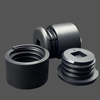
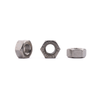
A nut is a type of fastener with a threaded hole. Nuts are almost always used opposite a mating bolt to fasten parts together. The two components work together by a combination of friction between the threads, a slight stretch of the bolt, and compression of the mating parts.
Nuts are graded with strength ratings compatible with their respective bolts; for example, an ISO property class 10 nut will be able to support the bolt proof strength load of an ISO property class 10.9 bolt without stripping. Likewise, an SAE class 5 nut can support the proof load of an SAE Grade 5 bolt, and so on. Typically hex nuts proof load should be matched with the mating hex bolts tensile strength.
A nylon insert lock nut is a kind of nut that includes a nylon collar insert. The insert is placed at the end of the nut and its inner diameter (ID) is slightly smaller than the major diameter of the screw. The insert deforms elastically over the threads of the screw, but threads are not cut into the nylon. The nylon insert locks the nut in two ways. It forces the bottom face of the screw threads against the top face of the nut threads, increasing the friction between the two, and applies a compressive force against the screw itself.
Heavy hex nuts are slightly larger and thicker than finish hex nuts. There are numerous grades and the heavy pattern is typically used for large diameter and high strength bolts.
NUTS - MOST COMMON INCH (US) STANDARD SPECIFICATIONS
ASTM A563 - Standard Specification for Carbon and Alloy Steel Nuts
ASTM A194 - Standard Specification for Carbon and Alloy Steel Nuts for Bolts for High Pressure or High Temperature Service, or Both
ASTM F594-01 Standard Specification for Stainless Steel Nuts
SAE J995 - Mechanical and Material Requirements for Steel Nuts
ASME B18.16.6 - NYLON INSERT LOCKNUTS (INCH SERIES)
NUTS - MOST COMMON METRIC STANDARD SPECIFICATIONS
DIN 934 - Hexagon Nuts
ASTM A194M - Standard Specification for Carbon and Alloy Steel Nuts for Bolts for High Pressure or High Temperature Service, or Both (Metric)
ANSI B18.16.3M - DIMENSIONAL REQUIREMENTS FOR PREVAILING-TORQUE TYPE STEEL METRIC HEX NUTS AND HEX FLANGE NUTS
SAE J995 Mechanical and Material Requirements for Metric Steel Nuts
DIN 985 - Nylon Insert Lock Nuts
FLAT WASHERS
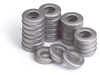
Washers provide a smooth bearing surface and are used under the head of a bolt and / or a nut. They help to create a larger, smooth bearing surface for the nut and/or bolt.
A washer is a thin plate with a hole that distributes the load of a threaded fastener, such as a screw or nut. They are also often also used as spacers. Washers usually have an outer diameter (OD) about twice the width of their inner diameter (ID).
High quality bolted joints require hardened steel washers to prevent the loss of pre-load due to Brinelling after the torque is applied.
FLAT WASHERS SPECIFICATIONS
ASTM F844 - Standard Specification for Washers, Steel, Plain (Flat), Unhardened for General Use
ASTM F436 - Standard Specification for Hardened Steel Washers
ASME B18.21.1 - Washers: Helical Spring-Lock, Tooth Lock, and Plain Washers (Inch Series)
DIN 125 - Standard Flat Washers
Spring Type Lock Washers
Lock Washers are designed to increase the strength of the assembly
ASME B18.21.1 - Washers: Helical Spring-Lock, Tooth Lock, and Plain Washers (Inch Series)
DIN 127B - Metric Helical Spring split-Lock Washers
A nut is a type of fastener with a threaded hole. Nuts are almost always used opposite a mating bolt to fasten parts together. The two components work together by a combination of friction between the threads, a slight stretch of the bolt, and compression of the mating parts.
Nuts are graded with strength ratings compatible with their respective bolts; for example, an ISO property class 10 nut will be able to support the bolt proof strength load of an ISO property class 10.9 bolt without stripping. Likewise, an SAE class 5 nut can support the proof load of an SAE Grade 5 bolt, and so on. Typically hex nuts proof load should be matched with the mating hex bolts tensile strength.
A nylon insert lock nut is a kind of nut that includes a nylon collar insert. The insert is placed at the end of the nut and its inner diameter (ID) is slightly smaller than the major diameter of the screw. The insert deforms elastically over the threads of the screw, but threads are not cut into the nylon. The nylon insert locks the nut in two ways. It forces the bottom face of the screw threads against the top face of the nut threads, increasing the friction between the two, and applies a compressive force against the screw itself.
Heavy hex nuts are slightly larger and thicker than finish hex nuts. There are numerous grades and the heavy pattern is typically used for large diameter and high strength bolts.
NUTS - MOST COMMON INCH (US) STANDARD SPECIFICATIONS
ASTM A563 - Standard Specification for Carbon and Alloy Steel Nuts
ASTM A194 - Standard Specification for Carbon and Alloy Steel Nuts for Bolts for High Pressure or High Temperature Service, or Both
ASTM F594-01 Standard Specification for Stainless Steel Nuts
SAE J995 - Mechanical and Material Requirements for Steel Nuts
ASME B18.16.6 - NYLON INSERT LOCKNUTS (INCH SERIES)
NUTS - MOST COMMON METRIC STANDARD SPECIFICATIONS
DIN 934 - Hexagon Nuts
ASTM A194M - Standard Specification for Carbon and Alloy Steel Nuts for Bolts for High Pressure or High Temperature Service, or Both (Metric)
ANSI B18.16.3M - DIMENSIONAL REQUIREMENTS FOR PREVAILING-TORQUE TYPE STEEL METRIC HEX NUTS AND HEX FLANGE NUTS
SAE J995 Mechanical and Material Requirements for Metric Steel Nuts
DIN 985 - Nylon Insert Lock Nuts
FLAT WASHERS
Washers provide a smooth bearing surface and are used under the head of a bolt and / or a nut. They help to create a larger, smooth bearing surface for the nut and/or bolt.
A washer is a thin plate with a hole that distributes the load of a threaded fastener, such as a screw or nut. They are also often also used as spacers. Washers usually have an outer diameter (OD) about twice the width of their inner diameter (ID).
High quality bolted joints require hardened steel washers to prevent the loss of pre-load due to Brinelling after the torque is applied.
FLAT WASHERS SPECIFICATIONS
ASTM F844 - Standard Specification for Washers, Steel, Plain (Flat), Unhardened for General Use
ASTM F436 - Standard Specification for Hardened Steel Washers
ASME B18.21.1 - Washers: Helical Spring-Lock, Tooth Lock, and Plain Washers (Inch Series)
DIN 125 - Standard Flat Washers
Spring Type Lock Washers
Lock Washers are designed to increase the strength of the assembly
ASME B18.21.1 - Washers: Helical Spring-Lock, Tooth Lock, and Plain Washers (Inch Series)
DIN 127B - Metric Helical Spring split-Lock Washers