BARTEC Resistive coupler resistive-coupler

Description
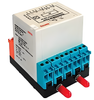
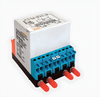
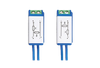
The resistive coupling element is used to monitor open circuits/short circuits on isolation amplifiers that are controlled by mechanical contacts. The resistive coupling element is installed on site directly on the contact to be monitored or in the connection area for it. Mode of operation Numerous isolation amplifiers are able to monitor the connected sensor cable for an open circuit and/or short circuit. This is possible because electronic proximity sensors in both an energized and a non-energized state can consume current as defined in EN 60947-5-6. Falling short of or exceeding this value can therefore be clearly assigned to an open circuit or short circuit. If simple mechanical contacts are used in place of electronic proximity sensors, however, it is not possible to distinguish whether a short circuit is present. The same applies to a line break and an open contact. This can be remedied by a combination of resistors at the end of the sensor cable directly before the switch. This ensures quiescent current in the cable also in the event of an open contact or to a limited extent with a closed contact, keeping the current at a value significantly below the response threshold for a short circuit. Four different statuses can be detected: open circuit, switch open, switch closed, short circuit. The resistive coupling element may be used with all isolation amplifiers with open circuit and short circuit monitoring, such as from BARTEC, CEAG, Hartmann & Braun, Pepperl + Fuchs
Request a Quote
Description
The resistive coupling element is used to monitor open circuits/short circuits on isolation amplifiers that are controlled by mechanical contacts. The resistive coupling element is installed on site directly on the contact to be monitored or in the connection area for it. Mode of operation Numerous isolation amplifiers are able to monitor the connected sensor cable for an open circuit and/or short circuit. This is possible because electronic proximity sensors in both an energized and a non-energized state can consume current as defined in EN 60947-5-6. Falling short of or exceeding this value can therefore be clearly assigned to an open circuit or short circuit. If simple mechanical contacts are used in place of electronic proximity sensors, however, it is not possible to distinguish whether a short circuit is present. The same applies to a line break and an open contact. This can be remedied by a combination of resistors at the end of the sensor cable directly before the switch. This ensures quiescent current in the cable also in the event of an open contact or to a limited extent with a closed contact, keeping the current at a value significantly below the response threshold for a short circuit. Four different statuses can be detected: open circuit, switch open, switch closed, short circuit. The resistive coupling element may be used with all isolation amplifiers with open circuit and short circuit monitoring, such as from BARTEC, CEAG, Hartmann & Braun, Pepperl + Fuchs
Request a Quote

Suppliers

Company
Product
Description
Supplier Links
Resistive coupler - resistive-coupler - BARTEC
Bad Mergentheim, Germany
Resistive coupler
resistive-coupler
Resistive coupler resistive-coupler
The resistive coupling element is used to monitor open circuits/short circuits on isolation amplifiers that are controlled by mechanical contacts. The resistive coupling element is installed on site directly on the contact to be monitored or in the connection area for it. Mode of operation Numerous isolation amplifiers are able to monitor the connected sensor cable for an open circuit and/or short circuit. This is possible because electronic proximity sensors in both an energized and a non-energized state can consume current as defined in EN 60947-5-6. Falling short of or exceeding this value can therefore be clearly assigned to an open circuit or short circuit. If simple mechanical contacts are used in place of electronic proximity sensors, however, it is not possible to distinguish whether a short circuit is present. The same applies to a line break and an open contact. This can be remedied by a combination of resistors at the end of the sensor cable directly before the switch. This ensures quiescent current in the cable also in the event of an open contact or to a limited extent with a closed contact, keeping the current at a value significantly below the response threshold for a short circuit. Four different statuses can be detected: open circuit, switch open, switch closed, short circuit. The resistive coupling element may be used with all isolation amplifiers with open circuit and short circuit monitoring, such as from BARTEC, CEAG, Hartmann & Braun, Pepperl + Fuchs

The resistive coupling element is used to monitor open circuits/short circuits on isolation amplifiers that are controlled by mechanical contacts. The resistive coupling element is installed on site directly on the contact to be monitored or in the connection area for it. Mode of operation Numerous isolation amplifiers are able to monitor the connected sensor cable for an open circuit and/or short circuit. This is possible because electronic proximity sensors in both an energized and a non-energized state can consume current as defined in EN 60947-5-6. Falling short of or exceeding this value can therefore be clearly assigned to an open circuit or short circuit. If simple mechanical contacts are used in place of electronic proximity sensors, however, it is not possible to distinguish whether a short circuit is present. The same applies to a line break and an open contact. This can be remedied by a combination of resistors at the end of the sensor cable directly before the switch. This ensures quiescent current in the cable also in the event of an open contact or to a limited extent with a closed contact, keeping the current at a value significantly below the response threshold for a short circuit. Four different statuses can be detected: open circuit, switch open, switch closed, short circuit. The resistive coupling element may be used with all isolation amplifiers with open circuit and short circuit monitoring, such as from BARTEC, CEAG, Hartmann & Braun, Pepperl + Fuchs

Supplier's Site

Technical Specifications

  BARTEC
Product Category Network Media Converters
Product Number resistive-coupler
Product Name Resistive coupler
Operating Temperature -40 to 15.56 C (-40 to 60 F)
Unlock Full Specs
to access all available technical data

Similar Products

Ethernet / LWL P-P-Coupler - ethernet-lwl-p-p-coupler - BARTEC
Specs
Operating Temperature -31.67 to 15.56 C (-25 to 60 F)
View Details
Ethernet / LWL T-Coupler - ethernet-lwl-t-coupler - BARTEC
Specs
Operating Temperature -31.67 to 15.56 C (-25 to 60 F)
View Details