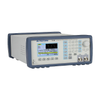
The 4077B is a 80 MHz arbitrary waveform generator from BK Precision. An arbitrary waveform generator (AWG) is a type of electronic test equipment people use to generate repetitive or single-shot electrical waveforms. Single-shot waveforms require a triggering source, either internal or external, while repetitive waveforms do not. Inject the signal the waveform generator creates into a device for analysis during testing, finding problems with the device, or confirming proper operation.
Features:
1 Channel
Sine frequency range: 80 MHz
Square frequency range: 60 MHz
Waveform length: 16 Mpts
14-bit, 200 MSa/s, up to 16 M-point Arbitrary Waveform Generator
Generate Sine waveforms up to 80 MHz, Square waveforms up to 60 MHz
Color LCD display
AM/FM/FSK modulation functions
Linear and logarithmic sweep
Programmable markers for precise triggering
Store and recall up to 49 different instrument setups
Standard USBTMC and GPIB (50 MHz and 80 MHz models only) interfaces
SCPI-compliant command set
Closed case calibration
Short circuit protection for resistive and capacitive loads on outputs and overvoltage protection on inputs
Simple integration with WaveXpress waveform editing software to send your waveform creations to the arbitrary waveform generator
The BK Precision 4077B Series Arbitrary/Function Waveform Generators combine a DDS architecture offering easy-to-use conventional function generator capabilities with a true point-by-point AWG architecture to produce accurate and precise arbitrary waveforms. Arbitrary waveforms have 14-bit amplitude resolution, 200 MSa/s sample rate, and large waveform memory up to 16,000,000 points (depending on model).
Waveforms can be output in continuous, triggered, gated, or burst modes. The instrument can be remotely controlled using SCPI-compliant commands via USB and GPIB. Extensive features such as internal or external AM, FM, and FSK modulation along with versatile sweep capabilities and variable edge pulse generation make these generators suitable for a wide range of applications including electronic design, sensor simulation, and functional test.
The 4077B is a 80 MHz arbitrary waveform generator from BK Precision. An arbitrary waveform generator (AWG) is a type of electronic test equipment people use to generate repetitive or single-shot electrical waveforms. Single-shot waveforms require a triggering source, either internal or external, while repetitive waveforms do not. Inject the signal the waveform generator creates into a device for analysis during testing, finding problems with the device, or confirming proper operation.
Features:
- 1 Channel
- Sine frequency range: 80 MHz
- Square frequency range: 60 MHz
- Waveform length: 16 Mpts
- 14-bit, 200 MSa/s, up to 16 M-point Arbitrary Waveform Generator
- Generate Sine waveforms up to 80 MHz, Square waveforms up to 60 MHz
- Color LCD display
- AM/FM/FSK modulation functions
- Linear and logarithmic sweep
- Programmable markers for precise triggering
- Store and recall up to 49 different instrument setups
- Standard USBTMC and GPIB (50 MHz and 80 MHz models only) interfaces
- SCPI-compliant command set
- Closed case calibration
- Short circuit protection for resistive and capacitive loads on outputs and overvoltage protection on inputs
- Simple integration with WaveXpress waveform editing software to send your waveform creations to the arbitrary waveform generator
The BK Precision 4077B Series Arbitrary/Function Waveform Generators combine a DDS architecture offering easy-to-use conventional function generator capabilities with a true point-by-point AWG architecture to produce accurate and precise arbitrary waveforms. Arbitrary waveforms have 14-bit amplitude resolution, 200 MSa/s sample rate, and large waveform memory up to 16,000,000 points (depending on model).
Waveforms can be output in continuous, triggered, gated, or burst modes. The instrument can be remotely controlled using SCPI-compliant commands via USB and GPIB. Extensive features such as internal or external AM, FM, and FSK modulation along with versatile sweep capabilities and variable edge pulse generation make these generators suitable for a wide range of applications including electronic design, sensor simulation, and functional test.