Design Features
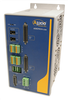
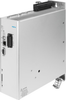
Closed-loop, two-axis servo drive for Aerotech's AGV series scanners
Infinite Field of View (IFOV) seamlessly combines AGV and servo motion to expand the scanner work area
Full servo state control with "zero-tracking error" eliminates speed-related part distortion such as necking on circles and rounding of corners
Position-based laser firing (PSO) with windowing maintains consistent spot spacing over a wide range of operating speeds
External clock input for synchronization with mode-locked lasers
The Nmark® GCL provides an optimized platform for controlling Aerotech’s family of AGV scanners. Industry leading settling times, long-term thermal stability, and micron-level tracking accuracy are possible due to advanced features such as full state feed-forward, 200 kHz servo rates, and look-ahead-based velocity control.
High-Resolution Feedback
The AGV-HP has thermally stable feedback transducers with virtually no gain or offset drift. The Nmark GCL uses advanced interpolation electronics to provide up to 26-bits of effective resolution. Onboard real-time 2D calibration ensures accurate beam placement over the entire field of view.
Position Synchronized Output
The ability to accurately place a laser spot as a function of X/Y axis position is a key feature of Aerotech’s linear positioning stages for laser processing applications (Figures 1 and 2). With the release of the Nmark GCL, this functionality is now available for scanner applications. The ability to accurately trigger the laser as a function of position removes the need to program mark, jump, and polygon delays, resulting in reduced programming complexity. By using the Position Synchronized Output functionality, scanner-based processes can now be programmed in the same fashion as traditional X/Y stage-based applications.
Remote Power Devices
Most competitive scanners have the power devices integrated directly into the head, along with the galvos and feedback devices. These power devices can inject considerable thermal energy into the scanner head causing drift in the feedback positions and changing offsets between the mirrors, all of which detract from marking accuracy. Some systems use PWM power stages to minimize heat input. However, this approach results in reduced tracking accuracy due to nonlinear effects that are present when the galvo motors and control currents reverse polarity. By moving the power stage out of the head, it is possible to use higher performing transistors to drive the galvos and the heat source is effectively removed from the scanner resulting in improved system accuracy (Figures 3 and 4).
Design Features
- Closed-loop, two-axis servo drive for Aerotech's AGV series scanners
- Infinite Field of View (IFOV) seamlessly combines AGV and servo motion to expand the scanner work area
- Full servo state control with "zero-tracking error" eliminates speed-related part distortion such as necking on circles and rounding of corners
- Position-based laser firing (PSO) with windowing maintains consistent spot spacing over a wide range of operating speeds
- External clock input for synchronization with mode-locked lasers
The Nmark® GCL provides an optimized platform for controlling Aerotech’s family of AGV scanners. Industry leading settling times, long-term thermal stability, and micron-level tracking accuracy are possible due to advanced features such as full state feed-forward, 200 kHz servo rates, and look-ahead-based velocity control.
High-Resolution Feedback
The AGV-HP has thermally stable feedback transducers with virtually no gain or offset drift. The Nmark GCL uses advanced interpolation electronics to provide up to 26-bits of effective resolution. Onboard real-time 2D calibration ensures accurate beam placement over the entire field of view.
Position Synchronized Output
The ability to accurately place a laser spot as a function of X/Y axis position is a key feature of Aerotech’s linear positioning stages for laser processing applications (Figures 1 and 2). With the release of the Nmark GCL, this functionality is now available for scanner applications. The ability to accurately trigger the laser as a function of position removes the need to program mark, jump, and polygon delays, resulting in reduced programming complexity. By using the Position Synchronized Output functionality, scanner-based processes can now be programmed in the same fashion as traditional X/Y stage-based applications.
Remote Power Devices
Most competitive scanners have the power devices integrated directly into the head, along with the galvos and feedback devices. These power devices can inject considerable thermal energy into the scanner head causing drift in the feedback positions and changing offsets between the mirrors, all of which detract from marking accuracy. Some systems use PWM power stages to minimize heat input. However, this approach results in reduced tracking accuracy due to nonlinear effects that are present when the galvo motors and control currents reverse polarity. By moving the power stage out of the head, it is possible to use higher performing transistors to drive the galvos and the heat source is effectively removed from the scanner resulting in improved system accuracy (Figures 3 and 4).