Abrisa Technologies Enhanced First Surface Aluminum

Description
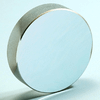
The front surface of the enhanced aluminum mirror coating reflects an average of 93% over the visible spectrum (450-650nm). Back surface reflective aluminum coatings are also available. Metal mirror coatings are often used in systems where a very broadband reflector or beam splitter is needed. Metal coatings can also be an excellent choice when an economical coating is especially important. Examples of common metal coating applications include telescope mirrors, neutral density filters, and general purpose laboratory mirrors. Metals commonly deposited at ZC&R include aluminum, chromium, silver, gold, and Inconel.
Datasheet
Description
The front surface of the enhanced aluminum mirror coating reflects an average of 93% over the visible spectrum (450-650nm). Back surface reflective aluminum coatings are also available. Metal mirror coatings are often used in systems where a very broadband reflector or beam splitter is needed. Metal coatings can also be an excellent choice when an economical coating is especially important. Examples of common metal coating applications include telescope mirrors, neutral density filters, and general purpose laboratory mirrors. Metals commonly deposited at ZC&R include aluminum, chromium, silver, gold, and Inconel.
Datasheet

Suppliers

Company
Product
Description
Supplier Links
Enhanced First Surface Aluminum -  - Abrisa Technologies
Clarksburg, WV, United States
Enhanced First Surface Aluminum
The front surface of the enhanced aluminum mirror coating reflects an average of 93% over the visible spectrum (450-650nm). Back surface reflective aluminum coatings are also available. Metal mirror coatings are often used in systems where a very broadband reflector or beam splitter is needed. Metal coatings can also be an excellent choice when an economical coating is especially important. Examples of common metal coating applications include telescope mirrors, neutral density filters, and general purpose laboratory mirrors. Metals commonly deposited at ZC&R include aluminum, chromium, silver, gold, and Inconel.

The front surface of the enhanced aluminum mirror coating reflects an average of 93% over the visible spectrum (450-650nm). Back surface reflective aluminum coatings are also available.

Metal mirror coatings are often used in systems where a very broadband reflector or beam splitter is needed. Metal coatings can also be an excellent choice when an economical coating is especially important. Examples of common metal coating applications include telescope mirrors, neutral density filters, and general purpose laboratory mirrors. Metals commonly deposited at ZC&R include aluminum, chromium, silver, gold, and Inconel.

Supplier's Site Datasheet

Technical Specifications

  Abrisa Technologies
Product Category Optical Mirrors
Product Name Enhanced First Surface Aluminum
Mirror Types Flat Mirror
Unlock Full Specs
to access all available technical data

Similar Products

Dielectric Mirror, Laser Line, Zerodur, 25.4 mm, λ/20, 632.8 nm - 10Z40DM.4 - Newport MKS
Specs
Mirror Types Laser Mirror
Wavelength Range 633 nm (6328 Å)
Diameter/Width 25.4 mm (1 inch)
View Details
Optical Dielectric HR Mirrors -  - Changchun Yutai Optics Co., Ltd.
Changchun Yutai Optics Co., Ltd.
Specs
Mirror Types Flat Mirror; Spherical Mirror
Mirror Shape Round; Rectangular / Square; Elliptical
Mirror Materials Fused Silica; H-K9L or fused silica
View Details
Cell Mirror -  - CRYSTECH, Inc.
CRYSTECH, Inc.
Specs
Mirror Types Laser Mirror
Mirror Shape Round
View Details
UV Mirror - 7770 - Alluxa, Inc.
Alluxa, Inc.
Specs
Diameter/Width 23.5 mm (0.9252 inch)
Thickness 1.04 mm (0.0409 inch)
Mirror Shape Round
View Details