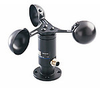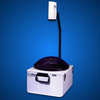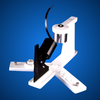

The Multi-Filter Rotating Shadowband Radiometer (Model MFR-7) is designed for precise measurement of solar irradiance components, including global, diffuse, and direct normal irradiance. It employs independent interference filter-photodiode combinations to capture spectral irradiance at six specific wavelengths (415, 500, 615, 673, 870, and 940 nm) along with a broadband channel for total solar irradiance measurement. The instrument features an automated microprocessor-contr
The Multi-Filter Rotating Shadowband Radiometer (Model MFR-7) is a field instrument that simultaneously measures global, diffuse, and direct normal components of spectral solar irradiance. The MFR-7 uses independent interference filter-photodiode combinations, mounted in a temperature-controll
The MFR-7 spectral measurements are made at six wavelengths: 415, 500, 615, 673, 870, and 940 nm. The choice of wavelengths allows the reconstruction of the incident solar spectral irradiance and the determination of optical depths of water vapor, aerosols, and ozone (using the Chappuis ozone absorption bands). The broadband channel measures the total solar irradiance, similar to a pyranometer such as our Model TSP-700. Custom wavelength channel configurations are available on special order.
The MFR-7's unique ability to make simultaneous spectral measurements of the three solar irradiance components makes it extremely versatile. For example, in order to obtain the data collected in the broadband channel of the MFR-7, at least two instruments would have to be used: a total solar pyranometer, and either a tracker-mounted normal incidence pyrheliometer or a second, shaded total solar pyranometer. The MFR-7 has the advantage of sensing the global and diffuse irradiance components with the same detector. This eliminates the error introduced into the measurement of solar irradiance components by the use of different detectors to measure the different components.
| Yankee Environmental Systems, Inc. | |
|---|---|
| Product Category | Weather Instruments |
| Product Number | MFR-7 |
| Product Name | Multifilter Rotating Shadowband Radiometer |
| Device Classification | Sensor System |
| Weather Component Sensed | Measures solar Radiation |
| Interface Options | Digital Serial |
| Wavelength Range Measured | 415 to 940 nm (4150 to 9400 Å) |