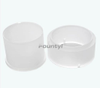
San Jose Delta Associates, Inc. MACOR® Glass-Ceramic Rods 3" Length Round MACOR Rod

Description
Macor is a relatively easy material to machine using ordinary carbide drills, end mills, taps, etc. and doesn’t require post machining firing. Macor-Machinable Glass Ceramic is also unique in that it can withstand 1000°C, has low thermal conductivity and is a good electrical insulator. Macor is often the material of choice because it is easy to machine into complex shapes, doesn’t require sintering and is, readily available even in small quantities. Properties MACOR® Machinable Glass Ceramic has a continuous use temperature of 800°C and a peak temperature of 1000°C. Its coefficient of thermal expansion readily matches most metals and sealing glasses. It is non-wetting, exhibits zero porosity, and unlike ductile materials, won't deform. It is an excellent insulator at high voltages, various frequencies, and high temperatures. When properly baked out, it won't outgas in vacuum environments. Machining Machining tolerances are surprisingly tight, up to .0005". It can be machined to a surface finish of less than 20µin.-AA. Configurations are limited only by available equipment and the experience of the machinist. Sealing, Joining and Metalizing MACOR® MGC can also be joined or sealed - both to itself and to other materials - in a number of ways: metalized parts can be soldered together and brazing has proven an effective method of joining the material to various metals; epoxy produces a strong joint, and a sealing glass creates a vacuum tight seal. Even a straight-forward mechanical joint is possible. It can be thick film metalized using metal links, or thin film metalized by sputtering.
Description
Macor is a relatively easy material to machine using ordinary carbide drills, end mills, taps, etc. and doesn’t require post machining firing. Macor-Machinable Glass Ceramic is also unique in that it can withstand 1000°C, has low thermal conductivity and is a good electrical insulator. Macor is often the material of choice because it is easy to machine into complex shapes, doesn’t require sintering and is, readily available even in small quantities. Properties MACOR® Machinable Glass Ceramic has a continuous use temperature of 800°C and a peak temperature of 1000°C. Its coefficient of thermal expansion readily matches most metals and sealing glasses. It is non-wetting, exhibits zero porosity, and unlike ductile materials, won't deform. It is an excellent insulator at high voltages, various frequencies, and high temperatures. When properly baked out, it won't outgas in vacuum environments. Machining Machining tolerances are surprisingly tight, up to .0005". It can be machined to a surface finish of less than 20µin.-AA. Configurations are limited only by available equipment and the experience of the machinist. Sealing, Joining and Metalizing MACOR® MGC can also be joined or sealed - both to itself and to other materials - in a number of ways: metalized parts can be soldered together and brazing has proven an effective method of joining the material to various metals; epoxy produces a strong joint, and a sealing glass creates a vacuum tight seal. Even a straight-forward mechanical joint is possible. It can be thick film metalized using metal links, or thin film metalized by sputtering.

Suppliers

Company
Product
Description
Supplier Links
MACOR® Glass-Ceramic Rods - 3
Santa Clara, CA, USA
MACOR® Glass-Ceramic Rods
3" Length Round MACOR Rod
MACOR® Glass-Ceramic Rods 3" Length Round MACOR Rod
Macor is a relatively easy material to machine using ordinary carbide drills, end mills, taps, etc. and doesn’t require post machining firing. Macor-Machinable Glass Ceramic is also unique in that it can withstand 1000°C, has low thermal conductivity and is a good electrical insulator. Macor is often the material of choice because it is easy to machine into complex shapes, doesn’t require sintering and is, readily available even in small quantities. Properties MACOR® Machinable Glass Ceramic has a continuous use temperature of 800°C and a peak temperature of 1000°C. Its coefficient of thermal expansion readily matches most metals and sealing glasses. It is non-wetting, exhibits zero porosity, and unlike ductile materials, won't deform. It is an excellent insulator at high voltages, various frequencies, and high temperatures. When properly baked out, it won't outgas in vacuum environments. Machining Machining tolerances are surprisingly tight, up to .0005". It can be machined to a surface finish of less than 20µin.-AA. Configurations are limited only by available equipment and the experience of the machinist. Sealing, Joining and Metalizing MACOR® MGC can also be joined or sealed - both to itself and to other materials - in a number of ways: metalized parts can be soldered together and brazing has proven an effective method of joining the material to various metals; epoxy produces a strong joint, and a sealing glass creates a vacuum tight seal. Even a straight-forward mechanical joint is possible. It can be thick film metalized using metal links, or thin film metalized by sputtering.

Macor is a relatively easy material to machine using ordinary carbide drills, end mills, taps, etc. and doesn’t require post machining firing. Macor-Machinable Glass Ceramic is also unique in that it can withstand 1000°C, has low thermal conductivity and is a good electrical insulator. Macor is often the material of choice because it is easy to machine into complex shapes, doesn’t require sintering and is, readily available even in small quantities.

Properties

MACOR® Machinable Glass Ceramic has a continuous use temperature of 800°C and a peak temperature of 1000°C. Its coefficient of thermal expansion readily matches most metals and sealing glasses. It is non-wetting, exhibits zero porosity, and unlike ductile materials, won't deform. It is an excellent insulator at high voltages, various frequencies, and high temperatures. When properly baked out, it won't outgas in vacuum environments.

Machining

Machining tolerances are surprisingly tight, up to .0005". It can be machined to a surface finish of less than 20µin.-AA. Configurations are limited only by available equipment and the experience of the machinist.

Sealing, Joining and Metalizing

MACOR® MGC can also be joined or sealed - both to itself and to other materials - in a number of ways: metalized parts can be soldered together and brazing has proven an effective method of joining the material to various metals; epoxy produces a strong joint, and a sealing glass creates a vacuum tight seal. Even a straight-forward mechanical joint is possible.

It can be thick film metalized using metal links, or thin film metalized by sputtering.

Supplier's Site

Technical Specifications

  San Jose Delta Associates, Inc.
Product Category Glass Materials
Product Number 3" Length Round MACOR Rod
Product Name MACOR® Glass-Ceramic Rods
Shape / Form Rod
Applications Refractory or High Temperature Insulation
Glass Type Glass; GlassCeramic
Length 3 inch (76.2 mm)
Width / OD 0.1880 to 3 inch (4.78 to 76.2 mm)
Unlock Full Specs
to access all available technical data

Similar Products

Lead Glass -  - MarShield
MarShield
Specs
Shape / Form Plate / Board
Applications Radiation Protections
Glass Type Glass; Lead Glass
View Details
Quartz Glass -  - Fountyl Technologies Pte. Ltd.
Fountyl Technologies Pte. Ltd.
Specs
Glass Type Glass; Quartz
Thermal Conductivity 1.24 to 1.38 W/m-K (0.7165 to 0.7973 BTU-ft/hr-ft²-F)
CTE 5.7 to 6.4 µm/m-C (3.17 to 3.56 µin/in-F)
View Details
 - 271 200 000 - Pegasus Glass
Pegasus Glass
Specs
Shape / Form Rod
Applications Laboratory; Chemical or material processing
Glass Type Glass; Borosilicate
View Details
Gold on Silver Coated Glass, GoSiGlass™ -  - Technic, Inc.
Specs
Applications Electronics or semiconductors
Features Glaze or protective coating
Glass Type Glass
View Details