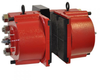
Messier-Bugatti-Dowty Boeing 737 Next Generation Brake

Description
In the same way as propulsion or lift, braking is one of the vital functions on an aircraft. Thanks to the braking function the aircraft is able to come to a halt after landing, taxies in safety and can stop in an emergency if there is a rejected take-off. Whether on a bicycle, car or aircraft, the problem is the same: the kinetic energy of the moving vehicle has to be absorbed and then transformed into heat in order to dissipate it. Stopping an Airbus A340 or a Boeing 777 travelling at 300 km/h in a few hundred meters means absorbing more than 1 billion joules in a few tens of seconds - around 125 mega joules per wheel and brake! Although the risk is in the order of 1 in 1 million take offs, it is the most extreme case that Messier-Bugatti-Dowt y's wheels and brakes have to deal with in the unlikely event of a rejected take-off. To do this, Messier-Bugatti-Dowt y has developed a range of innovative technologies, such as carbon and electric brakes, and can rely on its experience gained from decade-long partnerships on a range of commercial and military programs.
Datasheet
Description
In the same way as propulsion or lift, braking is one of the vital functions on an aircraft. Thanks to the braking function the aircraft is able to come to a halt after landing, taxies in safety and can stop in an emergency if there is a rejected take-off. Whether on a bicycle, car or aircraft, the problem is the same: the kinetic energy of the moving vehicle has to be absorbed and then transformed into heat in order to dissipate it. Stopping an Airbus A340 or a Boeing 777 travelling at 300 km/h in a few hundred meters means absorbing more than 1 billion joules in a few tens of seconds - around 125 mega joules per wheel and brake! Although the risk is in the order of 1 in 1 million take offs, it is the most extreme case that Messier-Bugatti-Dowt y's wheels and brakes have to deal with in the unlikely event of a rejected take-off. To do this, Messier-Bugatti-Dowt y has developed a range of innovative technologies, such as carbon and electric brakes, and can rely on its experience gained from decade-long partnerships on a range of commercial and military programs.
Datasheet

Suppliers

Company
Product
Description
Supplier Links
Boeing 737 Next Generation Brake -  - Messier-Bugatti-Dowty
Velizy-Villacoublay, Yvelines, France
Boeing 737 Next Generation Brake
In the same way as propulsion or lift, braking is one of the vital functions on an aircraft. Thanks to the braking function the aircraft is able to come to a halt after landing, taxies in safety and can stop in an emergency if there is a rejected take-off. Whether on a bicycle, car or aircraft, the problem is the same: the kinetic energy of the moving vehicle has to be absorbed and then transformed into heat in order to dissipate it. Stopping an Airbus A340 or a Boeing 777 travelling at 300 km/h in a few hundred meters means absorbing more than 1 billion joules in a few tens of seconds - around 125 mega joules per wheel and brake! Although the risk is in the order of 1 in 1 million take offs, it is the most extreme case that Messier-Bugatti-Dowt y's wheels and brakes have to deal with in the unlikely event of a rejected take-off. To do this, Messier-Bugatti-Dowt y has developed a range of innovative technologies, such as carbon and electric brakes, and can rely on its experience gained from decade-long partnerships on a range of commercial and military programs.

In the same way as propulsion or lift, braking is one of the vital functions on an aircraft. Thanks to the braking function the aircraft is able to come to a halt after landing, taxies in safety and can stop in an emergency if there is a rejected take-off.

Whether on a bicycle, car or aircraft, the problem is the same: the kinetic energy of the moving vehicle has to be absorbed and then transformed into heat in order to dissipate it.

Stopping an Airbus A340 or a Boeing 777 travelling at 300 km/h in a few hundred meters means absorbing more than 1 billion joules in a few tens of seconds - around 125 mega joules per wheel and brake! Although the risk is in the order of 1 in 1 million take offs, it is the most extreme case that Messier-Bugatti-Dowty's wheels and brakes have to deal with in the unlikely event of a rejected take-off. To do this, Messier-Bugatti-Dowty has developed a range of innovative technologies, such as carbon and electric brakes, and can rely on its experience gained from decade-long partnerships on a range of commercial and military programs.

Supplier's Site Datasheet

Technical Specifications

  Messier-Bugatti-Dowty
Product Category Hydraulic Brakes
Product Name Boeing 737 Next Generation Brake
Unlock Full Specs
to access all available technical data

Similar Products

Caliper Disc Brakes - Hydraulic Brakes - H962D | H962DUL -  - Branham, W.C. Inc.
Specs
Hydraulic Pressure 1000 psi (704 m H2O)
Configuration Disc
Bore Diameter 3.5 inch (88.9 mm)
View Details
Spring Applied, Hydraulic Pressure Released  Disc Brake - SKP 95-SA - Dellner Brakes AB
Specs
Configuration Disc
Engagement Friction
Operation Spring Actuation / Engage
View Details
 - Water-Cooled Third Generation Brake - Eaton Hydraulics Group
Specs
Configuration Disc
Engagement Friction
Operation Spring Actuation / Engage
View Details