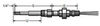
Pyromation Spring-Loaded RTD/Thermowell Assembly - Sensor with Connection Heads

Description
Resistance temperature detectors (RTDs), also known as resistance thermometers, accurately sense process temperatures with an excellent degree of repeatability and interchangeability of elements. The RTD is composed of certain metallic elements whose change in resistance is a function of temperature. In operation, a small excitation current is passed across the element, and the voltage, which is proportional to resistance, is then measured and converted to units of temperature calibration. The RTD measurement element is manufactured by winding a wire (wire wound elements) or plating a film (thin film elements) on a ceramic or glass core and sealing the element within a ceramic or glass capsule. Since most resistance temperature detectors and resistance thermometers have a low initial resistance, often 100 ohms, and have a small change in resistance per unit of temperature range, the resistance of the lead wire is often compensated for with a three or four wire bridge configuration built into the measuring devices. By selecting the proper elements and protective sheathing, RTDs can operate in a temperature range of (-200 to 650) °C [-328 to 1202] °F. Pyromation manufactures resistance temperature detectors and resistance thermometers for many industry applications. From single- or dual-element RTDs, PT100s-PT1000s, to Sanitary CIP configurations, we have the right RTD type for your job. If what you need is not available from our catalog, our product engineers will design an RTD measurement device for your specific application, including temperature sensor assemblies that require connection heads, thermowells and/or transmitters.
Request a Quote Datasheet
Description
Resistance temperature detectors (RTDs), also known as resistance thermometers, accurately sense process temperatures with an excellent degree of repeatability and interchangeability of elements. The RTD is composed of certain metallic elements whose change in resistance is a function of temperature. In operation, a small excitation current is passed across the element, and the voltage, which is proportional to resistance, is then measured and converted to units of temperature calibration. The RTD measurement element is manufactured by winding a wire (wire wound elements) or plating a film (thin film elements) on a ceramic or glass core and sealing the element within a ceramic or glass capsule. Since most resistance temperature detectors and resistance thermometers have a low initial resistance, often 100 ohms, and have a small change in resistance per unit of temperature range, the resistance of the lead wire is often compensated for with a three or four wire bridge configuration built into the measuring devices. By selecting the proper elements and protective sheathing, RTDs can operate in a temperature range of (-200 to 650) °C [-328 to 1202] °F. Pyromation manufactures resistance temperature detectors and resistance thermometers for many industry applications. From single- or dual-element RTDs, PT100s-PT1000s, to Sanitary CIP configurations, we have the right RTD type for your job. If what you need is not available from our catalog, our product engineers will design an RTD measurement device for your specific application, including temperature sensor assemblies that require connection heads, thermowells and/or transmitters.
Request a Quote Datasheet

Suppliers

Company
Product
Description
Supplier Links
Spring-Loaded RTD/Thermowell Assembly - Sensor with Connection Heads -  - Pyromation
Fort Wayne, IN, United States
Spring-Loaded RTD/Thermowell Assembly - Sensor with Connection Heads
Resistance temperature detectors (RTDs), also known as resistance thermometers, accurately sense process temperatures with an excellent degree of repeatability and interchangeability of elements. The RTD is composed of certain metallic elements whose change in resistance is a function of temperature. In operation, a small excitation current is passed across the element, and the voltage, which is proportional to resistance, is then measured and converted to units of temperature calibration. The RTD measurement element is manufactured by winding a wire (wire wound elements) or plating a film (thin film elements) on a ceramic or glass core and sealing the element within a ceramic or glass capsule. Since most resistance temperature detectors and resistance thermometers have a low initial resistance, often 100 ohms, and have a small change in resistance per unit of temperature range, the resistance of the lead wire is often compensated for with a three or four wire bridge configuration built into the measuring devices. By selecting the proper elements and protective sheathing, RTDs can operate in a temperature range of (-200 to 650) °C [-328 to 1202] °F. Pyromation manufactures resistance temperature detectors and resistance thermometers for many industry applications. From single- or dual-element RTDs, PT100s-PT1000s, to Sanitary CIP configurations, we have the right RTD type for your job. If what you need is not available from our catalog, our product engineers will design an RTD measurement device for your specific application, including temperature sensor assemblies that require connection heads, thermowells and/or transmitters.

Resistance temperature detectors (RTDs), also known as resistance thermometers, accurately sense process temperatures with an excellent degree of repeatability and interchangeability of elements. The RTD is composed of certain metallic elements whose change in resistance is a function of temperature. In operation, a small excitation current is passed across the element, and the voltage, which is proportional to resistance, is then measured and converted to units of temperature calibration. The RTD measurement element is manufactured by winding a wire (wire wound elements) or plating a film (thin film elements) on a ceramic or glass core and sealing the element within a ceramic or glass capsule.

Since most resistance temperature detectors and resistance thermometers have a low initial resistance, often 100 ohms, and have a small change in resistance per unit of temperature range, the resistance of the lead wire is often compensated for with a three or four wire bridge configuration built into the measuring devices. By selecting the proper elements and protective sheathing, RTDs can operate in a temperature range of (-200 to 650) °C [-328 to 1202] °F.

Pyromation manufactures resistance temperature detectors and resistance thermometers for many industry applications. From single- or dual-element RTDs, PT100s-PT1000s, to Sanitary CIP configurations, we have the right RTD type for your job. If what you need is not available from our catalog, our product engineers will design an RTD measurement device for your specific application, including temperature sensor assemblies that require connection heads, thermowells and/or transmitters.

Supplier's Site Datasheet

Technical Specifications

  Pyromation
Product Category RTD Temperature Probes
Product Name Spring-Loaded RTD/Thermowell Assembly - Sensor with Connection Heads
Sensed Temperature -328 to 399 F (-200 to 204 C)
Application Options Explosion Proof (optional feature); Transmitter (Typ. 4-20 mA) Output Available (optional feature)
Element Material Platinum
Reference Resistance 100 Ohms (Most Common)
# of Lead Wires Per Element 2 (optional feature); 3 (optional feature); 4 (optional feature)
Unlock Full Specs
to access all available technical data

Similar Products

Fixed Sheath w/ Mini Connection Heads - Sensor with Connection Heads -  - Pyromation
Specs
Sensed Temperature -328 to 399 F (-200 to 204 C)
Element Material Platinum
Reference Resistance 100 Ohms (Most Common)
View Details
Water-Tight CIP RTD Assembly - Food, Dairy & Pharmaceutical -  - Pyromation
Specs
Sensed Temperature -59.8 to 320 F (-51 to 160 C)
Application Options Splash Proof, Watertight or Direct Immersion; Designed Specifically for Sanitary Applications; Transmitter (Typ. 4-20 mA) Output Available
Element Material Platinum
View Details
Non-Intrusive Single Wall RTD -  - Pyromation
Specs
Sensed Temperature -40 to 399 F (-40 to 204 C)
Application Options Designed Specifically for Sanitary Applications; Transmitter (Typ. 4-20 mA) Output Available (optional feature)
Element Material Platinum
View Details
Miniature Temperature Sensor -  - Pyromation
Specs
Sensed Temperature -40 to 399 F (-40 to 204 C)
Element Material Platinum (optional feature)
Reference Resistance 100 Ohms (Most Common) (optional feature)
View Details
