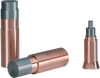
Plansee SE Resistance Welding Electrodes

Description
In the resistance welding process, the parts to be joined are pressed together and heated by an electric current until pools of molten material form at individual points between them. This operation requires high currents and large pressing forces. During the welding of thick sheets, the forces between the electrode and the workpiece may reach as much as 450 MPa. This represents a considerable challenge for the welding electrodes that have to withstand these loads. Welding electrodes made from our refractory metals and their alloys have a relatively high level of electrical conductivity while also exhibiting outstanding stability at high temperatures. They therefore have a considerably longer service life than conventional materials such as copper and copper alloys. Take a look for yourself and use our materials to increase your electrode service lives. Our welding electrodes made of tungsten, molybdenum and their alloys are particularly suitable for welding highly conductive materials such as copper. They are used in the following processes: Spot welding, Roller welding, Projection welding, Upset welding. Soldering versus back casting. And the winner is ... The better the joint between the tungsten electrode and the copper electrode is, the better and more reproducible your welding results will be. This is because defective joins reduce thermal conductivity and cause the electrical resistance of the electrode to fluctuate.
Description
In the resistance welding process, the parts to be joined are pressed together and heated by an electric current until pools of molten material form at individual points between them. This operation requires high currents and large pressing forces. During the welding of thick sheets, the forces between the electrode and the workpiece may reach as much as 450 MPa. This represents a considerable challenge for the welding electrodes that have to withstand these loads. Welding electrodes made from our refractory metals and their alloys have a relatively high level of electrical conductivity while also exhibiting outstanding stability at high temperatures. They therefore have a considerably longer service life than conventional materials such as copper and copper alloys. Take a look for yourself and use our materials to increase your electrode service lives. Our welding electrodes made of tungsten, molybdenum and their alloys are particularly suitable for welding highly conductive materials such as copper. They are used in the following processes: Spot welding, Roller welding, Projection welding, Upset welding. Soldering versus back casting. And the winner is ... The better the joint between the tungsten electrode and the copper electrode is, the better and more reproducible your welding results will be. This is because defective joins reduce thermal conductivity and cause the electrical resistance of the electrode to fluctuate.

Suppliers

Company
Product
Description
Supplier Links
Resistance Welding Electrodes -  - Plansee SE
Reutte, Austria
Resistance Welding Electrodes
In the resistance welding process, the parts to be joined are pressed together and heated by an electric current until pools of molten material form at individual points between them. This operation requires high currents and large pressing forces. During the welding of thick sheets, the forces between the electrode and the workpiece may reach as much as 450 MPa. This represents a considerable challenge for the welding electrodes that have to withstand these loads. Welding electrodes made from our refractory metals and their alloys have a relatively high level of electrical conductivity while also exhibiting outstanding stability at high temperatures. They therefore have a considerably longer service life than conventional materials such as copper and copper alloys. Take a look for yourself and use our materials to increase your electrode service lives. Our welding electrodes made of tungsten, molybdenum and their alloys are particularly suitable for welding highly conductive materials such as copper. They are used in the following processes: Spot welding, Roller welding, Projection welding, Upset welding. Soldering versus back casting. And the winner is ... The better the joint between the tungsten electrode and the copper electrode is, the better and more reproducible your welding results will be. This is because defective joins reduce thermal conductivity and cause the electrical resistance of the electrode to fluctuate.

In the resistance welding process, the parts to be joined are pressed together and heated by an electric current until pools of molten material form at individual points between them. This operation requires high currents and large pressing forces.

During the welding of thick sheets, the forces between the electrode and the workpiece may reach as much as 450 MPa. This represents a considerable challenge for the welding electrodes that have to withstand these loads.

Welding electrodes made from our refractory metals and their alloys have a relatively high level of electrical conductivity while also exhibiting outstanding stability at high temperatures. They therefore have a considerably longer service life than conventional materials such as copper and copper alloys. Take a look for yourself and use our materials to increase your electrode service lives.

Our welding electrodes made of tungsten, molybdenum and their alloys are particularly suitable for welding highly conductive materials such as copper. They are used in the following processes: Spot welding, Roller welding, Projection welding, Upset welding.

Soldering versus back casting. And the winner is ...

The better the joint between the tungsten electrode and the copper electrode is, the better and more reproducible your welding results will be. This is because defective joins reduce thermal conductivity and cause the electrical resistance of the electrode to fluctuate.

Supplier's Site

Technical Specifications

  Plansee SE
Product Category Electrodes and Electrode Materials
Product Name Resistance Welding Electrodes
Material Molybdenum; Tungsten
Unlock Full Specs
to access all available technical data

Similar Products

Automotive Terminals - 1-1719103-1 - TE Connectivity
Specs
Type Contact
Plating / Coating Tin Silver (SnAg)
Applications Motor or Generator
View Details
Battery Electrode Materials - PolyGrid® - Dexmet® Corporation, a part of PPG’s engineered materials division
Dexmet® Corporation, a part of PPG’s engineered materials division
Specs
OD / Width 12 to 48 inch (305 to 1219 mm)
Thickness 0.0020 to 0.0400 inch (0.0508 to 1.02 mm)
View Details
Tungsten Wire -  - Rhenium Alloys, Inc.
Rhenium Alloys, Inc.
Specs
Type Cathodic Emitters / Filaments
Material Tungsten
Shape / Form Bar Stock (optional feature); Wire
View Details