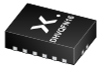
The NBM7100A/Bis a battery energy management device designed to maximize usable capacity from non-rechargeable, primary batteries when used in low-voltage, low-power applications requiring burst current loads. The devices overcome voltage drop and battery life limitations associated with extracting high pulse currents (Figure 1) from lithium primary batteries such as 3 V lithium manganese dioxide (LiMnO2) coin cells.which are commonly used in wireless, low-power IoT sensor applications.
The NBM7100A/Bcontains two stages of high efficiency DC-DC conversion and an intelligent learning algorithm. The first stage DC-DC conversion transfers energy from the lithium battery at a low constant current to a capacitive storage element. Once charged, a second DC-DC conversion cycle utilizes this stored energy to supply a regulated voltage with high pulse load current capability on the VDH output pin. The battery is never directly subjected to large load pulse currents, resulting in a longer, more predictable battery lifetime.
The proprietary learning algorithm monitors the energy used during repetitive load pulse cycles and optimizes first stage DC-DC conversion to minimize the residual charge in the storage capacitor.
A serial interface allows a microcontroller to change default configuration settings and read-back system information.
Table 1.Related devices
Type number
-
Bus interface
-
Auto
start
-
Pulse
ILOAD
NBM7100A
I²C
Yes
≥ 200 mA
NBM7100B
SPI
No
≥ 200 mA
Figure 1.IoT pulsed load profile
Features and benefits
Programmable constant battery load current: 2 mA to 16 mA
Protection against battery voltage dips (Brown-out)
Pulse output current: > 200 mA
Low ripple regulated programmable output voltage, VDH: 1.8 V to 3.6 V
Ultra-low standby current: 20 nA (typ)
Peak conversion efficiency up to 93% with adaptive optimization
Integrated fuel gauge
Small 16 pin lead-free package (SOT763-1/DHVQFN16
; 2.5 mm × 3.5 mm × 0.85 mm)
Specified from -40 °C to +85 °C
Applications
Battery powered wireless microcontroller applications (IoT): Bluetooth®, LoRaWAN®, Sigfox™, LTE-M, NB-IoT, Zigbee, etc.
Industrial: temperature, occupancy, e-metering, electronic shelf label, asset tracking, irrigation monitoring
Consumer/wearable: location tags, heart rate monitor, blood glucose meter, remote controls, key fobs
Figure 1. Simplified Application
The NBM7100A/Bis a battery energy management device designed to maximize usable capacity from non-rechargeable, primary batteries when used in low-voltage, low-power applications requiring burst current loads. The devices overcome voltage drop and battery life limitations associated with extracting high pulse currents (Figure 1) from lithium primary batteries such as 3 V lithium manganese dioxide (LiMnO2) coin cells.which are commonly used in wireless, low-power IoT sensor applications.
The NBM7100A/Bcontains two stages of high efficiency DC-DC conversion and an intelligent learning algorithm. The first stage DC-DC conversion transfers energy from the lithium battery at a low constant current to a capacitive storage element. Once charged, a second DC-DC conversion cycle utilizes this stored energy to supply a regulated voltage with high pulse load current capability on the VDH output pin. The battery is never directly subjected to large load pulse currents, resulting in a longer, more predictable battery lifetime.
The proprietary learning algorithm monitors the energy used during repetitive load pulse cycles and optimizes first stage DC-DC conversion to minimize the residual charge in the storage capacitor.
A serial interface allows a microcontroller to change default configuration settings and read-back system information.
Table 1.Related devices
Type number
-
Bus interface
-
Auto
start
-
Pulse
ILOAD
NBM7100A
I²C
Yes
≥ 200 mA
NBM7100B
SPI
No
≥ 200 mA
Figure 1.IoT pulsed load profile
Features and benefits
- Programmable constant battery load current: 2 mA to 16 mA
- Protection against battery voltage dips (Brown-out)
- Pulse output current: > 200 mA
- Low ripple regulated programmable output voltage, VDH: 1.8 V to 3.6 V
- Ultra-low standby current: 20 nA (typ)
- Peak conversion efficiency up to 93% with adaptive optimization
- Integrated fuel gauge
- Small 16 pin lead-free package (SOT763-1/DHVQFN16; 2.5 mm × 3.5 mm × 0.85 mm)
- Specified from -40 °C to +85 °C
Applications
- Battery powered wireless microcontroller applications (IoT): Bluetooth®, LoRaWAN®, Sigfox™, LTE-M, NB-IoT, Zigbee, etc.
- Industrial: temperature, occupancy, e-metering, electronic shelf label, asset tracking, irrigation monitoring
- Consumer/wearable: location tags, heart rate monitor, blood glucose meter, remote controls, key fobs
Figure 1. Simplified Application