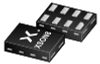
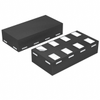
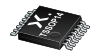
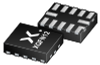
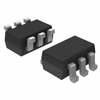
The LSF0102 and LSF0202 are both 2 channel bidirectional multi-voltage level translators for open-drain and push-pull applications. The LSF0102 and LSF0202 support up to 100 MHz up translation and ≥100 MHz down translation at ≤ 30 pF capacitive load. There is no need for a direction pin which minimizes system effort. Both support 5 V tolerant I/O pins for compatibility with TTL levels in a variety of applications. The ability to set up different voltage translation levels on each channel makes the device very flexible and suitable for a lot of different applications.
LSF0102 and LSF0202 differ in pin assignment only.
Features and benefits
Bidirectional voltage translation with no direction pin
Up translation
≤ 100 MHz; CL = 30 pF
≤ 50 MHz; CL = 50 pF
Down translation
≥ 100 MHz; CL = 30 pF
≥ 50 MHz; CL = 50 pF
Hot insertion
Bidirectional voltage level translation between:
0.95 V and 1.8 V, 2.5 V, 3.3 V and 5.0 V
1.2 V and 1.8 V, 2.5 V, 3.3 V and 5.0 V
1.8 V and 2.5 V, 3.3 V and 5.0 V
2.5 V and 3.3 V and 5.0 V
3.3 V and 5.0 V
Low standby current
5 V tolerant I/O pins to support TTL
Low RON provides less signal distortion
High-impedance I/O pins for EN = Low
Both, LSF0102 and LSF0202 support flow-through pinout for easy PCB trace routing
Latch-up performance exceeds 100 mA per JESD78 class II level A
ESD protection:
HBM: ANSI/ESDA/JEDEC JS-001 class 2 exceeds 2000 V
CDM: ANSI/ESDA/JEDEC JS-002 class C3 exceeds 1000 V
Specified from -40 °C to +125 °C
Applications
GPIO, MDIO, PMBus, SMBus, SDIO, UART, I2C, and other interfaces in Telecom infrastructure
Industrial
Personal computing
The LSF0102 and LSF0202 are both 2 channel bidirectional multi-voltage level translators for open-drain and push-pull applications. The LSF0102 and LSF0202 support up to 100 MHz up translation and ≥100 MHz down translation at ≤ 30 pF capacitive load. There is no need for a direction pin which minimizes system effort. Both support 5 V tolerant I/O pins for compatibility with TTL levels in a variety of applications. The ability to set up different voltage translation levels on each channel makes the device very flexible and suitable for a lot of different applications.
LSF0102 and LSF0202 differ in pin assignment only.
Features and benefits
- Bidirectional voltage translation with no direction pin
- Up translation
- ≤ 100 MHz; CL = 30 pF
- ≤ 50 MHz; CL = 50 pF
- Down translation
- ≥ 100 MHz; CL = 30 pF
- ≥ 50 MHz; CL = 50 pF
- Hot insertion
- Bidirectional voltage level translation between:
- 0.95 V and 1.8 V, 2.5 V, 3.3 V and 5.0 V
- 1.2 V and 1.8 V, 2.5 V, 3.3 V and 5.0 V
- 1.8 V and 2.5 V, 3.3 V and 5.0 V
- 2.5 V and 3.3 V and 5.0 V
- 3.3 V and 5.0 V
- Low standby current
- 5 V tolerant I/O pins to support TTL
- Low RON provides less signal distortion
- High-impedance I/O pins for EN = Low
- Both, LSF0102 and LSF0202 support flow-through pinout for easy PCB trace routing
- Latch-up performance exceeds 100 mA per JESD78 class II level A
- ESD protection:
- HBM: ANSI/ESDA/JEDEC JS-001 class 2 exceeds 2000 V
- CDM: ANSI/ESDA/JEDEC JS-002 class C3 exceeds 1000 V
- Specified from -40 °C to +125 °C
Applications
- GPIO, MDIO, PMBus, SMBus, SDIO, UART, I2C, and other interfaces in Telecom infrastructure
- Industrial
- Personal computing