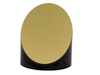
Newport MKS Hollow Retroreflector, Broadband, 63.5 mm, 2 arc sec, 650-16,000 nm UBBR2.5-2I

Description
The UBBR2.5-2I Broadband Hollow Retroreflector is constructed of three front-surface flat mirrors assembled into a corner cube. A stress-free mounting technique is employed to ensure dimensional stability. This geometry results in a reflected beam that is precisely parallel to the incident beam, independent of the angle of incidence. Unlike solid glass retroreflectors, the optical path is entirely in air so efficient performance is obtained without antireflection coatings which limit the operating wavelength range. The rugged aluminum and plastic housing is compatible with Newport mounts and components. Each unit has a backplate with an array of holes to accommodate various mounting requirements. Alignment-Free 180 Degree Reflection Retroreflectors, also known as corner cubes as all three mirror surfaces are perpendicular, will reflect all incoming light 180° regardless of incidence angle, resulting in a reflected beam that is precisely parallel to the incident beam. This is achieved without requiring prior alignment (as with a flat mirror). Images reflected by a corner cube are reversed and inverted. Retroreflector Stability Our broadband hollow retroreflectors are constructed of three front-surface flat mirrors assembled into a corner cube. A stress-free mounting technique is employed to ensure dimensional stability. Comparison with Solid Glass Retroreflectors Hollow retroreflectors offer advantages of more accurate parallelism, ability to accommodate larger beam diameters, and better preservation of polarization compared to solid glass retroreflectors. Our UBBR1-1 hollow retroreflectors provide as low as 1 arc sec return beam accuracy, compared to 2 arc sec provided by our BGR solid glass retroreflectors. The UBBR2.5 hollow retroreflectors' 2.5-in. (63.5-mm) aperture is larger than typical solid glass retroreflectors' diameters. Polarized light traveling through solid glass can result in unpredictable polarization, whereas reflected light from a metallic coating traveling through air in a hollow retroreflector tends to have its polarization preserved better. Finally, for psec and fsec ultrashort pulses, hollow retroreflectors introduce much lower dispersive effects compared to solid glass. Protected Gold Coating - 650 to 16,000 nm
Request a Quote
Description
The UBBR2.5-2I Broadband Hollow Retroreflector is constructed of three front-surface flat mirrors assembled into a corner cube. A stress-free mounting technique is employed to ensure dimensional stability. This geometry results in a reflected beam that is precisely parallel to the incident beam, independent of the angle of incidence. Unlike solid glass retroreflectors, the optical path is entirely in air so efficient performance is obtained without antireflection coatings which limit the operating wavelength range. The rugged aluminum and plastic housing is compatible with Newport mounts and components. Each unit has a backplate with an array of holes to accommodate various mounting requirements. Alignment-Free 180 Degree Reflection Retroreflectors, also known as corner cubes as all three mirror surfaces are perpendicular, will reflect all incoming light 180° regardless of incidence angle, resulting in a reflected beam that is precisely parallel to the incident beam. This is achieved without requiring prior alignment (as with a flat mirror). Images reflected by a corner cube are reversed and inverted. Retroreflector Stability Our broadband hollow retroreflectors are constructed of three front-surface flat mirrors assembled into a corner cube. A stress-free mounting technique is employed to ensure dimensional stability. Comparison with Solid Glass Retroreflectors Hollow retroreflectors offer advantages of more accurate parallelism, ability to accommodate larger beam diameters, and better preservation of polarization compared to solid glass retroreflectors. Our UBBR1-1 hollow retroreflectors provide as low as 1 arc sec return beam accuracy, compared to 2 arc sec provided by our BGR solid glass retroreflectors. The UBBR2.5 hollow retroreflectors' 2.5-in. (63.5-mm) aperture is larger than typical solid glass retroreflectors' diameters. Polarized light traveling through solid glass can result in unpredictable polarization, whereas reflected light from a metallic coating traveling through air in a hollow retroreflector tends to have its polarization preserved better. Finally, for psec and fsec ultrashort pulses, hollow retroreflectors introduce much lower dispersive effects compared to solid glass. Protected Gold Coating - 650 to 16,000 nm
Request a Quote

Suppliers

Company
Product
Description
Supplier Links
Hollow Retroreflector, Broadband, 63.5 mm, 2 arc sec, 650-16,000 nm - UBBR2.5-2I - Newport MKS
Irvine, CA, United States
Hollow Retroreflector, Broadband, 63.5 mm, 2 arc sec, 650-16,000 nm
UBBR2.5-2I
Hollow Retroreflector, Broadband, 63.5 mm, 2 arc sec, 650-16,000 nm UBBR2.5-2I
The UBBR2.5-2I Broadband Hollow Retroreflector is constructed of three front-surface flat mirrors assembled into a corner cube. A stress-free mounting technique is employed to ensure dimensional stability. This geometry results in a reflected beam that is precisely parallel to the incident beam, independent of the angle of incidence. Unlike solid glass retroreflectors, the optical path is entirely in air so efficient performance is obtained without antireflection coatings which limit the operating wavelength range. The rugged aluminum and plastic housing is compatible with Newport mounts and components. Each unit has a backplate with an array of holes to accommodate various mounting requirements. Alignment-Free 180 Degree Reflection Retroreflectors, also known as corner cubes as all three mirror surfaces are perpendicular, will reflect all incoming light 180° regardless of incidence angle, resulting in a reflected beam that is precisely parallel to the incident beam. This is achieved without requiring prior alignment (as with a flat mirror). Images reflected by a corner cube are reversed and inverted. Retroreflector Stability Our broadband hollow retroreflectors are constructed of three front-surface flat mirrors assembled into a corner cube. A stress-free mounting technique is employed to ensure dimensional stability. Comparison with Solid Glass Retroreflectors Hollow retroreflectors offer advantages of more accurate parallelism, ability to accommodate larger beam diameters, and better preservation of polarization compared to solid glass retroreflectors. Our UBBR1-1 hollow retroreflectors provide as low as 1 arc sec return beam accuracy, compared to 2 arc sec provided by our BGR solid glass retroreflectors. The UBBR2.5 hollow retroreflectors' 2.5-in. (63.5-mm) aperture is larger than typical solid glass retroreflectors' diameters. Polarized light traveling through solid glass can result in unpredictable polarization, whereas reflected light from a metallic coating traveling through air in a hollow retroreflector tends to have its polarization preserved better. Finally, for psec and fsec ultrashort pulses, hollow retroreflectors introduce much lower dispersive effects compared to solid glass. Protected Gold Coating - 650 to 16,000 nm

The UBBR2.5-2I Broadband Hollow Retroreflector is constructed of three front-surface flat mirrors assembled into a corner cube. A stress-free mounting technique is employed to ensure dimensional stability. This geometry results in a reflected beam that is precisely parallel to the incident beam, independent of the angle of incidence. Unlike solid glass retroreflectors, the optical path is entirely in air so efficient performance is obtained without antireflection coatings which limit the operating wavelength range. The rugged aluminum and plastic housing is compatible with Newport mounts and components. Each unit has a backplate with an array of holes to accommodate various mounting requirements.

Alignment-Free 180 Degree Reflection

Retroreflectors, also known as corner cubes as all three mirror surfaces are perpendicular, will reflect all incoming light 180° regardless of incidence angle, resulting in a reflected beam that is precisely parallel to the incident beam. This is achieved without requiring prior alignment (as with a flat mirror). Images reflected by a corner cube are reversed and inverted.


Retroreflector Stability

Our broadband hollow retroreflectors are constructed of three front-surface flat mirrors assembled into a corner cube. A stress-free mounting technique is employed to ensure dimensional stability.


Comparison with Solid Glass Retroreflectors


Hollow retroreflectors offer advantages of more accurate parallelism, ability to accommodate larger beam diameters, and better preservation of polarization compared to solid glass retroreflectors. Our UBBR1-1 hollow retroreflectors provide as low as 1 arc sec return beam accuracy, compared to 2 arc sec provided by our BGR solid glass retroreflectors. The UBBR2.5 hollow retroreflectors' 2.5-in. (63.5-mm) aperture is larger than typical solid glass retroreflectors' diameters. Polarized light traveling through solid glass can result in unpredictable polarization, whereas reflected light from a metallic coating traveling through air in a hollow retroreflector tends to have its polarization preserved better. Finally, for psec and fsec ultrashort pulses, hollow retroreflectors introduce much lower dispersive effects compared to solid glass.


Protected Gold Coating - 650 to 16,000 nm

Supplier's Site

Technical Specifications

  Newport MKS
Product Category Optical Mirrors
Product Number UBBR2.5-2I
Product Name Hollow Retroreflector, Broadband, 63.5 mm, 2 arc sec, 650-16,000 nm
Mirror Types Reflector
Wavelength Range 650 to 16000 nm (6500 to 160000 Å)
Mirror Shape Hollow Retroreflector
Mirror Materials Borofloat® 33
Unlock Full Specs
to access all available technical data

Similar Products

NIR Dielectric Mirror, 0.5 in. Diameter, 700-900 nm - 5152 - Newport MKS
Specs
Wavelength Range 700 to 900 nm (7000 to 9000 Å)
Diameter/Width 12.7 mm (0.5000 inch)
Thickness 5 mm (0.1969 inch)
View Details
Nd:YAG Laser Mirror, High-Energy, 25.4 mm, 0°, 1064 nm, S2 Polished - 10QM20HM.10 - Newport MKS
Specs
Mirror Types Laser Mirror
Wavelength Range 1064 nm (10640 Å)
Diameter/Width 25.4 mm (1 inch)
View Details
Dielectric Mirror, ValuMax, Borofloat, 50.8 mm Square, 700-950 nm - 20SD520BD.2 - Newport MKS
Specs
Wavelength Range 700 to 950 nm (7000 to 9500 Å)
Thickness 12.7 mm (0.5000 inch)
Mirror Shape Rectangular / Square; Square
View Details
Gold Mirror Pack, Borofloat, 25.4 mm, λ/10, 650-20,000 nm, Qty 10 - 10D20ER.4-PK - Newport MKS
Specs
Wavelength Range 650 to 20000 nm (6500 to 200000 Å)
Diameter/Width 25.4 mm (1 inch)
Thickness 6 mm (0.2362 inch)
View Details